
Home Blog Page 56

Shocking Moment California Cop Repeatedly Punches 14-yo Boy

1

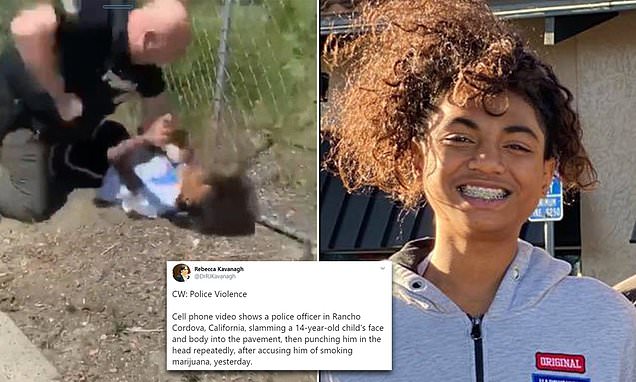
This is the horrifying moment a 14-year-old boy is repeatedly punched and slammed to the ground by a cop in California who suspected him of being in possession of marijuana.

Video footage shared on Twitter on Tuesday shows an incident in Rancho Cordova, California where the police officer has Elijah Tufono’s hands pinned behind his back but continues to thrash his body around and deliver blows.

His mother, Leata Tufono Tagalu, said the juvenile has a serious heart condition, supraventricular tachycardia (SVT), that thankfully did not trigger at the time of the incident on Monday but said Tuesday, ‘mentally he’s still not sure’.

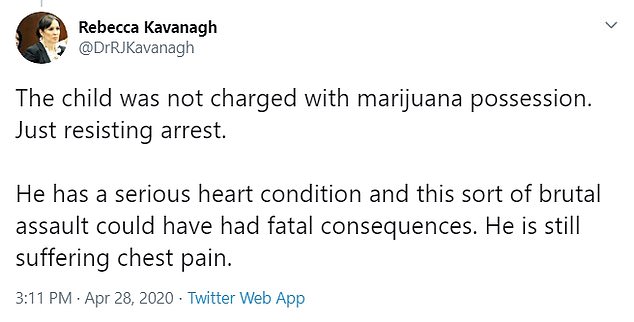
‘This sort of brutal assault could have had fatal consequence,’ criminal defense attorney Rebecca Kavanaugh warned in a tweet that repeated his sister Yralina Tufono, 20’s claims.

His sister said he was still suffering from chest pain a day after the violent encounter on Monday.

Video shows a Problem Oriented Policing (POP) Officer in Rancho Cordova, California punching the teen and slamming his head and body into the ground. The incident occurred on Monday:

Elijah Tufono’s mother shared an image of him on Facebook as she said he is ‘scratched up, has chest pains and he’s sore’. ‘He has SVT but thank God it did not trigger at the time of the incident or now,’ Leata Tufono wrote. ‘Mentally he’s still not sure’
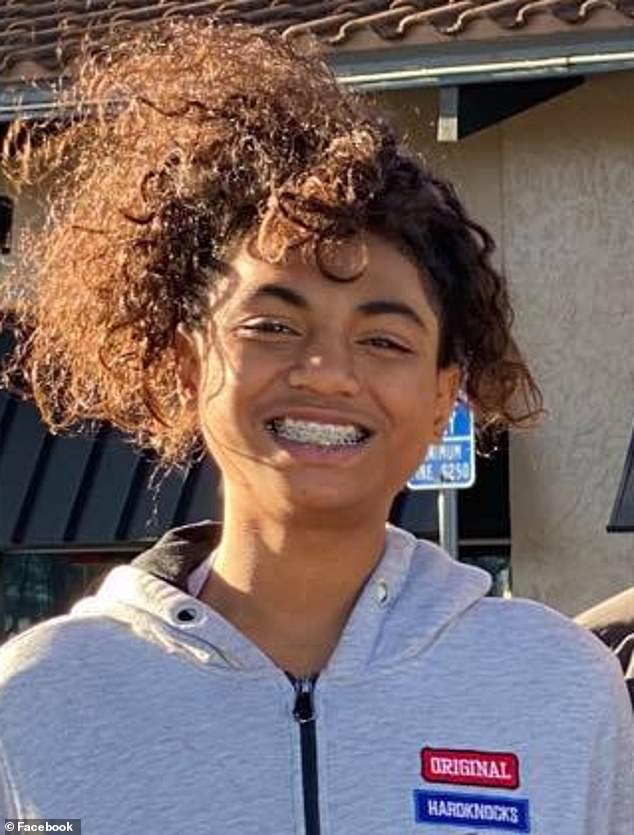
Attorney Rebecca Kavanaugh said the juvenile has a serious heart condition and was still suffering from chest pain a day after the violent encounter on Monday
According to the police department the Problem Oriented Policing (POP) Officer was proactively patrolling the area of Mills Station Road and Mather Field due to complaints from citizens about hand-to-hand sales of alcohol, tobacco and drugs to minors and saw what he believed to be a hand-to-hand exchange between an adult and juvenile.

The department stated that the cop lost sight of the adult in the area and when he approached the juvenile, ‘the juvenile was uncooperative and refused to give the deputy basic identifying information’.

‘He told the deputy he was 18 years old. Having reasonable suspicion that criminal activity was occurring, the deputy attempted to detain the juvenile so he could conduct further investigation,’ police continued in the statement.

‘The juvenile became physically resistive at that time, causing the deputy to lose control of his handcuffs, which landed several feet away. The deputy attempted to maintain control of the juvenile without his handcuffs and while alone waiting for his partners to arrive and assist him.’
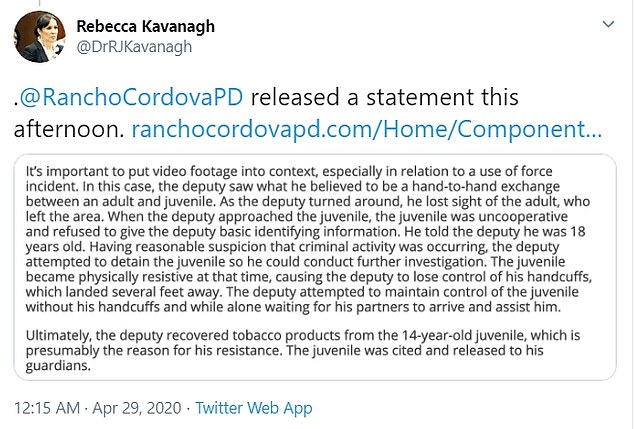
The department said in the statement: ‘It’s important to put video footage into context, especially in relation to a use of force incident.’ They added the deputy ‘recovered tobacco products from the 14-year-old juvenile, which is presumably the reason for his resistance’

The department said in the statement: ‘It’s important to put video footage into context, especially in relation to a use of force incident.’

They added the deputy ‘recovered tobacco products from the 14-year-old juvenile, which is presumably the reason for his resistance’.

The juvenile was cited for resisting arrest and released to his guardians.

The boy’s sister tweeted that he ‘was simply trying to get his arms free because he was in pain!!’

‘He’s a kid and has never been in any kind of trouble with the law!’ Tufono tweeted. ‘He was very scared and in so much pain!!!’

However the attorney clarified on Twitter that the child didn’t have marijuana on him, ‘just a Swisher (cigar).’ His mother confirmed on Facebook that he had an adult purchase a swisher for him before the cop arrived in an unmarked car.

‘I think it matters zero if he was smoking marijuana,’ Kavanaugh tweeted.

She said the family of the child asked for the video to be shared in hope the officer is fired or charges are brought upon him.
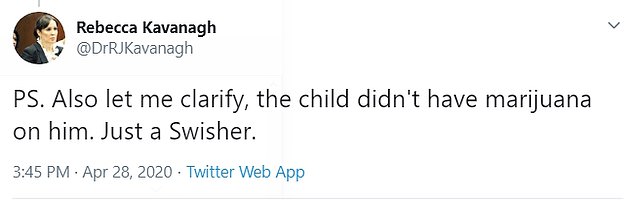
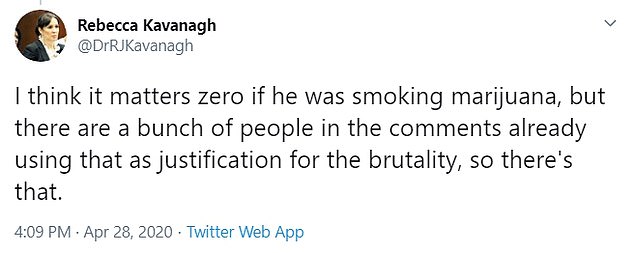
The attorney clarified on Twitter that the child didn’t have marijuana on him, ‘just a Swisher’ and said: ‘I think it matters zero if he was smoking marijuana’

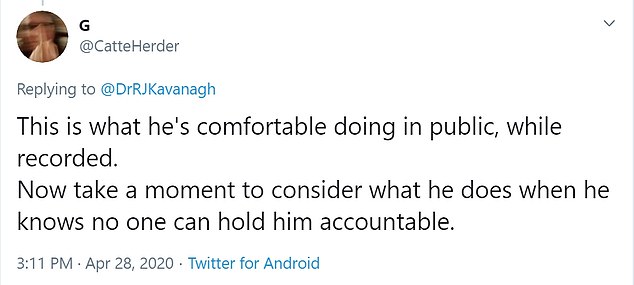
One shocked follower replied to her Twitter thread: ‘This is what he’s comfortable doing in public, while recorded. Now take a moment to consider what he does when he knows no one can hold him accountable.’

A social media user responded: ‘I was thinking the same. One of those punches alone could have killed that poor kid.’

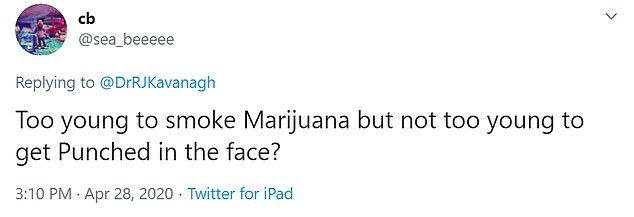
Another posted: ‘Too young to smoke Marijuana but not too young to get Punched in the face?’

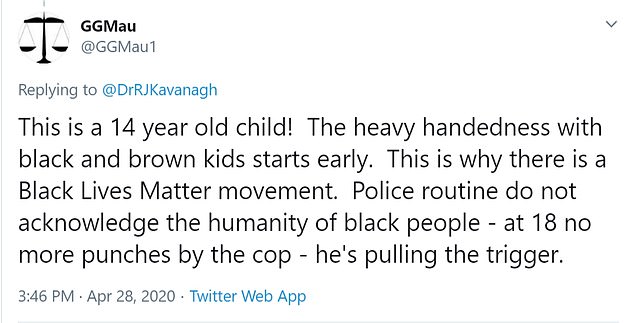
A third wrote: ‘This is a 14 year old child! The heavy handedness with black and brown kids starts early. This is why there is a Black Lives Matter movement. Police routine do not acknowledge the humanity of black people – at 18 no more punches by the cop – he’s pulling the trigger.’

The Sheriff’s Office and Rancho Cordova Police Department have started an investigation into the use of force by the deputy in an effort to maintain public trust and transparency.

‘The police department added in the statement: ‘This type of situation is hard on everyone–the young man, who resisted arrest, and the officer, who would much rather have him cooperate.
Viewers of the video were shocked at what occurred and said the cop needs to be held accountable for his actions

‘The community should know our deputies have a heart for the Rancho Cordova community, especially for the youth they serve through the schools, PAL sports, and our new Youth Center.’

Tyson Foods Warns “Food Supply Chain is Breaking” in the United States

0

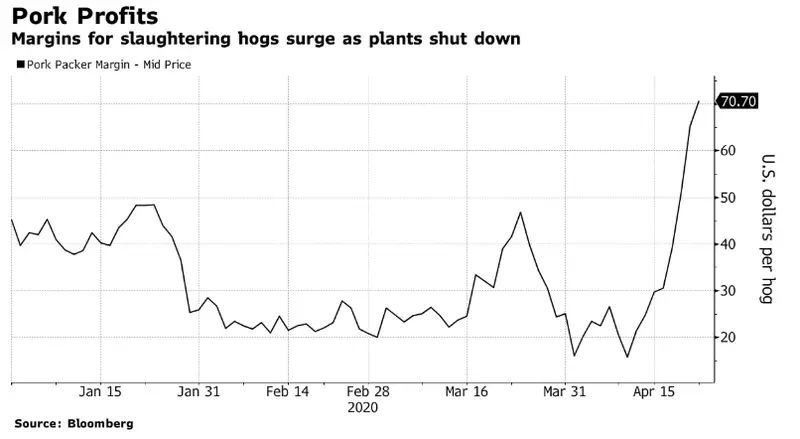
News feeds in April have been inundated with food supply chain disruption stories due to coronavirus-related shutdowns. At least a third of US meatpacking facilities handling hogs have shifted offline this month, other plants that process cows and chickens have also shuttered operations, forcing farmers to cull herds and flocks. This is because each plant closure diminishes the ability for a farmer to sell animals at the market, leaves them with overcapacity issues similar to the turmoil facing the oil industry. Only unlike oil where pumped oil must be stored somewhere (as one can’t just dump it in the nearest river) even if that ends up costing producers money as we saw last Monday when oil prices turned negative for the first time ever, food producers have a simpler option: just killing their livestock.

We previously explained what this imbalance has created: crashing live cattle spot prices while finished meat prices are soaring, which doesn’t just affect farmers but also consumers simultaneously and could spark a shortage of meat at grocery stores as soon as the first week of May.

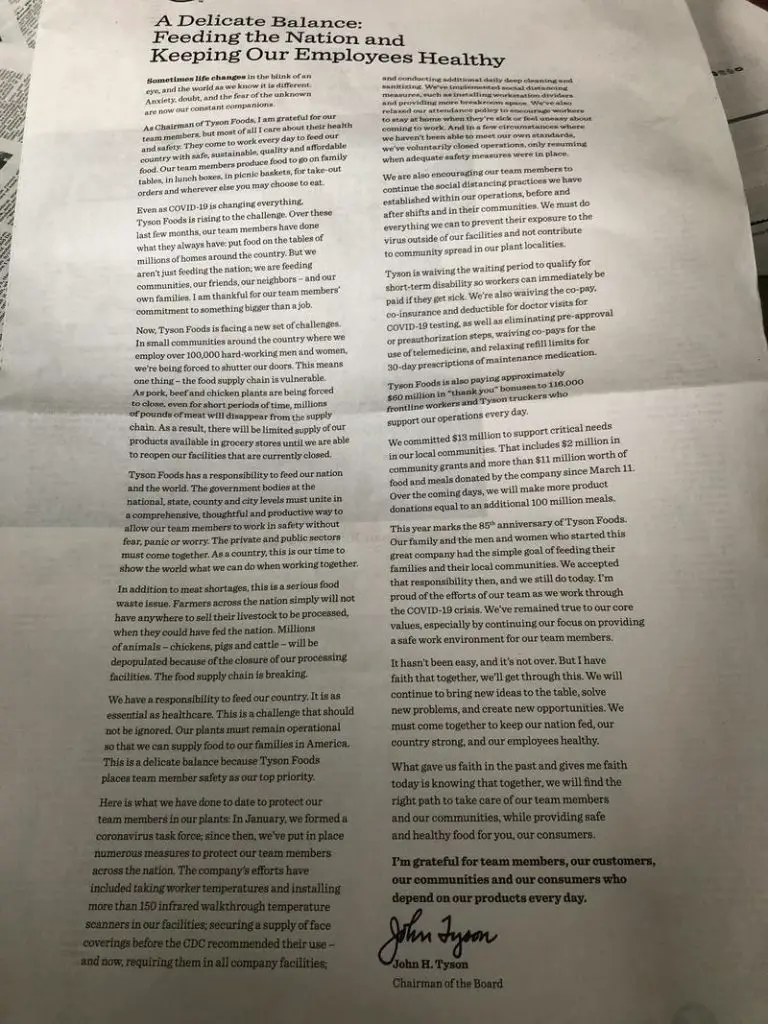
And in the starkest warning yet that high food prices could last for a long time, Tyson Foods warned in a full-page ad in the New York Times on Sunday that the “food supply chain is breaking.”

“As pork, beef and chicken plants are being forced to close, even for short periods of time, millions of pounds of meat will disappear from the supply chain,” wrote Tyson Chairman John Tyson, patriarch of the company’s founding family, in a Tyson Foods website post that also ran as a full-page ad in several newspapers. “The food supply chain is breaking.”

Confirming the worst fears of American pork and bacon consumers, Tyson wrote that the company has been forced to close plants, and that federal, state and local government officials needed to coordinate to allow plants to operate safely, “without fear, panic or worry” among employees. He warned that supply shortages of its products will be seen at grocery stores, as at least a dozen major meatpacking plants close operations for virus-related issues.

Brett Stuart, president of Denver-based consulting firm Global AgriTrends, calls the situation “absolutely unprecedented.”

“It’s a lose-lose situation where we have producers at the risk of losing everything and consumers at the risk of paying higher prices.” 

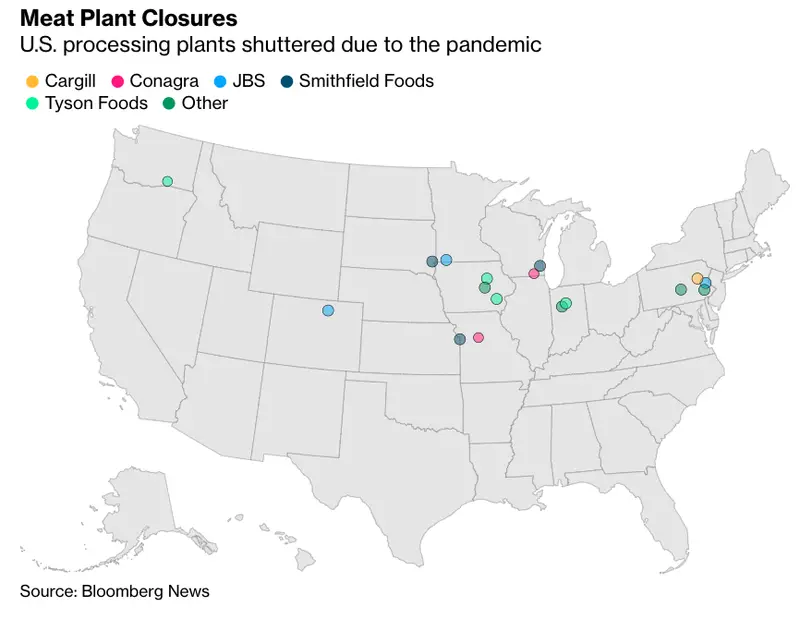
Last week, Smithfield Foods, one of the top pork producers in the world, closed another operation in Illinois. That news came directly after Hormel Foods closed two of its Jennie-O turkey plants in Minnesota. Then it was reported over the weekend that major poultry plants across Maryland, Delaware, and Virginia had reduced hours because of worker shortages due to virus issues. And then on Sunday, JBS USA closed a large beef production facility in Wisconsin.

“During this pandemic, our entire industry is faced with an impossible choice: continue to operate to sustain our nation’s food supply or shutter in an attempt to entirely insulate our employees from risk,” Smithfield said in a statement Friday. “It’s an awful choice; it’s not one we wish on anyone.”

Bloomberg’s map shows the latest closures of meatpacking plants:

Even before the Tyson warnings, last week we cautioned that it was appropriate to label virus outbreaks at meatpacking plants as the “next disaster zones” of the pandemic. This wasn’t just because of workers and USDA inspectors were contracting the virus, and in some cases dying – but because food shortages could also add to social instabilities during a pandemic and economic crisis.

The distress in the agricultural space has not been limited to just livestock. Dairy and produce farmers have had to dump or throw out spoiled products due to a collapse in demand for bulk products, mostly because of shifting supply chains with the closure of restaurants, cruise ships, hotels, resorts, education systems, and anyone else who is not deemed essential in a lockdown.

What this means is that farmers who generally sell bulk products do not have the means at the moment to convert product lines into individual items for direct to consumer selling. This will take time for the conversion. So, in the meantime, with no customers, farmers have to dump.

Politico has outlined some of this disruption:

“Images of farmers destroying tomatoes, piling up squash, burying onions and dumping milk shocked many Americans who remain fearful of supply shortages. At the same time, people who recently lost their jobs lined up for miles outside some food banks, raising questions about why there has been no coordinated response at the federal level to get the surplus of perishable food to more people in need, even as commodity groups, state leaders and lawmakers repeatedly urged the Agriculture Department to step in.”

Tom Vilsack, who served as agriculture secretary during the Obama administration, put it this way: “It’s not a lack of food, it’s that the food is in one place and the demand is somewhere else and they haven’t been able to connect the dots. You’ve got to galvanize people.”

The immediate outcome of this food supply chain collapse will be even more rapid food inflation, hitting Americans at a time of unprecedented economic hardships with at least 26.5 million now unemployed since the pandemic struck the US.

And with a sharp economic recession, if not outright depression unfolding, more Americans are ditching grocery stores for food banks, putting incredible stress on these charities, which has forced the government to deploy National Guard troops at many locations to ensure food security to the neediest.


By Tyler Durden | ZeroHedge.com | Republished with permission

UN Food Agency Chief Warns Global Famine of “Biblical Proportions” Just Months Away

0

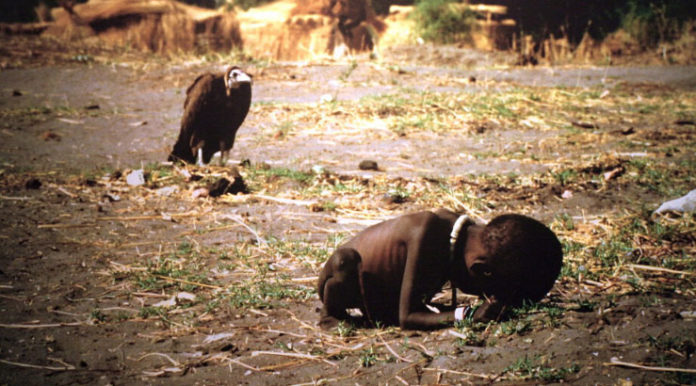
David Beasley, director of the United Nations World Food Program, told the U.N. Security Council this week that the world is on “the brink of a hunger pandemic” and we could be facing “multiple famines of biblical proportions within a short few months.”

Beasley warned that the world is facing “a perfect storm” due to the pandemic, economic crisis, locust swarms, and numerous wars that are still ongoing across the planet.

“It is critical we come together as one united global community to defeat this disease, and protect the most vulnerable nations and communities from its potentially devastating effects,” Beasley said.

According to the 2020 Global Report on Food Crisis, which was published this week, an additional 135 million people will be facing starvation by the end of the year.

“In a worst-case scenario, we could be looking at famine in about three dozen countries, and in fact, in 10 of these countries we already have more than one million people per country who are on the verge of starvation,” Beasley said.

“There’s a real danger that more people could potentially die from the economic impact of COVID-19 than from the virus itself,” he added.

Beasley said that places like Haiti, Nepal, and Somalia, where a large number of families depend on income from overseas workers will be hit especially hard. He urged world leaders to set aside their differences and slow down their military adventures to meet the current challenge.

Official address to the UN Security Council, 21 April

Yesterday, I spoke to the United Nations Security Council on the significant effect that war and conflict have on driving hunger. Millions of civilians living in conflict-scarred nations, including many women and children, face being pushed to the brink of starvation. With COVID-19, I want to stress that we're not only facing a global health pandemic, but also a global humanitarian catastrophe – a HUNGER pandemic.By the end of this year, 265 million people risk being on the verge of starvation. While there are no famines yet, I warned UN Security Council members that if we don’t prepare and take action now, we could be facing multiple famines of biblical proportions within a few short months.I know this is very startling but if we act wisely, and we act NOW, we can stop this. The actions we take, as a global community, will determine our success, or our failure.Watch my address to the UN Security Council below.

Posted by David Beasley on Wednesday, April 22, 2020

“We need all parties involved in conflicts to give us swift and unimpeded humanitarian access to all vulnerable communities, so they can get the assistance to them that they need, regardless of who they are or where they are. Supply chains have to keep moving if we are going to overcome this pandemic and get food from where it is produced to where it is needed,” he said.

Another concern is that countries will ban exports on certain important foods and medicines, which has already started to happen.

According to Bloomberg, Kazakhstan has banned exports of wheat flour, which is a major concern because the country is one of the world’s biggest producers. Meanwhile, Vietnam, the world’s third-largest exporter of rice, has temporarily suspended rice export contracts.

Politicians and business leaders have insisted that the supply chain is strong and that shelves will continue to be filled to meet the increasing demands at grocery stores. However, there is no doubt that there have been some supply chain disruptions to different parts of the global economy since the outbreak began.

There are also concerns that domestic supply chains will be disrupted if there are continued outbreaks among essential workers.

Last week, meat packaging plants across the U.S. were forced to close as hundreds of workers became sick with the virus. According to a new investigation by USA Today, meatpacking plants are acting as epicenters for the virus and causing further spread to neighboring communities.

According to the report, rates of infection around these meat packaging plants are higher than 75% of other counties in the country.

By John Vibes | Creative Commons | TheMindUnleashed.com


Kim Jong Un Reportedly on His Death Bed – These Are the Most Likely Heirs to the North Korean Throne

0

Earlier this week, when we first heard the reports about Kim Jong Un possibly being dead, or close to it, followed by Yonhap’s denial – which simply stated that one official who spoke with a reporter at the news org said SK Intel had nothing on it. We suspected that observers seemed to willing to accept that report as actual evidence to the contrary. We suspected there might be something more to it.

Even when Trump said KJU was probably fine, something still seemed to be amiss. If he was truly in good health, why hadn’t he made an appearance at any other scheduled public events to ward of panic? The North Koreans didn’t even have a convincing body double to fool the crowds into believing their dear leader was well?

Now, a few days later, the Japanese press appears to be getting closer to the truth: As we noted earlier today, it’s widely believed that Kim is in a “vegetative state”, and likely won’t survive.

Which – since Kim’s children are far too young to run the country – brings our attention to the line of succession. As we noted earlier this week, there are several potential successors to the throne. Since the founding of the modern state in the aftermath of the Korean War, the country has been ruled by the “Mt Paektu Bloodline”, which comprises most of the mythos and cult of personality around the Kim family.

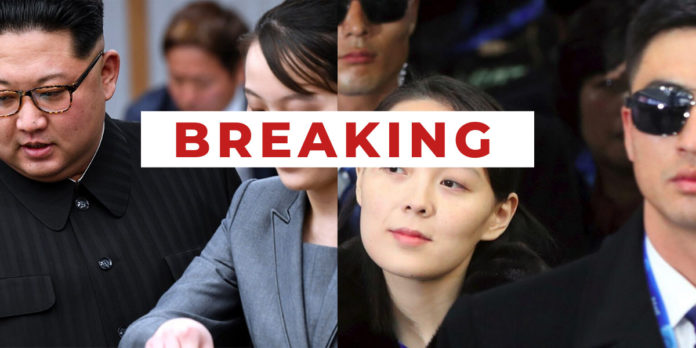
But one thing we didn’t really cover in great depth was the concerns that some in western intelligence have about Kim’s sister, who has been seen more frequently in international news reports in recent years. The younger Kim, believed to be 31, is one of her brother’s closest confidants and his de facto chief of staff. She has joined him at several high-profile international summits.

Unfortunately, to put it simply and straightforwardly, many fear that Kim Yo Jong would be even more diabolical and hostile than her brother. As one twitter wit joked, he is ready and willing to dunk on any ‘feminist takes’ claiming that the younger Kim would be a more judicious and receptive ruler.

The Telegraph reports that she was recently elevated to NK’s Politburo.

One reason for the anxieties about her hardline politics: Earlier this year, she issued a scathing political statement about South Korea in her own name, raising concerns that she was pushing back against her brothers purported efforts to deescalate the tensions on the peninsula, even as ‘expert’ after ‘expert’ has insisted that NK will never surrender its nukes.

If she takes the throne, would Kim’s younger sister instead send them flying across the Pacific? News this weekend that a mobile missile launcher has been deployed amidst the crisis of leadership certainly doesn’t make us feel less alarmed.

To be sure, Kim’s sister isn’t the only possible successor; there are doubts that the Party would allow her to lead, given the fact that she is a woman.

As the speculation mounts, here’s a quick run-through of the options, courtesy of Bloomberg:

Kim Yo Jong; Sister

Part royal representative, part personal assistant, Kim Yo Jong has emerged as one of her older brother’s closest aides. Earlier this month, she was reinstated as an alternate Politburo member of the ruling Workers Party of Korea. As such, she’s the only other member of the Kim family with anything approaching real power in the regime.

Although she became the first member of the ruling family to visit Seoul and accompanied Kim Jong Un in his summits with U.S. President Donald Trump and China’s Xi Jinping, she’s also performed mundane tasks, such as helping the leader extinguish a cigarette during a train stop in China. Whether North Korea’s patriarchal elite will support a relatively young woman as the country’s next “supreme leader” is unclear.

Kim Jong Un’s Son

A male heir would provide the most conventional line of succession in a dynasty previously ruled by Kim’s father, Kim Jong Il, and founded by his grandfather, Kim Il Sung. South Korean intelligence said Kim married Ri Sol Ju, a former singer, in 2009 and is thought to have three children.

Problem is, the children have yet to be officially mentioned in state media and the oldest is believed to be a son born in 2010, according to South Korea’s DongA Ilbo newspaper. Dennis Rodman, the offbeat former basketball star who visited North Korea, said in 2013 that he also held a baby daughter named Ju Ae. That would likely require any of the children to rule under some form of regent until they come of age.

Kim Han Sol; Nephew

Kim Han Sol, born in 1995, may have become heir-apparent himself if his father, Kim Jong Nam, hadn’t fallen out with Kim Jong Il and gone into exile in the Chinese gambling hub of Macau. Kim Jong Nam was Kim Jong Un’s older half-brother and his most serious rival, frequenting casinos and occasionally criticizing his younger sibling’s regime.

Any hopes that Kim Han Sol might have had of returning to Pyongyang were dashed in 2017, when his father was murdered at the Kuala Lumpur airport by two women who smeared VX nerve agent on his face. Chinese police later arrested several North Koreans dispatched to Beijing on suspicion of plotting to kill Kim Han Sol, South Korea’s JoongAng Ilbo newspaper reported at the time. His whereabouts remain unknown.

Kim Jong Chol; Brother

Kim Jong Chol, Kim Jong Un’s only surviving brother, would be another longshot, since he has shown more interest in guitars than politics.

Thae Yong Ho, the former No. 2 at North Korea’s embassy in London who defected to South Korea, once said Kim’s elder brother “doesn’t own any official title” adding he’s “just a really talented guitarist.”

Kim Jong Il saw his middle son as “girlish,” according to the person who goes by the pen name of Kenji Fujimoto and claims to have been the personal sushi chef for the former North Korean leader. In 2011, South Korean broadcaster KBS captured Kim Jong Chol enjoying an Eric Clapton concert in Singapore. Little else is known about him except that he studied in Switzerland and is a fan of U.S. professional basketball like his brother.


By Tyler Durden | ZeroHedge.com | Republished with permission

Is The “Second Wave” Of The COVID-19 Pandemic Already Here? (And Is It Worse Than The First?)

0

Top health officials and the mainstream media keep insisting that “the worst is behind us”, but is that actually true?  According to Worldometers.info, 2,804 new coronavirus deaths were added to the U.S. total during the 24 hour period that just ended, and that was a huge increase over the 1,939 new deaths from the previous 24 hour period.  In addition, we are seeing an alarming explosion in the number of newly confirmed coronavirus cases in Singapore, Pakistan, Saudi Arabia, Peru, India, Brazil and Russia.

So while it is true that the lockdowns have temporarily slowed down the spread of the virus in some areas of the globe, it appears that we are witnessing the emergence of a “second wave” in other areas.  And of course the countries that have been successful in slowing down this pandemic could see another huge surge in cases once their lockdowns are ended.  Sadly, the truth is that we are still in the early stages of this crisis, but most people don’t seem to realize that.

On Tuesday, CDC Director Robert Redfield made headlines all over the globe when he warned that there could be a “second wave” of COVID-19 next winter…

A second coronavirus outbreak could emerge this winter in conjunction with the flu season to make for an even more dire health crisis, the director of the Centers for Disease Control and Prevention told The Washington Post in an interview.

“There’s a possibility that the assault of the virus on our nation next winter will actually be even more difficult than the one we just went through,” CDC Director Robert Redfield said in a story published Tuesday.

“And when I’ve said this to others, they kind of put their head back, they don’t understand what I mean.”

But what if he is completely wrong and the “second wave” is already here?

Or perhaps it may be more accurate to say that the first wave has never ended.

If you go to the Johns Hopkins dashboard for this pandemic, you will notice that the global curve of confirmed cases has not “flattened” much at all even though much of the planet has been “locked down” for weeks.

And the antibody data is telling us that virtually the entire global population is still vulnerable.  According to the WHO, only 2 to 3 percent of the entire global population has developed antibodies for this virus…

The head of the World Health Organization on Monday said that likely no more than 2% to 3% of the global population have developed antibodies for COVID-19.

Here in the United States, a study of adults in L.A. County found that only 4 percent of them had developed antibodies for this virus…

Four percent of adults in Los Angeles County tested positive for COVID-19 antibodies in a recent study, suggesting hundreds of thousands of people might have actually been infected in early April when only 8,000 cases had been confirmed.

So what this means is that we are a long, long, long way from herd immunity.

More than 95 percent of the population is still vulnerable, and that means once the lockdowns are lifted this virus could start spreading like wildfire inside the U.S. once again.

In fact, the number of confirmed cases in Georgia is soaring just as that state is preparing to end the current restrictions…

The number of coronavirus deaths and infections in Georgia has spiked over a 24 hour period as the state prepares to partially lift lockdown restrictions this week – and cases across the country have doubled in two weeks to more than 200,000.

The death toll in the state increased by 85 in 24 hours, bringing the total number of fatalities to 772. Infections spiked by more than 1,000, bringing the number of cases in the state to more than 19,300.

And in Massachusetts, authorities are warning that the death toll in that state will likely double “in less than a week”

Massachusetts has quickly become a hot spot of coronavirus infections with the state’s death toll expected to double in less than a week.

COVID-19 deaths are expected to surpass 2,000 this week in Massachusetts where officials are scrambling to boost hospital capacity and trace new infections to curb the spread of the disease.

That certainly doesn’t sound like “the worst is behind us” to me.

And I don’t even know what to make of this story from Philadelphia

The horror of the coronavirus pandemic took an especially macabre turn on Sunday afternoon when a Ford pickup truck pulled up behind the Philadelphia Medical Examiner’s Office with five or six bagged bodies stacked in its open cargo bed.

The driver got out, spoke briefly to a medical examiner’s employee who seemed unnerved by the delivery, and then climbed onto the cargo bed, walking on bodies that initially had been covered by mats, according to an Inquirer photographer who was working near the site in University City.

Look, I understand that a lot of people out there are still mocking this pandemic and are absolutely convinced that it is a “nothingburger”.

One of those skeptics was 60-year-old John McDaniel

On March 15, he seemingly commented on Ohio governor Mike DeWine’s stay-at home order, which required shops, bars and restaurants to close.

“If what I’m hearing is true, that DeWine has ordered all bars and restaurants to be closed, I say bulls***!,” the post reads.

“He doesn’t have that authority. If you are paranoid about getting sick just don’t go out. It shouldn’t keep those of us from living our lives.”

Now he is dead, and it was the virus that he mocked that killed him.

And even if you get this virus and survive, it can permanently scar your lungs and leave you with “breathing difficulties for months”.

So please don’t mock this virus, because if you get hit really hard by COVID-19 it will be one of the worst experiences of your life even if you live through it.

For those that believe that a vaccine will be the golden ticket that gets us out of this mess, I am afraid that you may be setting yourself up for disappointment.  There has never been a successful vaccine developed for any coronavirus, and one leading expert is openly warning that it is possible that “we will never get a coronavirus vaccine”.

And if things weren’t already complicated enough, now a new study has discovered that there are “at least 30 different variations” of COVID-19.

A new study in China has found that the novel coronavirus has mutated into at least 30 different variations.

The results showed that medical officials have vastly underestimated the overall ability of the virus to mutate, in findings that different strains have affected different parts of the world, leading to potential difficulties in finding an overall cure.

So not only do scientists have to come up with a successful vaccine for a coronavirus for the first time in history, they also have to hope that they are targeting the correct strain.

Good luck with all that.

Unfortunately, the truth is that this pandemic is going to be with us for a long time to come, and what we have experienced so far is just the very beginning of our problems.

Even if all of the lockdowns around the world were kept in place for the foreseeable future, this virus would continue to spread.

And in the long run, approximately the same number of people are going to catch this virus and approximately the same number of people are going to die no matter what restrictions are instituted.

This pandemic is not going to be over until COVID-19 roars through most of the population and herd immunity is achieved, and the numbers are telling us that we are a long, long way from that point.