Theoretical physicist Sean Carroll expressed that clues in the small-scale structure of the universe point to the existence of numerous parallel worlds.
The shocking comments were made on the Jeff Rogan Experience (JRE) podcast last year. Carroll says that the fact that tiny particles like electrons and photons don’t have one set location in the universe is evidence that there are many parallel universes.
Recently, in a follow up interview with News.com.au, Carroll expanded his thoughts. “But there’s a lot more going on,” Carroll toldNews.com.au. “Not every world you imagine actually comes true.”
The common sense rules of physics that rule our lives everyday make sense to us but at very minuscule scales common sense breaks down altogether. At the quantum level, the empty vacuum of space is filled with tiny particles constantly popping in and out of existence.
Bell’s theorem, a fundamental construct in quantum mechanics, may prove that multiverses exist. This theorem deals with situations where particles interact with each other, become entangled, and then go their separate ways, according toNew Scientist.
“There are still equations, physical rules, patterns that must be obeyed. Some possible alternate worlds can come true. But not all of them,” Carroll said.
In the past, Carroll has advanced some groundbreaking yet controversial theories on topics such as the Big Bang theory and the nature of time.
He has said that the universe didn’t start in a huge explosion as most people now believe, but instead it is an infinitely old, constantly inflating entity in which time can run both forward and backward.
For Carroll quantum physics is not something that can be broken down and explained in simpler terms.
“As far as we currently know,” he writes. “Quantum mechanics isn’t just an approximation to the truth; it is the truth.”
“Physics is stuck trying to understand the fundamentals of nature and the Big Bang,” Carroll said. “It’s time to take a step back and understand its foundations. It’s time to tackle our understanding of the quantum world.”
In 2011 physicist Brian Greene wrote a book exploring the possibility called The Hidden Reality: Parallel Universes and the Deep Laws of the Cosmos.
You almost can’t avoid having some version of the multiverse in your studies if you push deeply enough in the mathematical descriptions of the physical universe,” Greene toldNPR. “There are many of us thinking of one version of parallel universe theory or another. If it’s all a lot of nonsense, then it’s a lot of wasted effort going into this far-out idea. But if this idea is correct, it is a fantastic upheaval in our understanding.”
Even Stephen Hawking suggested that, thanks to quantum mechanics, the Big Bang supplied us with an endless number of universes, not just one.
Up until this point understanding quantum physics and its realms has been impossible, but Carroll hopes that is changing thanks to technology.
“Now we’re getting better at that,” Carroll says. “Technology has improved. Maybe things are going to change.”
Greene, Carroll, and Hawking may be right, and researchers at Oak Ridge National Laboratory in Tennessee want to find out if there are multiverses or mirror images of our own reality. The team was set to record experiments last year sending a beam of subatomic particles down a 50-foot tunnel, past a powerful magnet and into an impenetrable wall.
“If it exists, it would form a bubble of reality nestling within the fabric of space and time alongside our own familiar universe, with some particles capable of switching between the two,” lead researcher Leah Broussard toldNew Scientist.
The novel human coronavirus has reached all corners of the Earth. Some of us thought it wouldn’t and some of us knew it would. And while some people in the U.S. remain resolute that COVID-19 is no worse than influenza, others are preparing for a doomsday pandemic.
While rushing to the store to buy six months worth of supplies and hunkering down in your basement is likely overkill at this point, having a potential global pandemic on the horizon is as good time as any to consider your level emergency preparedness.
While the term emergency preparedness may evoke images of wacky “preppers” for some, you don’t have to go over the top to be prepared. In fact, being prepared should be the smart and normal course of action for American families who have the means to do so. Being prepared is not synonymous with hoarding.
According to YouGov, in 2018, prior to outbreak of the novel coronavirus which began in Wuhan, China, 75 percent of Americans were worried about the possibility of a natural disaster, a terror attack, or a host of other serious incidents that may affect the communities in which they live. However, despite their concern very few of them reported being prepared for any of these things.
In fact, 41 percent of respondents say they are not prepared for a natural disaster and only 39 percent say they have an emergency kit on hand. Only 39 percent of respondents reported having a stock of non-perishable food and only 28 percent said they have a supply of potable water.
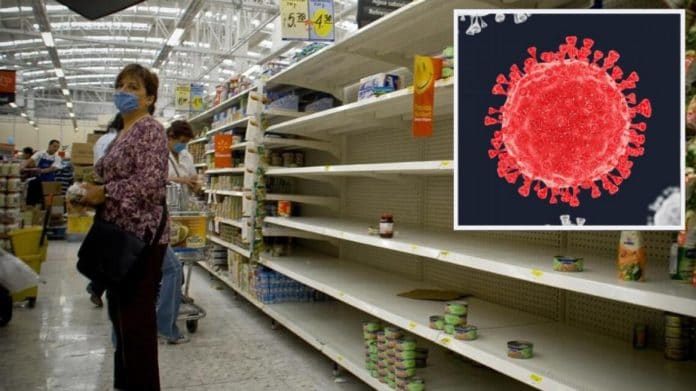
Do you have an emergency kit or a supply of shelf stable food? What about water? If not, right now might not be the easiest time to build up your supplies as social media is clearly showing that pandemic panic has set in across the United States, but if you play your cards right you can still snatch up a few essentials that you should always have on hand in case of emergency.
I live in the epicenter of the coronavirus outbreak in Washington State. My advice for those elsewhere – go to Costco now. Thousands of people at local stores yesterday – not where you want to be if there is a virus spreading. Glad I went a week ago.
— Bound Here By Evil! (@Da_Show_Stopper) March 1, 2020
Costco stores are flooded with customers buying health care items in bulk as fears of the coronavirus outbreak spread across the U.S. pic.twitter.com/3bcihAZAfL
Many of these people are likely buying above and beyond the necessary items (like the guy mentioned in the tweet below), but if you’re willing to brave the crowds and encounter some empty store shelves in the process we have some suggestions on what is most important to stock up on, whether or not there is a potentially deadly pandemic at your doorstep.
I was sent to a Costco to see if people are stocking up (even though health officials say it’s not necessary) in case COVID-19 gets more serious here. This guy came out of the store with 16 boxes of condoms and a big jar of coconut oil. We all have priorities. pic.twitter.com/C3edUsgZzH
Epidemics, pandemics, natural disasters, power outages, and more have an ability to interrupt our normal daily lives. When these things last long or impact the greater world economy, as the novel coronavirus is, we have the potential to feel a significant impact, sometimes long after—picture the tsunami after an earthquake—even if the initial thing isn’t directly affecting you.
We should prepare ahead of time for any one of these things, but especially for this particular pandemic, so that we don’t add to the inevitable panic, so we don’t find ourselves in crowds of people were sickness can spread, and so we are at our best and calm and therefore able to assist others in our communities that may need assistance.
Step 1: Don’t Panic, Have a Plan
You’re preparing, that means the emergency or disaster isn’t here yet. So stay calm and think clearly. Grab a piece of paper and start building your emergency preparedness plan. What is your goal? Do you want to have enough food for one week or one month? How many people are in your family? In the event of a loss of power or gas will you have a way to cook food? Does anyone in your household take medications that cannot be skipped? The answers to these questions and more will help you navigate what is most important for your household and will help you build a list of exactly what you need.
The U.S. Department of Homeland Security suggests keeping enough food and water for all members of your household on hand for a minimum of 72 hours but you may choose to extend that further by a week, two weeks, or more. Factors may depend on the size of your family, where you live, and the kind of emergency situations you may face.
Food:
Emergency meal kits can be purchased at stores like Costco, REI, and other online retailers that specialize in emergency preparedness. The kits come in varying sizes based on number of people and length of time. However, the purpose of these kids is to have them on hand before you need them. A lot of people have gained first hand experience with this recently when they found absolutely no meal kit results when searching Costco’s website. The kits can be nice because they take the guesswork out of building your emergency food supply and they are designed to not take up a lot of space but those who purchase them and don’t end up using them run into challenges when the things inside expire or when your family has dietary restrictions.
If you can’t currently get your hands on a food kit or don’t want to, here are some tips on what to collect individually. The exact amount will depend on the plan that you came up with.
Look for non-perishable and shelf stable items that your family is somewhat used to eating but that doesn’t need a lot of extra ingredients or materials to prepare. You should have a mix of things that need to be cooked and things that don’t. In some cases you may be short on water and fuel or not have access to it at all. If this is the case, an emergency supply of only food that requires cooking won’t get you too far. Pasta and sauce, canned and dried beans, canned vegetables, canned soups, oatmeal, shelf stable milks, along with snacks like granola bars, nuts, and dried fruits are a great place to start. And don’t forget about pet food if that applies to you.
Store your food in a cool, dry place and out of direct sunlight. Storage food in a hard-sided container is ideal especially if you’re keeping it in an attic or a basement. You don’t want pests to get to it before you do.
Check your kit every 6-months or so. During this time look for anything that might be damaged and pull it out. Look for expired foods or foods that will expire in the next six months. Use those items soon rather than throwing them away and make sure to replace anything you removed.
Reevaluate your kit every year. Has your household size changed? Is there a new dietary restriction or allergy you need to take into account?
Water:
It is recommended to store one gallon of water a day for each person in your household. This means a family of four with a 72-hour emergency kit should have 12 gallons of potable water in storage.
Bottled water flies off store shelves when communities are faced with illness, natural disaster, or impending inclement weather. However, unless you’ve been hiding under a rock you should be aware that most bottled water is no better than your tap water and some of it is actually worse because it is stored in thin plastic. When faced with an emergency some water is better than none, but consider the kind of water you’re storing and the source if you’re building a kit in advance of an emergency.
It’s great if you already filter your tap water but in the event that the water stops flowing, having filtration systems won’t do a darn thing to help you.
Water storage containers in varying sizes can be ordered online. Some, like WaterBricks, can be stacked for storage because water really can occupy a lot of space. Many of the containers out there are made of thick, blue plastic. Thick, colored plastic doesn’t let UV rays in and the blue color signals that there is water inside. In the filling process it is important to keep the area and your hands clean so that the water stays safe. Water won’t expire but some people like to swap it out every once in a while, though this isn’t necessary. If you’re storing your water in a basement, make sure it isn’t directly on a concrete floor.
Don’t forget to store water for your pets, too.
Medications and First Aid:
If someone in your household requires prescription medication find out how much you can secure ahead of time. Unfortunately this isn’t always easy when dealing with insurance companies in the United States and some medications don’t have a long shelf life anyway. When you have advance notice that something may impact your ability to get medications—like a big storm or a pandemic—contact your doctor and your pharmacy and find out if you can get approval to have some extra medication.
Keep a list of medications and pharmacies for those in your household in your emergency kit. Find out if there are over the counter items available to use in lieu of any of these medications in the event of an emergency and keep those items in your emergency kit. Skipping prescription medications and using something else is never ideal and is not something that should be taken lightly but in the event that it is literally impossible to get your medications, having some sort of back up, if available, is better than nothing.
Keep a first aid kit stocked. The essentials include a manual to help you tread wounds, pain reliever, bites, and other issues, tweezers, alcohol swabs, antibiotic ointment, bandages in multiples sizes, gauze pads and wrap, medical tape, elastic bandages, essential oils like lavender, colloidal silver cream and tincture, as well as instant cold packs. Add additional things specific to your household like children’s pain reliever and fever reducer, antacids, contact solution, etc.
Preventatives:
If you’re going to be eating from your emergency food kit for days and potentially rationing water during this time, your nutrition might not be at its best. And if you’re facing a potential pandemic you’re going to want your immune system to be supported. Keep a stock of all vitamins and supplements that you normally take but consider increasing your intake of things like vitamin C, elderberry syrup, and colloidal silver, depending the kind of emergency you’re facing or preparing for.
Fuel and Power:
Have extra batteries on hand and accessible for things like flashlights. And make sure you know where they are. When you need light the most is probably not when you’re going to want to be rummaging through your junk drawer. Keep flashlights in your kit but also in other places throughout your home. Back-up batteries for phones can come in handy during extended periods without electricity.
If you’re a camping enthusiast you probably have an alternative method for cooking food, like a small stove. If you need to use one remember to never do so inside your house. If you don’t already have something like this, small stoves are affordable and easily available from common brands like Coleman. Your emergency food won’t be of any use to you if it all must be cooked but your power is out, thus rendering your electric cooktop useless. Keep matches sealed in a waterproof container in your kit.
Generators come in handy but won’t be helpful if you don’t have fuel. However, as technology progresses we’re being given new options when it comes to alternative power sources. Small generators with different kinds of outlets can be charged from a wall outlet ahead of time or hooked up to a portable solar panel. Look for reliable brands like Goal Zero.
Keep your vehicle’s gas tank full when you have advanced notice that there may be an emergency situation on the horizon.
Cleaning Supplies and More:
Toilet paper, paper towels, trash bags, bleach, hand sanitizers, vinegar, diapers, feminine hygiene products, along with paper plates, cups, and cutlery or a reusable mess kit (but keep in mind you may not be able to wash it).
The Department of Homeland security also recommends the following items:
Battery-powered or hand crank radio and a NOAA Weather Radio with tone alert
Whistle to signal for help
Dust mask to help filter contaminated air and plastic sheeting and duct tape
Moist towelettes, garbage bags, and plastic ties
Wrench or pliers
Manual can opener
Local maps
Cell phone with chargers and a backup battery
Cash or traveler’s checks
Important household documents like insurance policies, identification and bank account records saved electronically or in a waterproof, portable container
Sleeping bag or warm blankets
Complete change of clothing and sturdy shoes
Fire extinguisher
Paper and pencil
Books, games, puzzles or other activities for children
Most importantly, remember not to panic. If you build up your supplies before an emergency strikes you’ll avoid the long lines and the inevitable panic. You won’t contribute to the empty shelves or the congestion at the stores and on the streets. If you’re facing an emergency as the result of a potential pandemic, staying home and out of the crowds is the best place to be and you will, because you’re prepared.
If you already are prepared, take a moment and pat yourself on the back—you’re in the minority. If you aren’t prepared, regardless of whether or not you’ve considered it in the past, don’t be discouraged. Sit down, plan your kit, and calmly get to work. It is never too early to prepare your household but it can be too late.
Both China and India are developing countries; we’ve been progressing, even if the pace isn’t as quick as we desired. But if there’s one thing that’s rather snowballing then it has to be the population in both these countries.
I think the fact that China and India’s population is off the charts proves that condoms aren’t really used here as much as they should be. In fact, if you see, a woman will never be the one refusing a condom; it’s always the men because they don’t get pregnant, should things go wrong. However, I do feel women must put their foot down and say ‘No protection, no sex!’
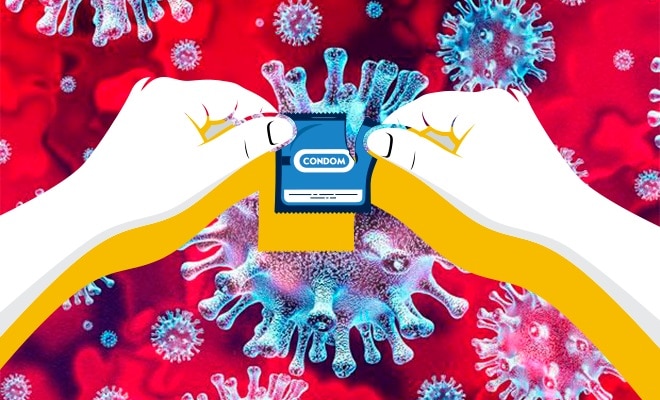
But Singapore’s population isn’t having any of this and it seems like they really do value their condoms, all the more now. And this is not just to have safe sex without any worries but as a desperate measure against protection from coronavirus. So much so that the medical stores have ran out of condoms (a phenomenon that will literally never occur in India!) This is after Durex jokingly advised people to use condoms as protection against the virus.
Desperate times call for desperate measures. In today’s time, the coronavirus outbreak has caused a global emergency, even though it’s China’s mainland that’s majorly affected. And it’s good that people are being extra cautious because prevention is better than cure. Singapore, has the very cool Changi airport which is also one of the most connected airports in the world, and this could mean that the country is more susceptible to the outbreak.
On 7th February, 2020, Singapore declared a ‘Disease Outbreak Response System Condition’ (DORSCON) orange level alert. The rapid advance of coronavirus called COVID-19 has spiked fear all over the world and people are stocking up on masks and surgical gloves. However, that has led to a shortage of these equipments. In fact, earlier some sellers had hiked the price of these items but eventually got fined by the authorities for doing so.
Singapore has been commended for the way it’s managing the crisis and people are stocking up on masks, hand sanitisers and food supplies. And now, even condoms! Apparently, people are using condoms on their fingers to press elevator buttons.
In fact, a conference that was held in a luxury hotel in Singapore where people from all over the world were present seemed to have contributed to the spread of the virus. Quite a few people tested positive for coronavirus when they went back to their home country. So, I think it’s great even if it seems a little too desperate.
Earlier, people in China have been seen making masks out of bras and pads when the stores ran out of surgical masks. Anything for protection! Only if people followed the same philosophy when it came to sex.
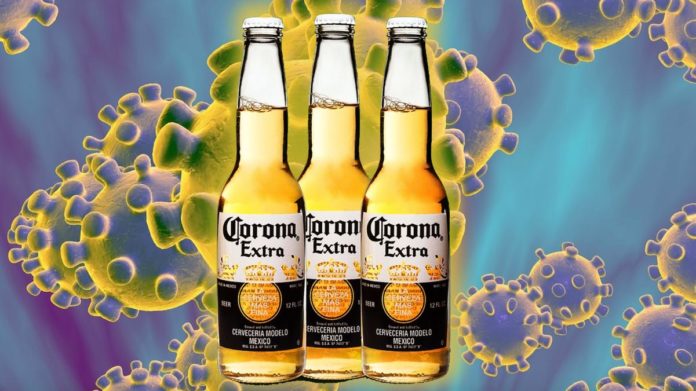
As the world struggles to control the novel coronavirus outbreak, Mexican beer brand Corona has suffered despite having no connection with the disease.
5W Public Relations revealed Thursday that 38 percent of beer-drinking Americans refuse to buy Corona “under any circumstances” while another 14 percent said they wouldn’t order a Corona in public. In the meantime, 16 percent of beer-drinkers in the U.S. were confused as to whether the beer and the virus are related. The survey encompassed polling from 737 beer drinkers in the United States.
As seen in the tweet below, the popular corporate media outlet CNN falsely tweeted that “38% of Americans wouldn’t buy Corona beer “under any circumstances” because of the coronavirus, according to a recent survey.”
This led to a flurry of misinformation across social media on Friday with people parroting the statistic that 38 percent of Americans think Corona beer is linked to COVID-19, the disease caused by the novel coronavirus.
The survey, it turns, out, does not say this!
What it says: -38% of beer drinkers say they wouldn't buy Corona (for any reason at all, including, presumably…they prefer other beer) -4% of people who usually drink Corona say they would stophttps://t.co/X4Wa6tLR3zhttps://t.co/r37un3LRSG
As it turns out, only 4% of people who typically drink Corona beer have said that they will stop.
In a separate survey conducted by YouGov, the firm found that consumer intent to purchase Corona has plummeted to its lowest level in two years. The survey also showed that Corona’s buzz score—a metric measuring favorability—has likewise fallen by a significant measure since the beginning of the year.
Despite the public relations nightmare, parent company Constellation Brands isn’t planning to make any marketing changes. Constellation, which brews a number of variations of the popular beverage, said in a statement that its customers “understand there is no link between the virus and our business.”
“Sales of Corona remain very strong and we appreciate the continued support from our fans.
Our advertising with Corona is consistent with the campaign we have been running for the last 30 years and is based off strong consumer sentiment.”
However, the outbreak of the disease could spell disaster for the company as it rolls out a new Corona-branded hard seltzer through a $40 million promotional campaign. Early sponsored tweets advertising the drink as “coming ashore soon” have already sparked a backlash on social media, with some claiming the ad is in “poor taste” and that the brand should “lay low for a few weeks.”
Beginning January 18, online searches for “beer virus,” “corona beer virus,” and “beer coronavirus” began surging across search engines, according to Google Trends.
On Thursday, Constellation Brands reported that its stock had dropped by 8 percent. However, the entire stock market has also been plummeting, with stocks of all kinds dropping across the board due in part to fears related to the fast-spreading virus.
Dr. Barbara Ziv the forensic psychologist who played a key role in the conviction of Harvey Weinstein by testifying as a witness in his trial was recently hospitalized after being hit by a car.
Not much is known about her condition or the circumstances of the incident aside from the fact that she was hit by a car while crossing the street and is in the hospital with multiple broken bones.
Law and Crimenoted that there is no evidence that Ziv’s injuries have anything to do with her role as a witness in the Weinstein trial, but the timing and the fact that Weinstein is notorious for his ruthless intimidation tactics makes the incident suspicious. Weinstein’s reputation led many potential witnesses and even journalists to fear for their lives when dealing with his case.
Ziv took the stand last month as an expert witness in the case against Weinstein where she gave in-depth psychological analysis about why his victims did not initially report the crimes and why survivors of sexual assault will often continue friendships or business relationships with their attackers, especially when that person is extremely powerful and influential as Weinstein was.
“As devastating as sexual assault is, most individuals think, ‘Ok, I can put it behind me. I can move on with my life. I don’t want it to get worse. I don’t want this person who sexually assaulted me to ruin my friendships or put my job in jeopardy. I am just going to put it in a box and forget what happened. I don’t want it to get worse, but they can’t,” Ziv said in court.
Ziv also testified as an expert witness in the case against Bill Cosby.
This week, a jury in New York found Harvey Weinstein guilty on charges of rape and criminal sexual act in the first degree. He was initially supposed to be sent to Rikers Island but ended up being diverted to a local hospital after complaining of chest pains.
This website uses cookies to improve your experience. We'll assume you're ok with this, but you can opt-out if you wish.AcceptRead More
Privacy & Cookies Policy
Privacy Overview
This website uses cookies to improve your experience while you navigate through the website. Out of these, the cookies that are categorized as necessary are stored on your browser as they are essential for the working of basic functionalities of the website. We also use third-party cookies that help us analyze and understand how you use this website. These cookies will be stored in your browser only with your consent. You also have the option to opt-out of these cookies. But opting out of some of these cookies may affect your browsing experience.
Necessary cookies are absolutely essential for the website to function properly. This category only includes cookies that ensures basic functionalities and security features of the website. These cookies do not store any personal information.
Any cookies that may not be particularly necessary for the website to function and is used specifically to collect user personal data via analytics, ads, other embedded contents are termed as non-necessary cookies. It is mandatory to procure user consent prior to running these cookies on your website.