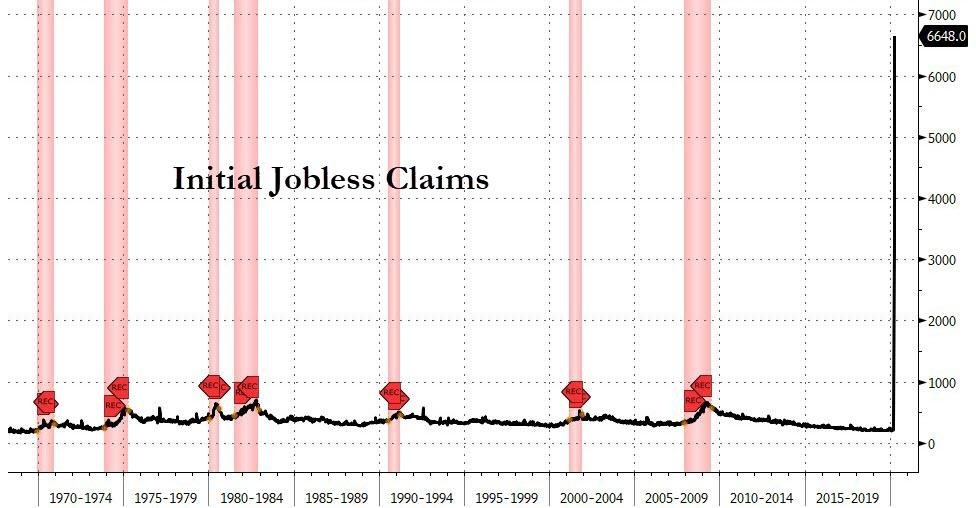
As @GreekFire noted, “We’ve lost 46 jobs for every confirmed case of COVID-19 in the US…“
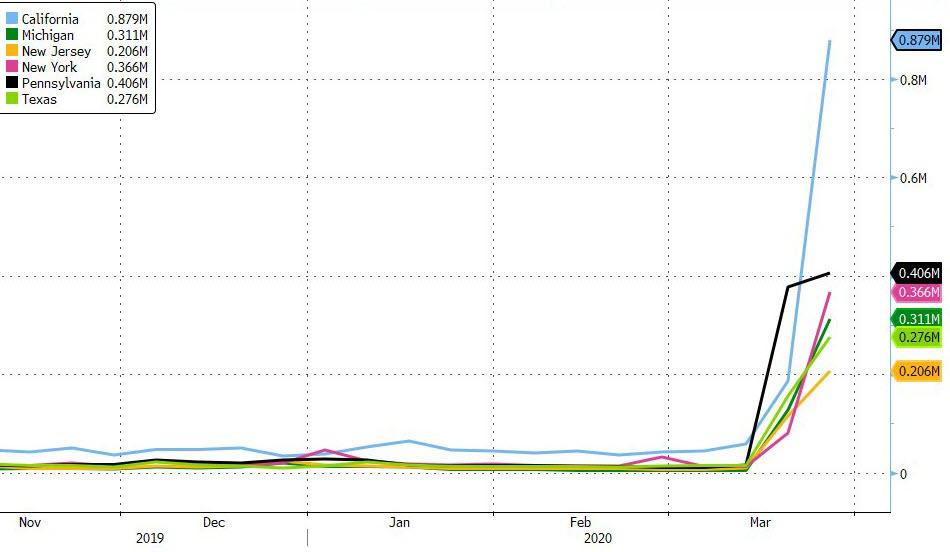
The 6.648mm print is worse than the worst of 50 estimating analysts’ expectations. Breaking down by state (which is one week lagged and so represents the prior week’s 3.3mm print detail), California, Pennsylvania, and New York dominate…
Source: Bloomberg
“The U.S. labor market is in free-fall,” said Gregory Daco, chief U.S. economist at Oxford Economics in New York.
“The prospect of more stringent lockdown measures and the fact that many states have not yet been able to process the full amount of jobless claim applications suggest the worst is still to come.”
And another important note is that weekly jobless claims data are based on “hard facts”, UBS points out, unlike survey data which is subject to quirks around:
a) some of the treatment of supply chains, which has flattered data,
b) the fact that many respondents will not be replying to surveys during the virus disruption period, and
c) survey data will give more accurate assessments during ‘normal’ times, perhaps not as much in unusual times.
Of course, the government is coming to the rescue. As a result of the freshly-passed ‘relief’ bill, self-employed and gig-workers who previously were unable to claim unemployment benefits are now eligible. In addition, the unemployed will get up to $600 per week for up to four months, which is equivalent to $15 per hour for a 40-hour workweek. By comparison, the government-mandated minimum wage is about $7.25 per hour and the average jobless benefits payment was roughly $385 per person per month at the start of this year.
“Why work when one is better off not working financially and health wise?” said a Sung Won Sohn, a business economics professor at Loyola Marymount University in Los Angeles.
With more than 80% of Americans under some form of lockdown, up from less than 50% a couple of weeks ago, this is far from over.
As RealInvestmentAdvice.com’s Lance Roberts warns, the importance is that unemployment rates in the U.S. are about to spike to levels not seen since the “Great Depression.” Based on the number of claims being filed, we can estimate that unemployment will jump to 15-20% over the next quarter as economic growth slides 8%, or more.
Is America Preparing For Civil War?
It surely isn’t helping when a white American Christian TV Host Warns Followers To Stockpile Ammo For Civil War With ‘Pagan Left’:
Infection in New Delhi slum sparks fears of mass breakout
PM Abe mocked for handing out ‘two masks’ to every Japanese household
British health official says “everybody is frustrated” about test shortage
Half the world on lockdown, AFP reports
UN climate summit canceled
Singapore reports 49 new cases
London’s Francis Crick institute develops rapid test
Pence says US facing similar trajectory to Italy
Tokyo reports record 97 cases in a day
UN projects global economy will contract 1% in 2020
Putin extends Russian shutdown
Philippines’ ambassador to Lebanon dies of COVID-19
* * *
Update (1030ET): As data begin to show that lockdowns in Italy and Spain are finally showing some success in ‘flattening the curve’ (though this unfortunately didn’t stop hospitals in Madrid and Milan and the surrounding area from being overwhelmed), more leaders are imposing them. Russian President Vladimir Putin on Thursday extended the country’s “non-working holiday” until the end of April, adding an additional 2 weeks to the shutdown as he insisted that the isolation efforts were working to stop the spread of the virus.
The AFP, which has been assiduously tracking stay at home orders and government lockdowns, just proclaimed that half of the world’s population has been subjected to some level of lockdown during the crisis so far.
As the US quarantines troops in Afghanistan, the French government announced on Thursday that four French soldiers stationed in Mali have tested positive for COVID-19. Of them, three have been sent home.
Elsewhere, Singapore reported 49 new novel coronavirus cases on Thursday, raising the city-state’s total number of infections to 1,049. It’s the latest indication that Asian countries that initially found success in combating the virus are seeing a resurgence.
In the UK, the official death toll from the coronavirus rose 24% to 2,921 as of Thursday morning, the Department of Health announced. Total cases numbered at 33,718.
UPDATE on coronavirus (#COVID19) testing in the UK:
As of 9am 2 April, a total of 163,194 people have been tested of which 33,718 tested positive.
As of 5pm on 1 April, of those hospitalised in the UK who tested positive for coronavirus, 2,921 have sadly died. pic.twitter.com/AbPp29Ijwv
— Department of Health and Social Care (@DHSCgovuk) April 2, 2020
Testing update for England from Public Health England (@PHE_uk):
10,657 tests were carried out yesterday in England.
Testing capacity for inpatient care in England currently stands at 12,799 tests per day. pic.twitter.com/vV24UUtXLi
— Department of Health and Social Care (@DHSCgovuk) April 2, 2020
Even as Boeing’s CEO brazenly insists his company won’t accept federal bailout money if it would leave the federal government with a stake in Boeing, the struggling aerospace company and defense contractor on Thursday rolled out a ‘voluntary worker layoff program’, telling employees that it hoped to avoid “other workforce actions” as the entire aviation industry is rattled by the crisis.
And unfortunately for Greta Thunberg, who has probably finished recovering from her imaginary case of the coronavirus by now, the outbreak has led to this year’s United Nations global climate summit being postponed. Looks like Greta will need to find another gathering of world leaders to shout at.
* * *
Before we get started today, let’s take a minute to review…
3/10 1,000
3/11 1,267
3/12 1,645
3/13 2,204
3/14 2,826
3/15 3,505
3/16 4,466
3/17 6,135
3/18 8,760
3/19 13,229
3/20 18,763
3/21 25,740
3/22 34,276
3/23 42,663
3/24 52,976
3/25 65,273
3/26 82,135
3/27 101,295
3/28 121,176
3/29 139,773
3/30 160,377
3/31 185,469
4/01 199,729
…and on Thursday? 4/02 216,722
That looks like exponential growth to us.
Now that the administration is “all in” on social distancing as America battles what is now the biggest novel coronavirus outbreak in the world, President Donald Trump warned that Americans are heading for a “horrendous” two or three weeks as they hunker down at home, reiterating his warning about “painful” times ahead, while raising the possibility that the government might shutter all remaining domestic flights between coronavirus ‘hot spots’ in the US like NYC and Miami.
“I am looking where flights are going into hot spots.” Trump replied when asked if he was considering a temporary ban on all domestic flights. “Some of those flights I didn’t like from the beginning, but closing up every single flight on every single airline, that’s a very, very, very rough decision. But we are thinking about hot spots, where you go from spot to spot, both hot. And we’ll let you know fairly soon.”
“We’re certainly looking at it but once you do that you really are clamping down on an industry that is desperately needed,” Trump said.
On Thursday morning, the number of confirmed cases in the US climbed above 5,000 (it was 5,137 when we last checked), while the number of confirmed cases has climbed above 200k (to 216,722). This, after Vice President Pence said during last night’s press conference that models suggest the US is facing a trajectory similar to Italy’s, the country with the highest number of coronavirus deaths with more than 13k.
NYC remains the epicenter in the US, with more than 1,374 deaths, more than double the death toll from the rest of the state (585). The global case count is quickly heading toward the big 1 million (last count: 939,436) as case numbers in the US and Europe surge (even as Italy and Spain show the first signs of a ‘plateau’ of new cases) while China, South Korea and other Southeast Asian nations and territories (Thailand, Malaysia, Hong Kong) report a second wave. Around the world, 76,836 cases were reported yesterday.
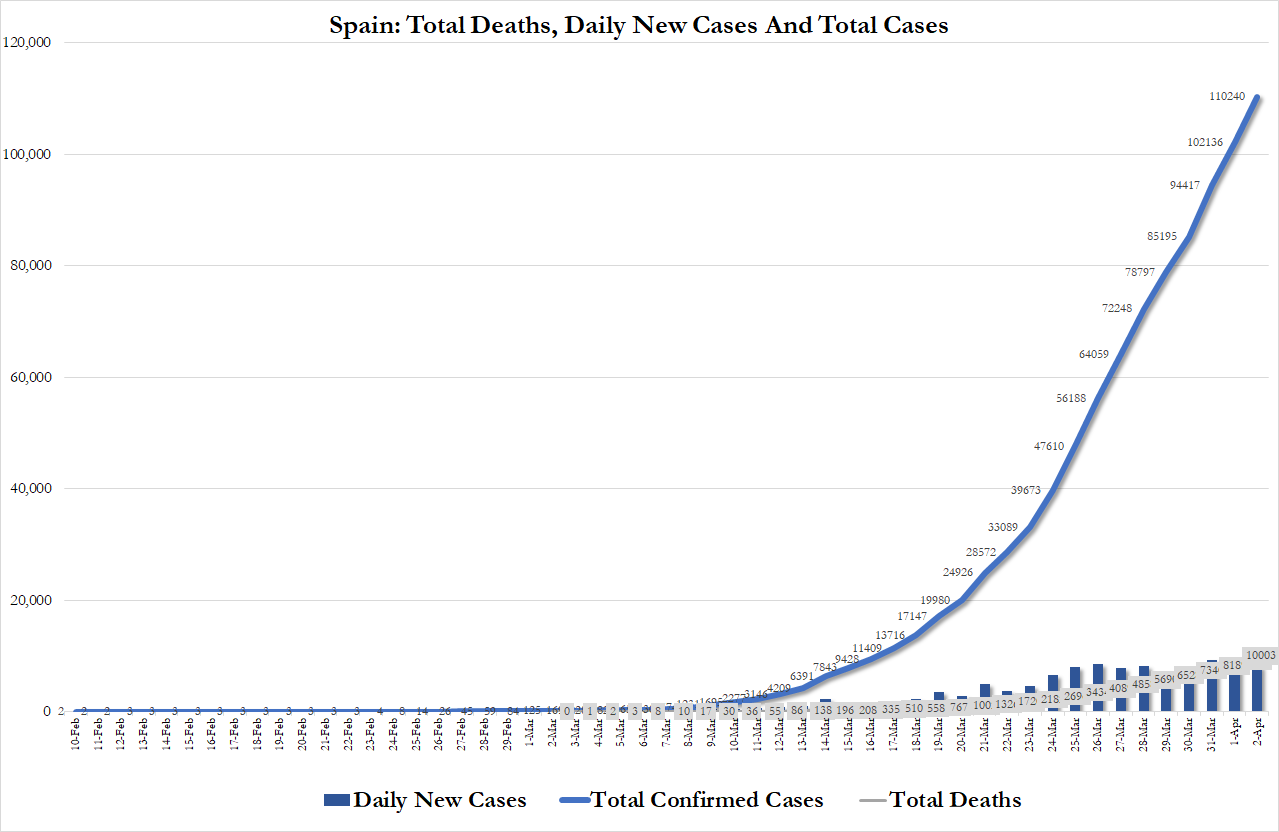
More than 10,000 people have now died in Spain after contracting coronavirus, with a record 950 of them dying on Wednesday, the latest in a grim streak of daily death-toll records. Death toll records released Thursday morning in Spain showed the official death toll hitting 10,003, up from 9,053 the day before.
Spain now has 110,238 confirmed cases of coronavirus, an 8% increase. Though that’s slowed from the ~25% daily jumps seen earlier this month, it doesn’t change the fact that Spain is 2.5 weeks into a shelter in place-style lockdown. Thanks to the lockdown, Spain recorded its biggest jump in unemployment in its history, with more than 800,000 people filing for benefits last week. The jump in deaths recently has pushed Spain’s mortality rate well above that of the US.
As it turns out, the US isn’t the only developed western country that is ill-prepared to ramp up testing for the novel coronavirus: As angry tabloid headlines bash the British government, led by a currently sickened PM Boris Johnson, a top British health official expressed frustration with the government’s struggles to provide enough tests, claiming that “everybody involved is frustrated” as the UK scrambles to ramp up testing, the FT reports.
Fortunately, London’s Francis Crick Institute has developed a rapid diagnostic coronavirus test and says it hopes to test 500 frontline workers a day from next week.
Though the US government is preparing to bail out American airlines, international airlines remain locked in a free fall: On Thursday, British Airways is expected to announce plans to suspend about 32,000 employees as it seeks to cut costs now that nobody is flying unless they absolutely need to.
As businesses continue to struggle with planning for the future, a new report from the UN Department of Economic and Social Affairs said the global economy could shrink by almost 1% before year’s end. Before the outbreak, they had anticipated growth of 2.5%, the Washington Post reports.
Now that the 2020 Tokyo Games have been officially postponed until next year (they’re still the 2020 Games though), Japan can focus on fighting the virus without that albatross around its neck: But as the country stands “on the very brink” of a coronavirus crisis, Prime Minister Shinzo Abe has resisted calls to try and enforce a state of emergency and other measures. Instead, he’s planning to send every household two small washable cloth masks, a decision that has earned him no shortage of ridicule.
Abe’s “two masks” plan was brutally mocked on social media, with many questioning how the masks would be split between a whole family.
Tokyo alone reported 97 new cases on Thursday, a new record high, and the latest in a two-week resurgence that has turned back the clock on Japan’s fight against the virus.
As more government officials catch the virus, the Philippine ambassador to Lebanon died of complications arising from the virus this week, the country’s Department of Foreign Affairs announced on Thursday. Ambassador Bernardita M. Catalla, a nearly 30-year veteran of the diplomatic corps., died in Beirut early Thursday morning.
Finally, as Indians continue to grumble about that the inept implementation of that country’s three-week lockdown, imposed despite a relative dearth of cases as officials feared rapid spreading in the country’s slums, the death of a middle-aged man in Mumbai’s Dharavi slum has stoked worries about the highly contagious virus ripping through what’s widely regarded as the largest slum in Asia.
We’ve all seen the jokes on social media about how nine months from now a new generation will be born that will eventually be dubbed “Coronials”—and once they come of age, “quaranteens.”
After all, if we’re stuck working from home or self-isolating along with our partner or significant other, it’s only natural and healthy for us to seek solace through sexual activity—and the increase in baby-making activities can naturally result in a miniature “baby boom.”
But as it turns out, the joke may have some basis after all—especially because a global shortage of condoms could deprive couples staying at home from one of the more popular birth control methods.
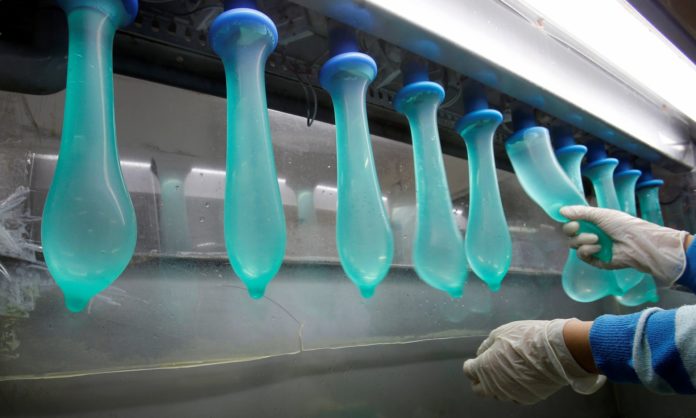
Reutersreports that Malaysia’s Karex Bhd, a company that is responsible for producing one out of every five condoms globally, spent over a week without producing a single condom at its three factories after the government imposed a lockdown to halt the spread of the coronavirus.
This has resulted in a shortfall of 100 million condoms which normally would be marketed worldwide under such brands as Durex, distributed through aid programs like the United Nations Population Fund, and the U.K.’s National Health Service (NHS).
On Friday, the company was granted permission to resume production under a special exemption for critical industries but with only half of its workforce.
Chief Executive Goh Miah Kiat said:
“It will take time to jumpstart factories and we will struggle to keep up with demand at half capacity.
We are going to see a global shortage of condoms everywhere, which is going to be scary.
My concern is that for a lot of humanitarian programs deep down in Africa, the shortage will not just be two weeks or a month. That shortage can run into months.”
The news comes as condoms rank among toilet paper and hand sanitizer as one of the most sought-after items during the CoViD-19 crisis, reportsHighsnobiety.
Earlier this month, sex product retailer Promescent’s CEO Jeff Abraham confirmed that the company saw surging condom sales all month.
“In fact, we’ve seen a 54 percent increase in our online sales since the beginning of the pandemic.
With the tremendous effort put forth by so many government and local organizations, we want to do our part to ensure people are continuing to practice safe sex and have adequate access to birth control in a time of social distancing and self-isolation.”
In times of uncertainty and isolation, it’s natural to seek physical and emotional intimacy https://t.co/ybAyWkzgF6
Condom factories in China, India, and Thailand have also faced disruptions in their operations. Similar problems have also been faced by regional manufacturers of critical protective gear like medical gloves in Malaysia.
A Durex spokesman reassured Reuters that operations would continue as normal, and no supply shortages are anticipated. They added:
“For our consumers, many of whom will be unable to access shops, our Durex online stores remain open for business.”
Goh added that while condom production may face interruptions, the demand for the contraceptive remains stronger than ever. He said:
“The good thing is that the demand for condoms is still very strong because like it or not, it’s still an essential to have.
Given that at this point in time people are probably not planning to have children. It’s not the time, with so much uncertainty.”
Mercedes F1 Race Team Fast-Tracks Creation of Revolutionary New Coronavirus Breathing Aid
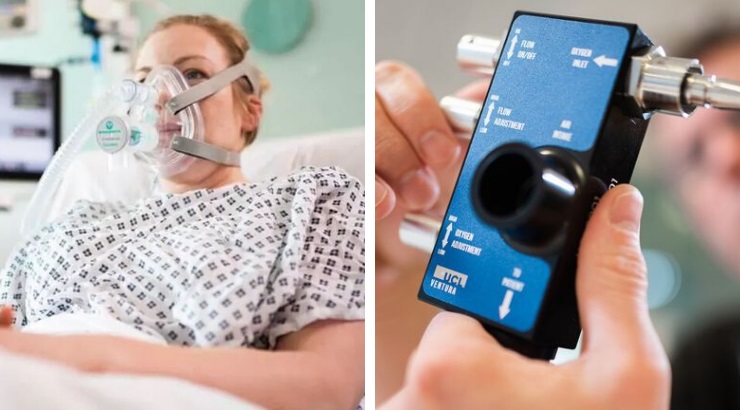
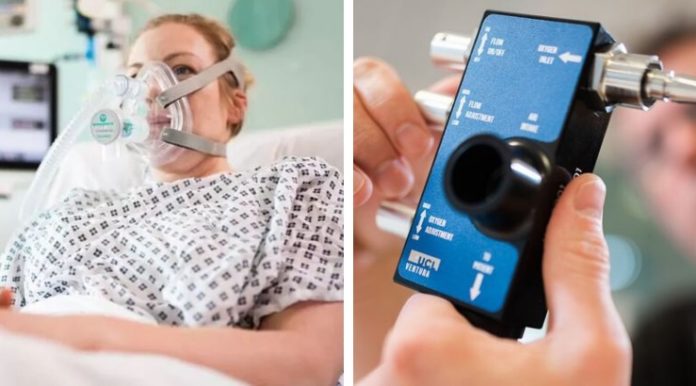
A collaboration between Mercedes Formula One and a group of clinicians and engineers has led to the creation of a new type of breathing aid for CoViD-19 patients.
The Continuous Positive Airway Pressure (CPAP) breathing aid delivers oxygen to patients’ lungs without the need for a ventilator and has commonly been used to treat sleep apnea. Now, an improvement on the device, is allowing those suffering from CoViD-19 to breathe easier without needing to be intubated.
The device, which was created within 100 hours of the first conceptual meeting, has been widely used with success on patients in China and Italy and has already been approved for use by the U.K.’s National Health Service (NHS), reportsBBC.
Engineers at University College London (UCL) and clinicians at UCL’s NHS Foundation Trust worked around the clock with experts from the U.K.-based Mercedes-AMG High Performance Powertrains to reverse engineer the device based on the CPAP system.
Forty of the devices are already being rolled out to University College Hospital (UCLH) and three other hospitals in London. If the trials are successful, the German automotive giant will be able to mass-produce the CPAP machines at a rate of 1,000 per day.
A breathing aid that can help keep coronavirus patients out of intensive care has been created in under a week. UCL engineers worked with clinicians at UCLH and Mercedes Formula One to build the device, which delivers oxygen to the lungs without needing a ventilator. (CPAP) pic.twitter.com/GcC8oNAHRf
UCLH critical care consultant Professor Mervyn Singer said:
“These devices will help to save lives by ensuring that ventilators, a limited resource, are used only for the most severely ill.
While they will be tested at UCLH first, we hope they will make a real difference to hospitals across the UK by reducing demand on intensive care staff and beds, as well as helping patients recover without the need for more invasive ventilation.”
Andy Cowell, managing director of Mercedes-AMG High Performance Powertrains, said:
“The Formula One community has shown an impressive response to the call for support … we have been proud to put our resources at the service of UCL to deliver the CPAP project to the highest standards and in the fastest possible timeframe.”
In the meantime, VentilatorChallengeUK—a consortium of engineering firms including Airbus, Ford, Rolls-Royce, BAE Systems, Siemens, and a range of Formula One racing teams—has secured orders of over 10,000 ventilators to be provided to the U.K.’s healthcare system. Production will kick off in a week.
Dick Elsy, chief executive of High Value Manufacturing Catapult, said:
“This consortium brings together some of the most innovative companies in the world.
They are working together with incredible determination and energy to scale up production of much-needed ventilators and combat a virus that is affecting people in many countries.”
This comes as the U.K. government continues to struggle with the pandemic and top officials warn that emergency measures could remain in place for as long as six months.
There are currently 9,000 people hospitalized with CoViD-19 in the U.K., a sharp rise from 6,000 on Friday. As of Sunday, the total number of people who have died from the virus in the U.K. reached at least 1,408.
A collaboration between Mercedes Formula One and a group of clinicians and engineers has led to the creation of a new type of breathing aid for CoViD-19 patients.
The Continuous Positive Airway Pressure (CPAP) breathing aid delivers oxygen to patients’ lungs without the need for a ventilator and has commonly been used to treat sleep apnea. Now, an improvement on the device, is allowing those suffering from CoViD-19 to breathe easier without needing to be intubated.
The device, which was created within 100 hours of the first conceptual meeting, has been widely used with success on patients in China and Italy and has already been approved for use by the U.K.’s National Health Service (NHS), reportsBBC.
Engineers at University College London (UCL) and clinicians at UCL’s NHS Foundation Trust worked around the clock with experts from the U.K.-based Mercedes-AMG High Performance Powertrains to reverse engineer the device based on the CPAP system.
Forty of the devices are already being rolled out to University College Hospital (UCLH) and three other hospitals in London. If the trials are successful, the German automotive giant will be able to mass-produce the CPAP machines at a rate of 1,000 per day.
A breathing aid that can help keep coronavirus patients out of intensive care has been created in under a week. UCL engineers worked with clinicians at UCLH and Mercedes Formula One to build the device, which delivers oxygen to the lungs without needing a ventilator. (CPAP) pic.twitter.com/GcC8oNAHRf
UCLH critical care consultant Professor Mervyn Singer said:
“These devices will help to save lives by ensuring that ventilators, a limited resource, are used only for the most severely ill.
While they will be tested at UCLH first, we hope they will make a real difference to hospitals across the UK by reducing demand on intensive care staff and beds, as well as helping patients recover without the need for more invasive ventilation.”
Andy Cowell, managing director of Mercedes-AMG High Performance Powertrains, said:
“The Formula One community has shown an impressive response to the call for support … we have been proud to put our resources at the service of UCL to deliver the CPAP project to the highest standards and in the fastest possible timeframe.”
In the meantime, VentilatorChallengeUK—a consortium of engineering firms including Airbus, Ford, Rolls-Royce, BAE Systems, Siemens, and a range of Formula One racing teams—has secured orders of over 10,000 ventilators to be provided to the U.K.’s healthcare system. Production will kick off in a week.
Dick Elsy, chief executive of High Value Manufacturing Catapult, said:
“This consortium brings together some of the most innovative companies in the world.
They are working together with incredible determination and energy to scale up production of much-needed ventilators and combat a virus that is affecting people in many countries.”
This comes as the U.K. government continues to struggle with the pandemic and top officials warn that emergency measures could remain in place for as long as six months.
There are currently 9,000 people hospitalized with CoViD-19 in the U.K., a sharp rise from 6,000 on Friday. As of Sunday, the total number of people who have died from the virus in the U.K. reached at least 1,408.
Researchers Discover Method to Sterilize and Reuse N95 Masks to Help Relieve Shortages
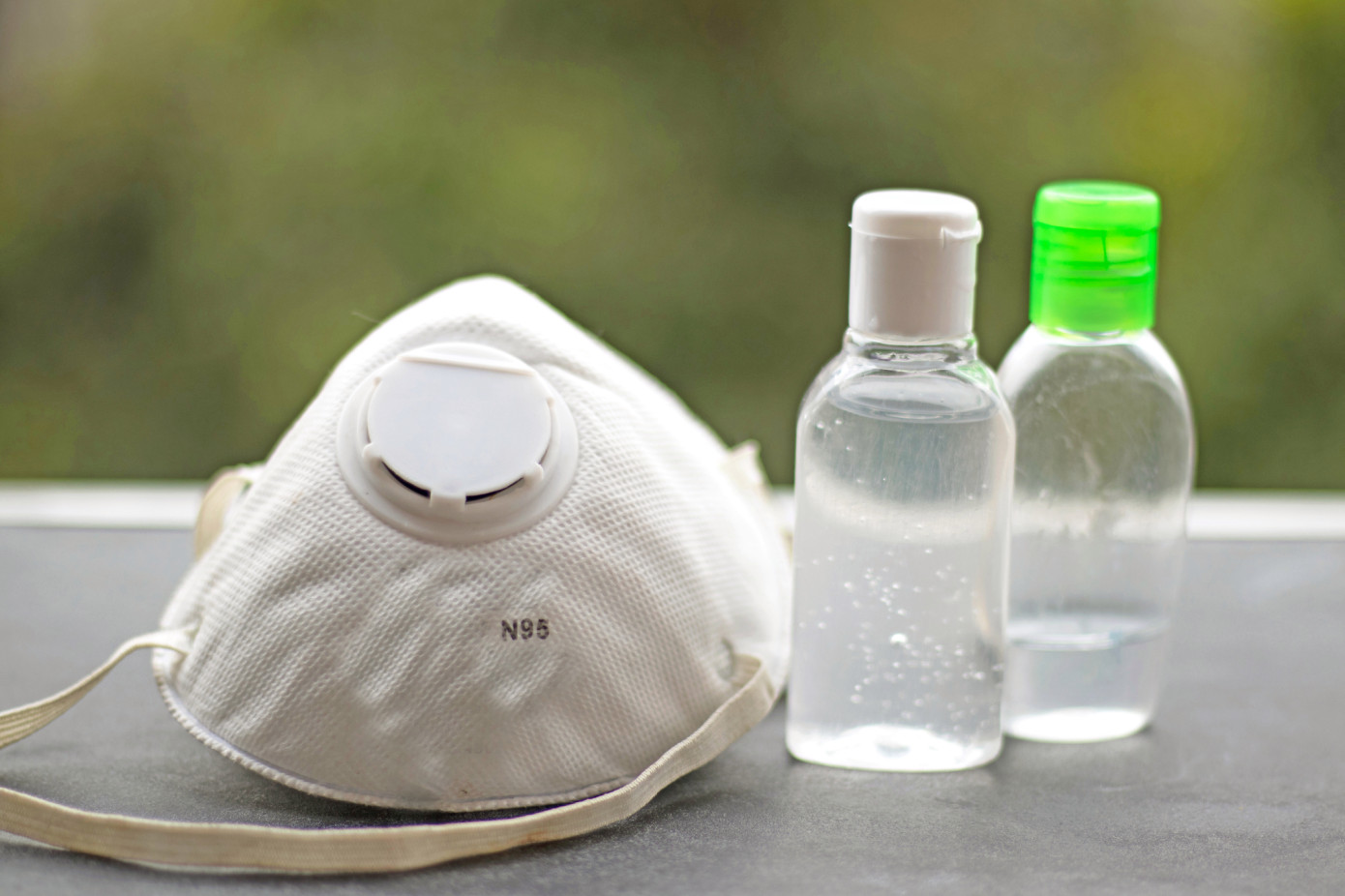
N95 face mask and hand sanitizer displayed
As healthcare workers continue to cope with a tsunami of patients infected with CoViD-19, they’ve been forced to cope with critical shortages of N95 face masks that block the virus.
Some facilities like NewYork-Presbyterian Hospital are burning through no less than 40,000 N95 masks per day with the chief of surgery expecting the number to swell to 70,000 per day as the pandemic spreads, amNYreports.
But now, researchers at Duke University in Durham, North Carolina, say that they have discovered a method to decontaminate the masks and reuse them, extending a crucial lifeline to frontline medical staff coping with surging cases of the novel virus.
Scientists are using specialized equipment to vaporize hydrogen peroxide, permeating the layers of the N95 masks with a cleansing aerosol that can kill germs, including viruses, without degrading the materials used in the precious masks.
So far, at least 763 cases of CoViD-19 and three deaths have been reported in North Carolina. And while the state isn’t yet facing the level of crisis experienced in flashpoints like New York City, California, or Italy, medical personnel in the Tar Heel State are hoping to get ahead of the curve.
The preservation of personal protective equipment (PPE) like N95 masks that would otherwise be disposed of will help them along in achieving that goal.
The decontamination technology and method had long been in use by Duke Health’s biocontainment lab, but applying it to the typically-disposable N95 masks hadn’t been considered until the present crisis.
Dr. Matthew Stiegel, director of the Occupational and Environmental Safety Office, said:
“We had never considered needing it for something like face masks. But we’ve now proven that it works and will begin using the technology immediately in all three Duke Health hospitals.”
The application of hydrogen peroxide to contaminated N95 masks had been tested and published by researchers in 2016, but the process wasn’t adapted on a widespread basis. However, Duke has managed to include fit testing into the cleaning process, ensuring that the masks are cleaned for all sizes, which hadn’t previously been done.
Dr. Monte Brown, vice president for administration for the Duke University Health Care System, said that Duke plans on making the protocols for the technique known on a widespread basis throughout international healthcare systems. The equipment needed for the process is already available for many hospitals and pharmaceutical companies.
“We could stand up in front of our staff and state with confidence that we are using a proven decontamination method.
It has been a proven method for years. While this alone will not solve the problem, if we and others can reuse masks even once or twice, that would be a huge benefit given the current shortages.”
As healthcare workers continue to cope with a tsunami of patients infected with CoViD-19, they’ve been forced to cope with critical shortages of N95 face masks that block the virus.
Some facilities like NewYork-Presbyterian Hospital are burning through no less than 40,000 N95 masks per day with the chief of surgery expecting the number to swell to 70,000 per day as the pandemic spreads, amNYreports.
But now, researchers at Duke University in Durham, North Carolina, say that they have discovered a method to decontaminate the masks and reuse them, extending a crucial lifeline to frontline medical staff coping with surging cases of the novel virus.
Scientists are using specialized equipment to vaporize hydrogen peroxide, permeating the layers of the N95 masks with a cleansing aerosol that can kill germs, including viruses, without degrading the materials used in the precious masks.
So far, at least 763 cases of CoViD-19 and three deaths have been reported in North Carolina. And while the state isn’t yet facing the level of crisis experienced in flashpoints like New York City, California, or Italy, medical personnel in the Tar Heel State are hoping to get ahead of the curve.
The preservation of personal protective equipment (PPE) like N95 masks that would otherwise be disposed of will help them along in achieving that goal.
The decontamination technology and method had long been in use by Duke Health’s biocontainment lab, but applying it to the typically-disposable N95 masks hadn’t been considered until the present crisis.
Dr. Matthew Stiegel, director of the Occupational and Environmental Safety Office, said:
“We had never considered needing it for something like face masks. But we’ve now proven that it works and will begin using the technology immediately in all three Duke Health hospitals.”
The application of hydrogen peroxide to contaminated N95 masks had been tested and published by researchers in 2016, but the process wasn’t adapted on a widespread basis. However, Duke has managed to include fit testing into the cleaning process, ensuring that the masks are cleaned for all sizes, which hadn’t previously been done.
Dr. Monte Brown, vice president for administration for the Duke University Health Care System, said that Duke plans on making the protocols for the technique known on a widespread basis throughout international healthcare systems. The equipment needed for the process is already available for many hospitals and pharmaceutical companies.
“We could stand up in front of our staff and state with confidence that we are using a proven decontamination method.
It has been a proven method for years. While this alone will not solve the problem, if we and others can reuse masks even once or twice, that would be a huge benefit given the current shortages.”
Mercedes F1 Race Team Fast-Tracks Creation of Revolutionary New Coronavirus Breathing Aid
A collaboration between Mercedes Formula One and a group of clinicians and engineers has led to the creation of a new type of breathing aid for CoViD-19 patients.
The Continuous Positive Airway Pressure (CPAP) breathing aid delivers oxygen to patients’ lungs without the need for a ventilator and has commonly been used to treat sleep apnea. Now, an improvement on the device, is allowing those suffering from CoViD-19 to breathe easier without needing to be intubated.
The device, which was created within 100 hours of the first conceptual meeting, has been widely used with success on patients in China and Italy and has already been approved for use by the U.K.’s National Health Service (NHS), reportsBBC.
Engineers at University College London (UCL) and clinicians at UCL’s NHS Foundation Trust worked around the clock with experts from the U.K.-based Mercedes-AMG High Performance Powertrains to reverse engineer the device based on the CPAP system.
Forty of the devices are already being rolled out to University College Hospital (UCLH) and three other hospitals in London. If the trials are successful, the German automotive giant will be able to mass-produce the CPAP machines at a rate of 1,000 per day.
A breathing aid that can help keep coronavirus patients out of intensive care has been created in under a week. UCL engineers worked with clinicians at UCLH and Mercedes Formula One to build the device, which delivers oxygen to the lungs without needing a ventilator. (CPAP) pic.twitter.com/GcC8oNAHRf
UCLH critical care consultant Professor Mervyn Singer said:
“These devices will help to save lives by ensuring that ventilators, a limited resource, are used only for the most severely ill.
While they will be tested at UCLH first, we hope they will make a real difference to hospitals across the UK by reducing demand on intensive care staff and beds, as well as helping patients recover without the need for more invasive ventilation.”
Andy Cowell, managing director of Mercedes-AMG High Performance Powertrains, said:
“The Formula One community has shown an impressive response to the call for support … we have been proud to put our resources at the service of UCL to deliver the CPAP project to the highest standards and in the fastest possible timeframe.”
In the meantime, VentilatorChallengeUK—a consortium of engineering firms including Airbus, Ford, Rolls-Royce, BAE Systems, Siemens, and a range of Formula One racing teams—has secured orders of over 10,000 ventilators to be provided to the U.K.’s healthcare system. Production will kick off in a week.
Dick Elsy, chief executive of High Value Manufacturing Catapult, said:
“This consortium brings together some of the most innovative companies in the world.
They are working together with incredible determination and energy to scale up production of much-needed ventilators and combat a virus that is affecting people in many countries.”
This comes as the U.K. government continues to struggle with the pandemic and top officials warn that emergency measures could remain in place for as long as six months.
There are currently 9,000 people hospitalized with CoViD-19 in the U.K., a sharp rise from 6,000 on Friday. As of Sunday, the total number of people who have died from the virus in the U.K. reached at least 1,408.
This website uses cookies to improve your experience. We'll assume you're ok with this, but you can opt-out if you wish.AcceptRead More
Privacy & Cookies Policy
Privacy Overview
This website uses cookies to improve your experience while you navigate through the website. Out of these, the cookies that are categorized as necessary are stored on your browser as they are essential for the working of basic functionalities of the website. We also use third-party cookies that help us analyze and understand how you use this website. These cookies will be stored in your browser only with your consent. You also have the option to opt-out of these cookies. But opting out of some of these cookies may affect your browsing experience.
Necessary cookies are absolutely essential for the website to function properly. This category only includes cookies that ensures basic functionalities and security features of the website. These cookies do not store any personal information.
Any cookies that may not be particularly necessary for the website to function and is used specifically to collect user personal data via analytics, ads, other embedded contents are termed as non-necessary cookies. It is mandatory to procure user consent prior to running these cookies on your website.