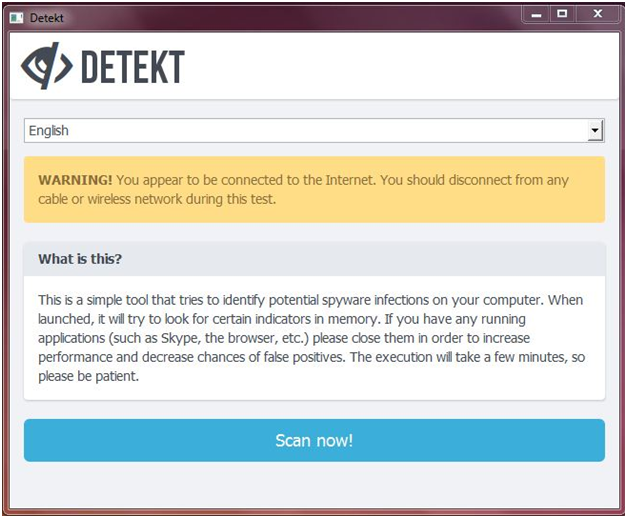
People from Amnesty International, Digitale Gesellschaft, Electronic Foundation & Privacy International have created a program that is able to detect spywares like FinFisher, Hacking Team Remote Control System and other commercial surveillance softwares for spying.
This is free software originally developed by Claudio Guarnieri with help of Bill Marczack, Morgan Marquis-Boire, Eva Galperin and many others. Detekt was developed because Guarnieri and his gang saw a huge growth in spywares and commercial surveillance technologies. These softwares have the potential to snoop massive amounts of emails, listen to Skype conversations, and switch on your default on board microphone (usually on mother board) or the webcam without you even knowing its active.
Thanks to Edward Snowden (former National Security Agency Contractor) for telling us that agencies like NSA and GCHQ have been violating laws like this for years. And people like Guarnieri developing open source softwares like Detekt to help protect the world.
You’ve seen it in the cinema, on the television and even in cartoons. Rendered 3 dimensional projection has entered the world of here and now. Well, the almost here and now. There won’t be any holographic French maids or pool boys to bend and pose at your command for a good length of time.
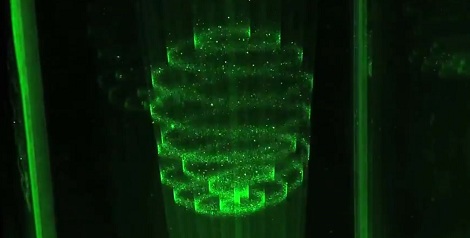
Thanks to the people at Tokyo’s Advanced Industrial Science and Technology (AIST), in collaboration with Burton Inc. and Keio University, new ground has definitely been broken in the ability to create 3D projections without any type of medium as a target focus point. No screen, no vapor… nothing. Crisp, clean everyday air is all that’s needed (that may be hard to find soon too).
The technology is relatively simple to understand yet complex to achieve. We’re told the correct description is that of a volumetric display.
“A volumetric display device is a graphic display device that forms a visual representation of an object in three physical dimensions, as opposed to the planar image of traditional screens that simulate depth through a number of different visual effects”.*
The original technology used a high brightness, infrared pulse laser. This particular laser just happens to pulse at about 100 times per second. It’s definitely not your 70’s strobe light that’s hanging in the closet. The beam is shot into a motorized scanner which moves and focuses the laser in conjunction with the pulsing to create a matrix of dots in 3 dimensional patterns. OK, it doesn’t sound exciting to some people but, it’s a baby step into an untouched abyss of creative euphoria. Fast forward to the latest press release from AIST… they are now producing projections at 1000 flashes per second. Is there any doubt of what may come in the near future? When will the first Star Trek Holo-deck be built?!
Perhaps you’re asking yourself “how is this gonna help my life?” To some, this whole deal may just be a tripping hazard; another project to distract you while walking down the street until that steel pole stops you. To others, it’s another miracle of science triggered by the imagination of science fiction. We’ve come a long way since 1951 and the 13 ton Univac computer (with its 5,200 vacuum tubes). Where would we be without imagination?
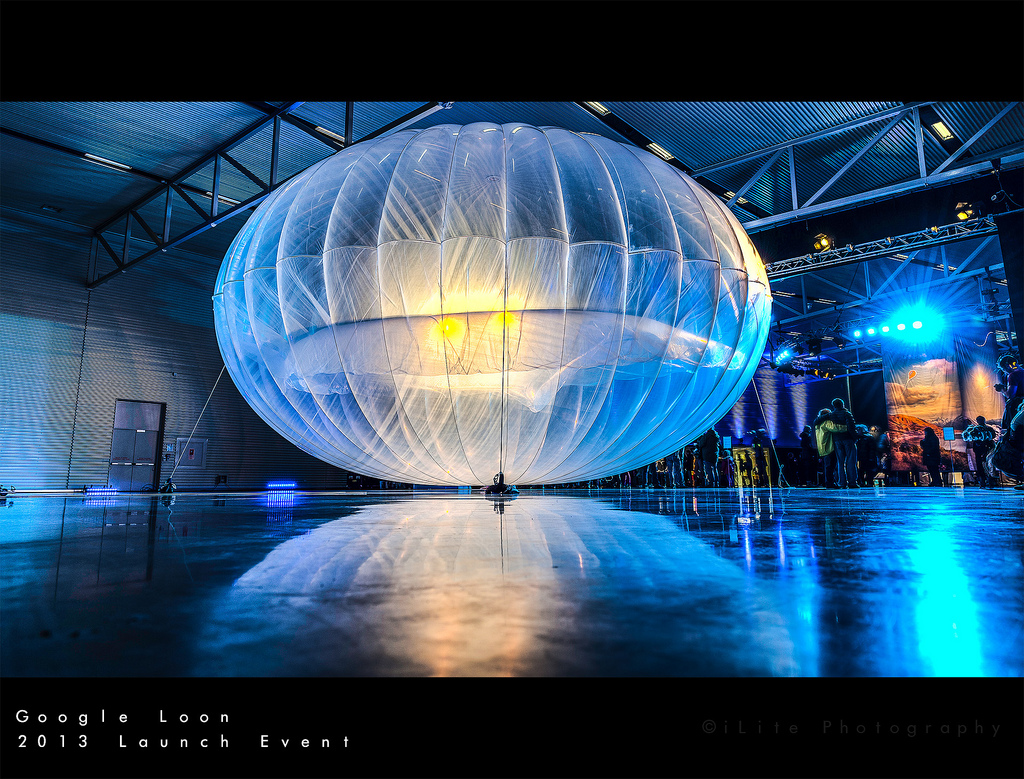
Back in June of 2014, Internet icon Google announced its next step in providing unwired internet access to the globe. The plan was to spend over a billion dollars on a startup fleet of about 180 high capacity communication satellites. These little buggers would orbit at a lower altitude than most common satellites thus leaving a vast future of expansion. This following Google’s “Loon”* project which seems to have not only been successful but possibly the clincher for the decision to build the floating fleet. For those unfamiliar with “loon”*, it is an undertaking by Google as a less expensive method of bringing wireless internet to the 2/3 of our world that has little or no internet as of right now. Yes, believe it or not you crazy kids… there’s a vast part of our planet that has no access to the tube, facebook and other social silliness. Google describes it this way:
“Project Loon is a network of balloons traveling on the edge of space, designed to connect people in rural and remote areas, help fill coverage gaps, and bring people back online after disasters.
Project Loon began in June 2013 with an experimental pilot in New Zealand, where a small group of Project Loon pioneers tested Loon technology. The results of the pilot test, as well as subsequent tests in New Zealand, California’s Central Valley and in Northeast Brazil, are being used to improve the technology in preparation for the next stages of the project.”
Project Loon definitely has a place in the world but, as a long term ideal? It’s not looking good. Onward to the next adventure.
The satellite project’s forecast cost is somewhere between $1 billion and $3 billion dollars depending on the final design, number of machines etc… Why would they even consider this stellar undertaking? For the good of the planet and all mankind? Yeah, no…probably not. We would guess the money. Let’s lay it out simply…even though the population of our world is not spread evenly you can get a very general idea of the “return of investment” possibilities. We’ll just pretend people are spread out like icing on a cake (relatively even with a few lumps) If that were the case (given there are roughly 7.3 billion people in the world) that means that about 5 Billion people have minimal or no internet access. Give them access and start sending out free IPhones with Google apps on them? Question answered?
Initially, the whole adventure was being led by Greg Wyler (founder of satellite-communications startup O3b Networks Ltd). Greg had joined with Google in 2013 and had a theory and a plan.
Now, we throw an Orion rocket sized monkey wrench into things when we find out that Mr. Wyler parted company with Google in August 2014 taking with him the rights to a certain radio spectrum that could be used to provide Internet access to the project. Lips are tight and not a word is being said as to why these all happened but, fear not! All is not lost! It just so happens that Mr. Wyler has connected with one Mr. Elon Musk, just after his departure from Google. This billionaire inventor/entrepreneur that has taken on such projects as the SpaceXDragon spacecraft and the hyperloop high speed transportation system in the recent past is looking at a satellite fleet of around 700 satellites, each costing only 1 million dollars and weighing in at a mere 250 pounds (half the weight of the current smallest communication Satellites in use today). Will it happen? Only time will tell us. However, recent reports state that both Wyler and Musk have actively been in contact with state officials in both Florida and Colorado in regards to building satellite factories.
A leap toward a new Utopia or a slide farther into Dystopia/ what’s your opinion?
In mid-September of 2014, numerous companies such as Netflix, Reddit, Etsy and an assortment of others participated in what is now known as an “internet slowdown day” in order to encourage “net neutrality”.
There are some who believe that certain internet providers along with our illustrious government are not treating all information equally (It’s shocking, I know) The first word that may pop into your mind is censorship. Don’t jump to any conclusions yet. It’s more like a process of slowing down the flow to or from certain sources. Let’s think of the internet like the water system in your home or apartment. There’s one main line that supplies all the water to your home (fed from other pipes on the outside). Ideally you have valves for your bathroom, kitchen, powder room and maybe even your garage if you have one. The information / water (i.e. websites, pages, games, or even the dictionary) flows through the pipes freely on a regular basis. What happens if you close the valve to your powder room half way? You’ll still get the same water there but, it may take twice as long for the toilet to shut off after reading the latest propaganda. How about a nice hot shower? That particular valve is closed ¾ of the way. IF the water is still hot by the time it actually gets to the shower, you may have already gotten tired of waiting and moved on to another bathroom…or website.
It comes down to the fear of internet providers or other agencies slowing down the flow of data to shift your focus and possibly pad their pockets. Admit it, nowadays the only thing more frustrating than a 404 error for most people is that little ring of death that appears when a page is trying to download…and it won’t go away. The internet has become a necessity and the realization of this has many up in arms. This is where net neutrality is supposed to sweep in and help. Even President Obama is getting in on the opinions by his released statement:
“So the time has come for the FCC to recognize that broadband service is of the same importance and must carry the same obligations as so many of the other vital services do. To do that, I believe the FCC should reclassify consumer broadband service under Title II of the Telecommunications Act — while at the same time forbearing from rate regulation and other provisions less relevant to broadband services”.*
Let’s say that the idea becomes reality. How does the FCC monitor and regulate it for one? More importantly, where does the money come from? If it should come to pass that the internet is deemed a utility then what? Even though the FCC is an “independent agency” you can bet your undies we the people are gonna foot the bill. There will be Licenses for use, licenses for higher powered machines, usage identification just for a start. It’s happened before in a not so far off America. Long before cell phones and smart phones the 1960’s brought about a revolution of affordable, short distance personal radios that used public frequencies. They were not nearly as strong as police and emergency radios but worked well generally. They were given the name Citizen’s Band Radio or CB’s as we still call them. Popularity skyrocketed as people deemed them a vital piece of equipment in many places. Even though these radios were never actually defined as a utility, the government and the FCC stepped in because public frequencies were being used and no one in the government was benefitting from it. License requirements, “call sign” applications and power restrictions seemed to sprout overnight…and the clams came rolling in. Fast forward to 2014 and these radios are still being used. What’s the difference 50 years later? Scientific advancements in communications diminished the user base by 95% and with that most of those money grabbing opportunities and rules disappeared.
Knowing this brief period of capitalistic history along with things that happen within the now unregulated utilities… is net neutrality an honest concern for the reasons thrown out there or is it just a rough path for the big corporations to expand into a full blown road of guaranteed cash?
This website uses cookies to improve your experience. We'll assume you're ok with this, but you can opt-out if you wish.AcceptRead More
Privacy & Cookies Policy
Privacy Overview
This website uses cookies to improve your experience while you navigate through the website. Out of these, the cookies that are categorized as necessary are stored on your browser as they are essential for the working of basic functionalities of the website. We also use third-party cookies that help us analyze and understand how you use this website. These cookies will be stored in your browser only with your consent. You also have the option to opt-out of these cookies. But opting out of some of these cookies may affect your browsing experience.
Necessary cookies are absolutely essential for the website to function properly. This category only includes cookies that ensures basic functionalities and security features of the website. These cookies do not store any personal information.
Any cookies that may not be particularly necessary for the website to function and is used specifically to collect user personal data via analytics, ads, other embedded contents are termed as non-necessary cookies. It is mandatory to procure user consent prior to running these cookies on your website.