
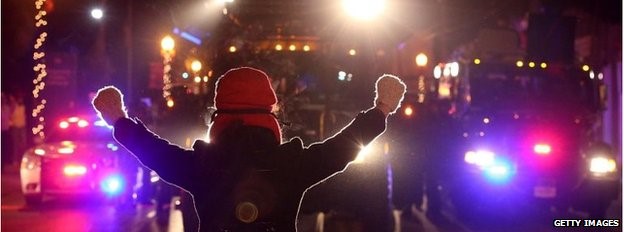
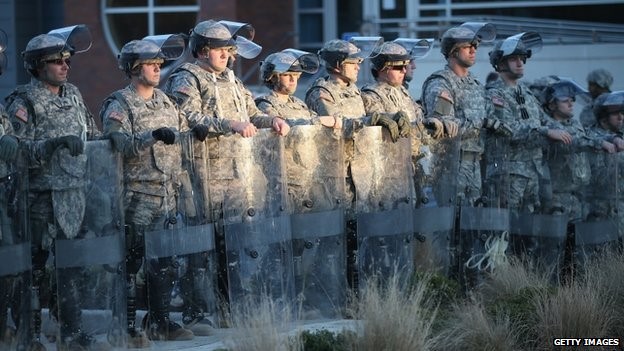
The National Guard have been brought in to control the spreading protests across the United States of America. Following the ruling on the court case involving Darren Wilson’s innocence in the shooting of Michael Brown, who saw him killed, communities have demonstrated their frustrations with the police, in general.
New York, Seattle, Washington DC, , Georgia, Oregon, Cleveland, and California, in the San Francisco Bay area, all were witness to largely, peaceful protests this week. Ferguson saw 44 arrests in the town, and Oakland, CA., saw unrest on Tuesday night. In other areas, it was largely protesters blocking traffic in demonstration.
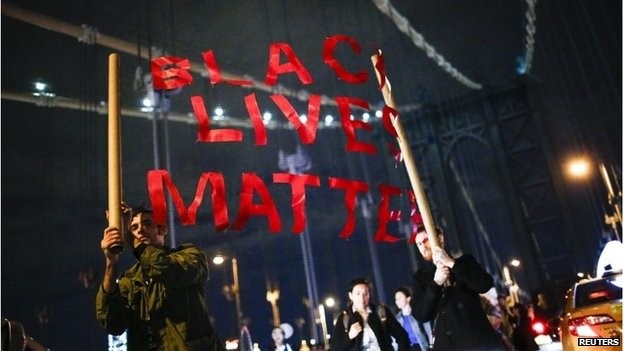
In California, protestors gathered on the U.S. 101 freeway, bringing traffic to a halt with their demonstrations across the lanes. LAPD arrived within minutes to chase and round them up onto an overpass. In New York, thousands took to the streets of Manhattan, occupying Union Square and marching through Times Square, also peacefully holding up traffic. Elsewhere, in Cleveland a similar story unfolded, while in Minneapolis, it is reported a car struck one protestor and continued to plough through the crowd surrounding the woman.[1]
It is said that around 2,200 National Guard soldiers have been deployed to assist the police in keeping order as protestors chanted “no justice,” and “hands up, don’t shoot.” The protests reflect the general consensus of the dissatisfaction with the justice system, referring to police shootings and brutality in their own communities. [2]
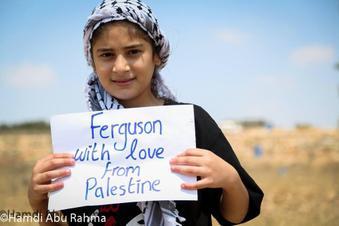
While Darren Wilson states to the ABC news that things could not have been done differently, and “…the reason I have a clean conscience is because I know I did my job right,” President Obama condemned the protests as “no excuse for the [destructive behavior],” while overseas, in the war-torn Gaza, a solidarity emerged in support for the protests in Ferguson and across the States. [3]
“We understand your moral outrage. We empathize with your hurt and anger. We understand the impulse to rebel against the infrastructure of a racist capitalist system that systematically pushes you to the margins of humanity,” read one banner in the Gaza.
A federal rights investigation is currently underway in conjunction with a federal investigation to see if there is any basis for the accusations of discriminatory behavior and if there are any emerging patterns.
__________________________________________________________________________________________________________________
[1] Sanner, A., Franco, K., Baenen, J., Rodriguez, O., Hajela, D., Duara, N., White, J. (2014, November 25). Protesters take to the streets across the U.S. to protest lack of indictment in Ferguson shooting. Retrieved from http://www.mercurynews.com/nation-world/ci 27015140/protesters-take-streets-across-u-s-protest-lack
[2] BBC News, US and Canada. (2014, November 26). Ferguson shooting: Protests spread across US. Retrieved from http://www.bbc.com/news/world-us-canada-30203526
[3] Middle East Eye. (2014, November 25). Palestinians send messages of solidarity to #Ferguson protestors. Retrieved from http://www.middleeasteye.net/news/palestinians-send-messages-solidarity-ferguson-protestors-1477331164