
Home Blog Page 32

WHO Report: The World Is Running Out Of Antibiotics

0

A report, Antibacterial agents in clinical development – an analysis of the antibacterial clinical development pipeline, including tuberculosis, launched today by WHO shows a serious lack of new antibiotics under development to combat the growing threat of antimicrobial resistance.

Most of the drugs currently in the clinical pipeline are modifications of existing classes of antibiotics and are only short-term solutions. The report found very few potential treatment options for those antibiotic-resistant infections identified by WHO as posing the greatest threat to health, including drug-resistant tuberculosis which kills around 250 000 people each year.

“Antimicrobial resistance is a global health emergency that will seriously jeopardize progress in modern medicine,” says Dr Tedros Adhanom Ghebreyesus, Director-General of WHO. “There is an urgent need for more investment in research and development for antibiotic-resistant infections including TB, otherwise we will be forced back to a time when people feared common infections and risked their lives from minor surgery.”

In addition to multidrug-resistant tuberculosis, WHO has identified 12 classes of priority pathogens – some of them causing common infections such as pneumonia or urinary tract infections – that are increasingly resistant to existing antibiotics and urgently in need of new treatments.

The report identifies 51 new antibiotics and biologicals in clinical development to treat priority antibiotic-resistant pathogens, as well as tuberculosis and the sometimes deadly diarrhoeal infection Clostridium difficile.

Among all these candidate medicines, however, only 8 are classed by WHO as innovative treatments that will add value to the current antibiotic treatment arsenal.

There is a serious lack of treatment options for multidrug- and extensively drug-resistant M. tuberculosis and gram-negative pathogens, including Acinetobacter and Enterobacteriaceae (such as Klebsiella and E.coli) which can cause severe and often deadly infections that pose a particular threat in hospitals and nursing homes.

There are also very few oral antibiotics in the pipeline, yet these are essential formulations for treating infections outside hospitals or in resource-limited settings.

“Pharmaceutical companies and researchers must urgently focus on new antibiotics against certain types of extremely serious infections that can kill patients in a matter of days because we have no line of defence,” says Dr Suzanne Hill, Director of the Department of Essential Medicines at WHO.

To counter this threat, WHO and the Drugs for Neglected Diseases Initiative (DNDi) set up the Global Antibiotic Research and Development Partnership (known as GARDP). On 4 September 2017, Germany, Luxembourg, the Netherlands, South Africa, Switzerland and the United Kingdom of Great Britain and Northern Ireland and the Wellcome Trust pledged more than €56 million for this work.

“Research for tuberculosis is seriously underfunded, with only two new antibiotics for treatment of drug-resistant tuberculosis having reached the market in over 70 years,” says Dr Mario Raviglione, Director of the WHO Global Tuberculosis Programme. “If we are to end tuberculosis, more than US$ 800 million per year is urgently needed to fund research for new antituberculosis medicines”.

New treatments alone, however, will not be sufficient to combat the threat of antimicrobial resistance. WHO works with countries and partners to improve infection prevention and control and to foster appropriate use of existing and future antibiotics. WHO is also developing guidance for the responsible use of antibiotics in the human, animal and agricultural sectors.

Source: WHO
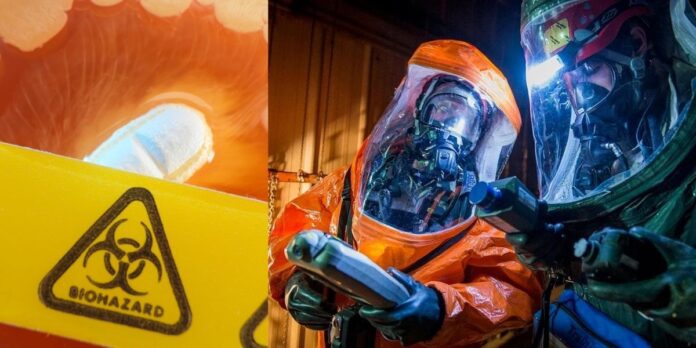
WHO Told Ukraine To Destroy ‘High-Threat Pathogens’ In Labs To Prevent Disease Spread

0

The World Health Organization advised Ukraine to destroy ‘high-threat pathogens’ in the country’s public health laboratories in order to prevent “any potential spills” that might infect the population during the Russian invasion, Reuters reports.

“As part of this work, WHO has strongly recommended to the Ministry of Health in Ukraine and other responsible bodies to destroy high-threat pathogens to prevent any potential spills,” said the UN agency.

The report comes after a tense back-and-forth between US and Russian officials over “dangerous” biolabs in the country – with Russia, and then China, accusing the US military of involvement in Ukraine’s biolabs.

On Wednesday, Russian foreign ministry spokesperson Maria Zakharova repeated a longstanding claim that the United States operates a biowarfare lab in Ukraine, an accusation that has been repeatedly denied by Washington and Kyiv.Zakharova said that documents unearthed by Russian forces in Ukraine showed “an emergency attempt to erase evidence of military biological programmes” by destroying lab samples. -Reuters

The US has denied the allegations – issuing (among other things) a Thursday statement that “The United States does not have chemical or biological weapons labs in Ukraine,” adding that America “does not develop or possess chemical and biological weapons anywhere.”

On Tuesday, US Undersecretary of State Victoria Nuland acknowledged that Ukraine “has biological research facilities, which, in fact, we are now quite concerned Russian troops, Russian forces may be seeking to gain control of. So we are working with the Ukrainians on how they can prevent any of those research materials from falling into the hands of Russian forces should they approach.”

Nuland’s answer made clear that whatever is inside Ukraine’s biolabs is a serious concern, however it should be noted that there’s no public evidence of bioweapons, nor did the WHO statement make reference to biowarfare – which is a separate issue from whether the laboratories contained, or contain, dangerous pathogens which could be used in a bioweapon

In response to Russian foreign ministry spokesperson Maria Zakharova’s Wednesday claim that the US is operating a biowarfare lab in Ukraine, a Ukrainian presidential spokesperson said: “Ukraine strictly denies any such allegation.”

The UN Security Council will convene on Friday at Russia’s request to discuss the claims.

https://twitter.com/ColumbiaBugle/status/1502094871217287169

Russia Calls For UN Security Council Meeting Over “Biological Activities” In Ukraine

Dmitry Polyanskiy, first deputy permanent representative of Russia to the United Nations, said in a Twitter post on March 10:

“Russian Mission asked for a meeting of #SecurityCouncil for 11 March to discuss the military biological activities of the US on the territory of #Ukraine.

Reuters reported that diplomats have indicated the U.N. Security Council will convene on Friday, March 11, to discuss Moscow’s claims of U.S. biological activities in Ukraine.

Late on March 9, the United States denied Russian accusations that Washington is running labs in Ukraine geared toward developing bioweapons.

Russia on March 8 repeated its longstanding accusations the United States is working with Ukrainian laboratories to develop biological weapons.

The United States and Ukraine maintain that the laboratories seek to prevent bioweapons and pathogens, not develop them. Ukraine, like many other countries, has public health laboratories researching how to minimize the threats of dangerous diseases affecting humans and animals.

Fact sheets featured on the U.S. Embassy of Ukraine website, found via Internet Archive, link to several documents detailing what appears to be U.S. government investments for select laboratories in Ukraine.

Under Secretary of State for Political Affairs Victoria Nuland on March 8 said Ukraine has “biological research facilities” and the United States is working to prevent Russians from taking control of them.

In a statement released on March 9, State Department spokesman Ned Price said Russia “is inventing false pretexts in an attempt to justify its own horrific actions in Ukraine.”

Separately, the World Health Organization (WHO) said in an interview with Reuters on Thursday that it “has strongly recommended to the Ministry of Health in Ukraine and other responsible bodies to destroy high-threat pathogens to prevent any potential spills.”

“Phone Hasn’t Stopped Ringing” – The World’s Ultra Rich Are Panic Buying Doomsday Bunkers

0

Russian President Vladimir Putin’s move to place his nuclear forces on heightened alert as the invasion of Ukraine continues for more than 2 weeks now has increased demand for custom-made doomsday bunkers for the paranoid rich.

Gary Lynch, the general manager of Texas-based Rising S Co., told The Sun that underground doomsday bunker demand is up more than 1000% since Russian troops invaded Ukraine on Feb. 24.

“Typically, I’ll sell between two and six shelters a month – and usually winter is a quiet time for us.“But I sold five units alone on Thursday, and I’ve sold two more already today – there’s no telling how many more [orders] we will get.“The phone hasn’t stopped ringing, and we’ve been sending out so many quotes,” added Lynch.

This luxury doomsday bunker built to withstand nuclear blast is listed at $17.5 million.

Readers may recall hearing about Rising S in the early days of the COVID pandemic and social unrest as underground bunkers were in high demand.

The five doomsday bunkers sold on the Russian invasion day ranged between $70,000 to $240,000. Bunkers start as low as $40,000 and can reach multi-million-dollar, depending on the client’s needs.

Lynch said interest in his doomsday bunkers is pouring in worldwide:

“I’ve gotten inquiries from Italy. I’ve gotten an inquiry from the United Kingdom, from Denmark, from Japan, from Canada, from the USA – and that’s just from over the weekend. “The interest isn’t just isolated to the US, it’s everywhere.”

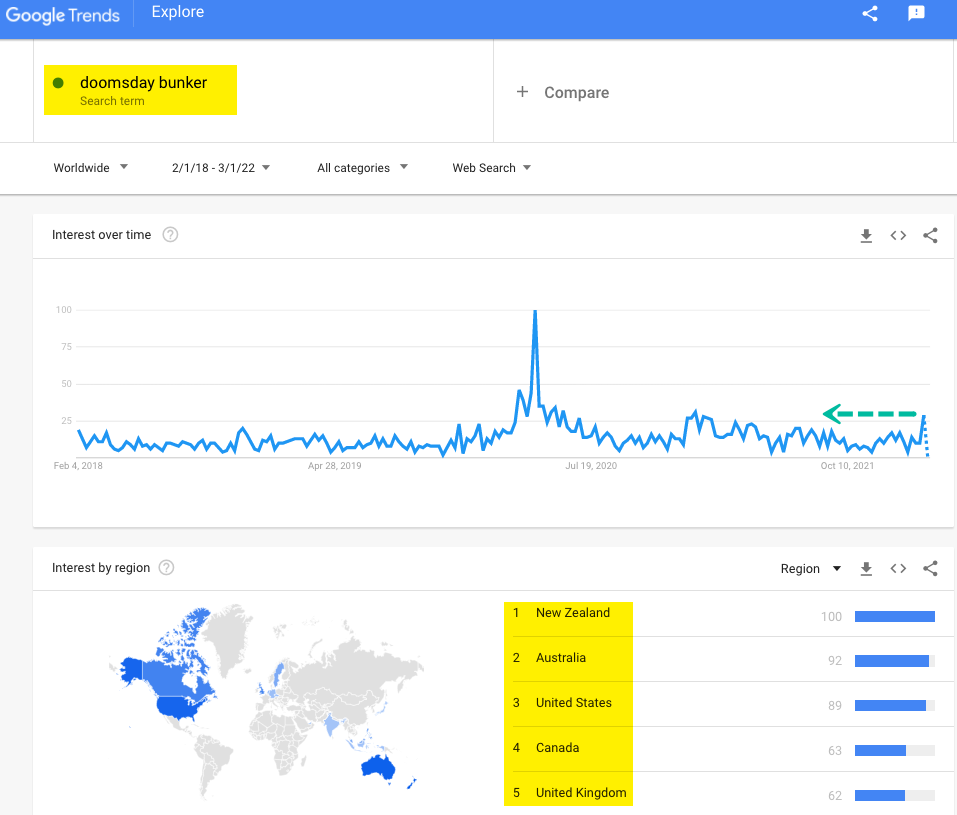
Since the invasion, people in New Zealand, Australia, the US, Canada, and United Kingdom are panic searching “doomsday bunker.” The search trend exploded to highs not seen a year at the end of last week.

Lynch said prospective buyers are calling him as they fear Russia might invade other neighboring countries and could lead to a “fully-fledged world war.”

“And they’re justified to be fearful of that,” Lynch said. “Just look at what’s going on.“[Vladimir Putin] is threatening nuclear war, saying it would be something the world has never seen.“The world has seen Hiroshima,” he continued, “and if what they are threatening is worse than that then, by all means, we should all be worried.”

We’ve seen this trend before, and people usually begin to panic hoard critical things for survival, such as food, ammo, guns, and precious metals. Doomsday bunkers are only a luxury for the rich.

Source: https://www.zerohedge.com

Foreign Volunteer Fighters Arrive In Ukraine From All Over The World

0

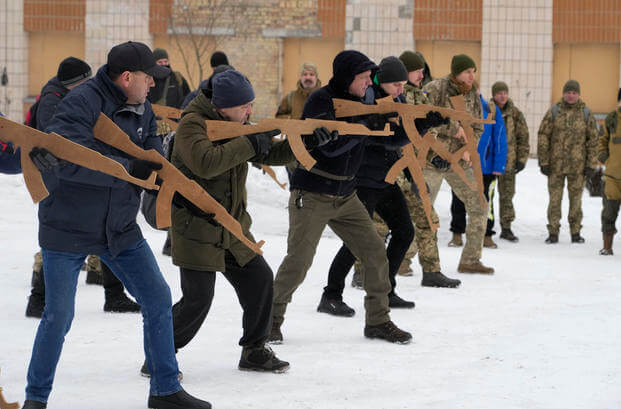
At least 16,000 foreign nationals have volunteered to join an “international legion” created to resist Russia’s invasion of Ukraine, President Volodymyr Zelensky claimed, after Kiev lifted visa requirements for anyone willing to fight. “Every friend of Ukraine who wants to join Ukraine in defending the country, please come over,” Zelensky pleaded at a recent press conference, adding “We will give you weapons.”

Though the president offered no details on the international fighting force, including the origin of the volunteers, the request comes as Kiev appears to grow more desperate for help in pushing back Russian troops – having already declared martial law and a “general mobilization” of its populace. Those policies include conscription for men aged 18-60 and the commandeering of civilian vehicles and structures, while Ukrainian convicts with military experience are being released from prison to back up the war effort.

Despite the lack of specifics from officials, however, media reports suggest that foreigners from a long list of nations are lining up to enlist.

A Call To Arms

Around 400 Swedes have signed up for the legion, according to the country’s TT News Agency, which cited the group’s coordinator Philip Brannval. The first flight departed Thursday for Poland – thought to be a logistics hub for arms and aid deliveries – and from there the volunteers will enter Ukraine by land, Brannval said.

Czech Prime Minister Petr Fiala, meanwhile, announced on Thursday that the government would not punish those seeking to join up with Ukrainian forces, as the country typically prohibits citizens from serving in foreign armies. Up to 300 Czechs have reportedly vowed to ship out. Prague, unlike non-aligned Stockholm, is among NATO’s 30 member states.

The Czech government is also now moving to criminalize speech supporting Russian President Vladimir Putin or the Russian invasion. Czech police report that they are already investigating hundreds of people for alleged support for Moscow, with criminal proceedings in nine cases.

A small handful of American, Canadian and German special forces veterans are also set to join the fightaccording to interviews by BuzzFeed News. The outlet noted the group – numbering just 10 people in total – is “NATO-trained and experienced in close combat and counterterrorism.” A pair of retired American infantry officers will also fly over to provide “leadership” for the squad, while several other US and Canadian citizens also told Reuters they intend to answer Zelensky’s call.

Canadian Foreign Minister Melanie Joly told reporters over the weekend that Ottawa would leave the decision to fight up to individual citizens. The US State Department, however, continues to urge Americans to avoid travel to Ukraine amid the hostilities.

Like Canada, the UK’s Foreign Secretary Liz Truss said she would “support” British nationals heading out for Ukraine, but added, “that is something that people can make their own decisions about.” Speaking with Insider, two UK vets said they intend to join the Georgian National Legion, which has close ties with Kiev and has clashed with Russian-speaking fighters in the breakaway Donbass region. “Since the UK parliament has said that we’ll back anyone that goes, that’s kind of like the UK government giving anyone a green light to go and help,” one veteran told Insider.

Japan, a close partner with the West, has also seen at least 70 citizens volunteer, among them 50 veterans of the country’s Self-Defense Forces and two from the French Foreign Legion. However, Ukraine’s Japanese Embassy stressed that any candidates must have military experience or, at minimum, “specialized training.” Tokyo, too, has warned against travel to Ukraine.

Having received requests from “several veterans” on how to join the international brigade, the Military Times has published a step-by-step guide for those looking to face down Russian troops. Kiev’s British Embassy, meanwhile, also offered advice, telling volunteers to fill out an online form before taking a flight to Poland, where it said they would receive additional instructions.

It remains unclear who will command the foreign force, whether they will receive training before deployment, or how long they will be expected to serve.

An unspecified number of fighters are also arriving from neighboring states such as Georgia and Belarus, the Washington Post reported. Citing a Chechen activist in Ukraine, war correspondent Elijah Magnier said “two battalions” of Chechen fighters are already on the ground in the country and prepared to resist the Russian advance. The unconfirmed report comes after Chechen leader Ramzan Kadyrov – a close ally to Putin – said he mobilized thousands of troops to fight on behalf of Moscow.

Russia, for its part, has warned of stiff consequences for any foreign nationals looking to support Ukraine, vowing to criminally prosecute any fighters captured while arguing that international rules for POWs would not apply to them.

“None of the mercenaries the West is sending to Ukraine to fight for the nationalist regime in Kiev can be considered as combatants in accordance with international humanitarian law or enjoy the status of prisoners of war,” Russian Defense Ministry spokesman Igor Konashenkov said Thursday, as cited by Tass.

Hillary Clinton issues plea to arm an insurgency in Ukraine…

The droves of foreign fighters pouring into Ukraine are reminiscent of Afghanistan in the 1980s – when countless militants from across the region lined up to battle the Red Army – and more recently Iraq, Syria and Libya. In the latter cases, those willing to travel and fight were largely ideologically motivated and often far more brutal than the local opposition forces.

In the meantime, current and former US officials, such as ex-Secretary of State Hillary Clinton, have made vocal calls to arm up a Ukrainian “insurgency” suggesting Washington and its allies send weapons and gear to “volunteers” while making a direct comparison to the Soviet invasion of Afghanistan. A deluge of weapons shipments has already begun to flow.

Study: If You Were Born Before 1996 in U.S. Your IQ Is Lowered by “Startling Amount”

0

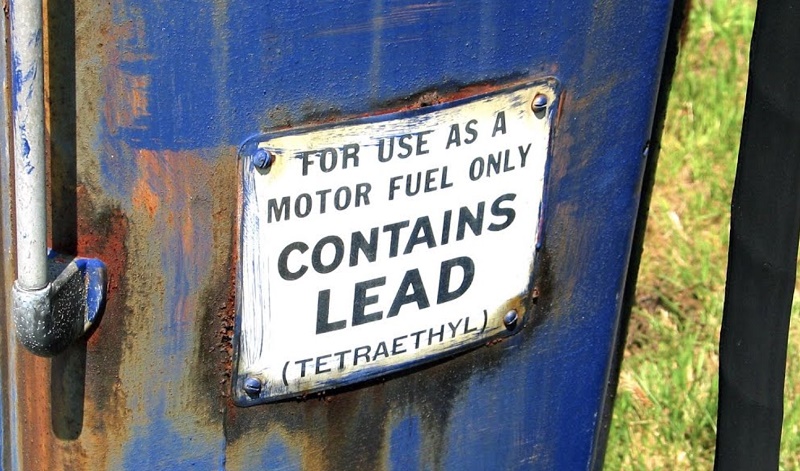
Although leaded gas was outlawed in 1996, studies believe that those who were born before that year lost several IQ points as a result of their exposure to the toxin.

According to the findings of a recent research, exposure to leaded gasoline decreased the intelligence of almost half of the population of the United States.

It was published Monday in the journal Proceedings of the National Academy of Sciences. The research, which was peer-reviewed, focused on persons who were born before 1996, the year in which the United States outlawed gas containing lead.

Exposure to high levels of lead may cause anemia, weakness, and kidney and brain damage. Very high lead exposure can cause death. Lead can cross the placental barrier, which means pregnant women who are exposed to lead also expose their unborn child. Lead can damage a developing baby’s nervous system.

Youth lead exposure, according to the findings of researchers from Florida State University and Duke University, cost the United States an estimated 824 million points, or 2.6 points per person on average throughout their childhood.

Certain groups were impacted more than others. The IQ loss for those born in the 1960s and 1970s, when leaded gas consumption was at an all-time high, was estimated to be up to 6 points, with some people losing more than 7 points. Inhaling vehicular exhaust was the main source of exposure.

The study’s authors estimated that in 2015, over 170 million Americans had blood lead levels exceeding 5 micrograms per deciliter in their early childhood.

Lead is a neurotoxic that has no safe dose. The permissible blood lead level used to be more than 3.5 micrograms per deciliter, but now there is no acceptable safe dose.

The study’s author, Michael McFarland, assistant professor of sociology at Florida State University and director of the Center for Demography and Population Health, described the study’s findings “staggering.”

“This is important because we often think about lead as an issue for children, and of course it is,” he postulates. “But what we really wanted to know is what happens to those children who were exposed?”

A 2 to 3 point IQ difference is considered insignificant in many circumstances, according to McFarland, unless the person is on the bottom end of the IQ spectrum.

“If you’re more toward cognitive impairment, a couple points can mean a lot,” he continues.

However, Sung Kyun Park, an assistant professor of epidemiology and environmental health sciences at the University of Michigan School of Public Health, believes that even a minor decrease in average IQ may have significant implications on a population-wide level. He noted that the whole bell curve moves, with a greater proportion of the population falling into what was once the very low end of IQ ratings.

Lead was formerly added to gasoline to make engines operate more smoothly, but it was eventually phased out in favor of newer, safer additives. Apart from being related with lower IQ levels, it has also been linked to heart and renal disorders.

Source: https://themindunleashed.com/2022/03/leaded-gas-iq.html