

Home Blog Page 87

The “Most Important Article You Should Read Today. Period.”

0

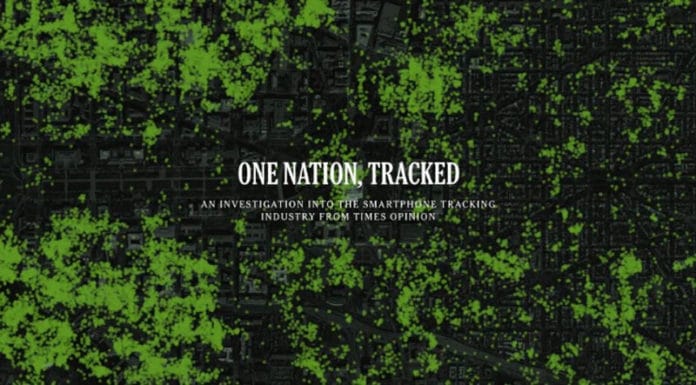
The New York Times‘ on Thursday sparked calls for congressional action by publishing the first article in its “One Nation, Tracked” series, an investigation into cellphone tracking based on a data set with over 50 billion location pings from the devices of more than 12 million people in the United States.

The data, from 2016 and 2017, “was provided to Times Opinion by sources who asked to remain anonymous because they were not authorized to share it and could face severe penalties for doing so,” explained reporters Stuart A. Thompson and Charlie Warzel. “The sources of the information said they had grown alarmed about how it might be abused and urgently wanted to inform the public and lawmakers.”

Readers and fellow journalists quickly turned to social media to draw attention to the reporting. Laura Rosenberger, director of the Alliance for Securing Democracy, tweeted: “This is the most important article you should read today. Period.”

Aaron Zitner of the Wall Street Journal concurred, writing on Twitter: “This is surely the most consequential piece of journalism published today, and its presentation is the highest form of storytelling. Think of what an authoritarian state is already doing with this technology.”

The new report—the first of seven pieces set to be published this week by the Times Opinion Section’s “Privacy Project“—features visualizations of the data from Central Park, Grand Central Terminal, and the New York Stock Exchange in New York City; Beverly Hills; downtown San Francisco; Mar-a-Lago, President Donald Trump’s resort in Florida; the White House; and the Pentagon.

“The data reviewed by Times Opinion didn’t come from a telecom or giant tech company, nor did it come from a governmental surveillance operation. It originated from a location data company, one of dozens quietly collecting precise movements using software slipped onto mobile phone apps,” explained Thompson and Warzel.

The reporters added that “you’ve probably never heard of most of the companies—and yet to anyone who has access to this data, your life is an open book. They can see the places you go every moment of the day, whom you meet with or spend the night with, where you pray, whether you visit a methadone clinic, a psychiatrist’s office or a massage parlor.”

But Thompson and Warzel weren’t just “shaken” by what they found when delving into what data location companies can see—they also highlighted that this behavior is only governed by the companies’ internal policies and the moral compasses of employees. As the article detailed: “Today, it’s perfectly legal to collect and sell all this information. In the United States, as in most of the world, no federal law limits what has become a vast and lucrative trade in human tracking.”

The reporters described the data collected from smartphones as “a diary of your every movement.”

The companies that collect all this information on your movements justify their business on the basis of three claims: People consent to be tracked, the data is anonymous, and the data is secure.

None of those claims hold up, based on the file we’ve obtained and our review of company practices.

Yes, the location data contains billions of data points with no identifiable information like names or email addresses. But it’s child’s play to connect real names to the dots that appear on the maps.

To demonstrate how easy it is to figure out who someone is based on their smartphone data, Thompson and Warzel included some examples.

“We spotted a senior official at the Department of Defense walking through the Women’s March, beginning on the National Mall and moving past the Smithsonian National Museum of American History that afternoon,” they reported. “His wife was also on the mall that day, something we discovered after tracking him to his home in Virginia. Her phone was also beaming out location data, along with the phones of several neighbors.”

“The official’s data trail also led to a high school, homes of friends, a visit to Joint Base Andrews, workdays spent in the Pentagon and a ceremony at Joint Base Myer-Henderson Hall with President Barack Obama in 2017 (nearly a dozen more phones were tracked there, too),” the piece continued. The reporters even spoke with some of the individuals they were able to identify, such as Ben Broili, a manager for the drone delivery service Amazon Prime Air, and Mary Millben, a Virginia-based singer who has performed for three presidents.

“To know that you have a list of places I have been, and my phone is connected to that, that’s scary,” Millben told the Times. “What’s the business of a company benefiting off of knowing where I am? That seems a little dangerous to me.”

The ACLU responded to the Times report with a call to action directed at Congress, tweeting: “This investigation exposes the disastrous implications of living in a society where companies are allowed to turn our cell phones into always-on tracking devices with zero legal limitations or oversight. Action from lawmakers is already years overdue.”

“We need strong laws that prevent apps from collecting unnecessary but sensitive location data and feeding it into surveillance databases,” the group added. “Laws should also provide transparency into how companies are using and selling data, and allow individuals to sue privacy-violating companies.”

There have been some sweeping digital privacy proposals introduced in Congress recently, but in the absence of any established nationwide rules, “states are starting to respond with their own laws,” the Times reported. “The California Consumer Protection Act goes into effect next year and adds new protections for residents there, like allowing them to ask companies to delete their data or prevent its sale. But aside from a few new requirements, the law could leave the industry largely unencumbered.”

Although the Times article was widely lauded for contributing to national awareness about issues and debates related to personal data in the digital era, it also was met with some criticism from privacy rights experts and advocates.

In a lengthy Twitter thread, Lindsey Barrett, a staff attorney and teaching fellow at Georgetown University Law Center’s Institute for Public Representation, called the report “revealing and important” while also criticizing it for framing “surreptitious and functionally unavoidable surveillance as an individual failing rather than the intentional project of corporations and their enablers.”

“Framing is everything,” Barrett added. “Relying on the premise of ‘people choose to be tracked so our project has to be talking them out of it, not arguing that the surveillers need more accountability’ gives tech lobbyists who make those self-serving arguments credibility they don’t deserve.”


By Jessica Corbett | CommonDreams.org | Creative Commons

BREAKING: Missing Surveillance Footage of Epstein’s First Alleged Suicide Attempt Has Been Found

0

Just yesterday the Mind Unleashed and others reported that surveillance footage from Jeffrey Epstein’s “first suicide attempt” at the Metropolitan Correctional Center in New York City on July 23 had gone missing, according to Bruce Barket, the attorney representing the convicted pedophile’s cellmate at the time.

The New York Daily News is now reporting that the footage has been found.

Despite Assistant U.S. Attorney Jason Swergold admitting in a court hearing on Wednesday that the footage cannot be found, Swergold wrote that the “video was preserved” in a letter to Judge Kenneth Karas.

“Earlier today, the government confirmed with MCC staff that the video was preserved by MCC staff upon defense counsel’s request,” Swergold wrote in the letter than gave no explanation for the major mix-up.

Of the “found” footage, Barket said:

“We look forward to seeing it.”

***

On July 23, convicted sex offender Jeffrey Epstein was reportedly found injured on the floor of his cell at the Metropolitan Correctional Center in Manhattan in what has frequently been referred to as a suicide attempt.

But now, the only evidence that may shine a light onto what exactly happened that day in July has reportedly gone missing.

Rumors began swirling both on and off the internet almost immediately following the incident. Most of the discussion and many theories surrounding the incident focused on Epstein’s cellmate, Nicholas Tartaglione.

As previously reported by the Mind Unleashed, Epstein was found “semi-conscious with marks on his neck and in the fetal position on the floor of his cell.” Tartaglione, a former Orange County police officer who killed four men and buried their bodies in his yard, was questioned following the incident. His attorney, Bruce Barket, maintained that his client and Epstein got along well together.

Following the incident, Epstein was treated for neck injuries and allegedly placed on suicide watch—one of many details discussed in-depth following Epstein’s death only weeks later—but the July 23 incident has been largely overshadowed by the pedophile’s August 10 death at the Metropolitan Correctional Center (MCC). Hope for more information about the “first suicide attempt” was mostly lost.

While it has been widely reported that footage does not exist from the August day on which Epstein did die—with reports initially indicating that there were no cameras pointed at the cell and later reports indicating that the FBI was examining two cameras outside of Epstein’s cell that “malfunctioned” that night—talk of footage or any evidence at all from the July 23 incident has been virtually nonexistent—until now.

According to the New York Post, surveillance footage of the July 23 incident does exist but officials admitted on Wednesday that is has “mysteriously gone missing.” Assistant U.S. Attorney Jason Swergold admitted in a court hearing that the footage cannot be found.

Barket requested that the footage be preserved but learned of its disappearance on Wednesday.

“I don’t know the details of how it was lost or destroyed or why it wasn’t retained when it should have been,” Barket said.

Barket went on to explain:

“We want to be sure that all the evidence is preserved to show that Nick behaved appropriately and even admirably that evening.

We asked for all the video and photographic evidence to be preserved, specifically this surveillance video. Now it’s gone.”

While Tartaglione’s attorney maintains that the former cop who is facing the death penalty actually tried to help the convicted pedophile and alert the guards during the July 23 incident, Epstein told his lawyer’s that Tartaglione attacked him in their cell.

Spencer Kuvin, an attorney for three of Epstein’s alleged victims, told the Sun in July “there may be some powerful people who just don’t want him to talk,” suggesting that there may have been a hit out on the billionaire.

By Emma Fiala | Creative Commons | TheMindUnleashed.com

US Government Lists Fictional “Wakanda” as Trade Partner on Official USDA Website

0

According to USDA Spokesperson, Mike Illenberg, the agency was intentionally using fake names to test the function of their website, but forgot to remove Wakanda after the testing was completed.

Over the past few weeks, the Foreign Agricultural Service staff who maintain the Tariff Tracker have been using test files to ensure that the system is running properly. The Wakanda information should have been removed after testing and has now been taken down,” Illenberg said.

The mistake was first noticed by Jain Family institute fellow Francis Tseng, who was browsing the agency’s website on Wednesday morning to research how trade deal tariffs can affect food distribution.

That’s when he saw Wakanda listed on the site, thought it had apparently been there as far back as June 10, according to NBC News.

If the Wakanda listing was on the site for several months without having been noticed, it can be assumed that the system must not be getting much use.

I definitely did a double take. I Googled Wakanda to make sure it was actually fiction, and I wasn’t misremembering. I mean, I couldn’t believe it,” Tseng said.

“I was trying to figure out whether this is someone at the USDA making a joke or if it’s a developer who accidentally left it in,” he added.

There was also data associated with the fictional listing, which included commodity listings like a price of 0.5 cent/kg for yellow potatoes.

By John Vibes | Creative Commons | TheMindUnleashed.com

BREAKING: Pope Francis Lifts Rule That Protected Catholic Church Pedophiles & Silenced Victims

0

In a move that is being greeted as long overdue, Pope Francis has stricken down Vatican secrecy rules in cases of sexual abuse that had previously been shielded by the Catholic Church’s highest levels of confidentiality.

The church had previously defended the rule known as “pontifical secrecy” on the grounds that it protected the privacy of victims and reputations of the accused, but critics claimed that the rule protected clergy accused of sexual misconduct and abuse. The new policy will also allow victims to see the previously top-secret information about their cases, and will give them a degree of freedom to speak about their experiences.

Critics had accused the church of using pontifical secrecy to protect pedophiles, silence victims, and prevent scrutiny from law enforcement bodies.

The rule also covered a range of administrative subjects within the Vatican including the nomination of cardinals and various types of internal investigations. Violations of pontifical secrecy can result in excommunication, reports CNN.

In February, the secrecy rule came under fire at a historic Vatican summit focusing on ongoing efforts to combat sexual abuse by clergy. Church leaders had accused certain officials of hiding behind what they saw as outdated rules that shielded the highest levels of Vatican officialdom from transparency.

In a church decree approved by Francis and signed by Cardinal Secretary of State Pietro Parolin, the new policy read:

“The person who files the report, the person who alleges to have been harmed and the witnesses shall not be bound by any obligation of silence with regard to matters involving the case.” 

The special declaration by the pope, known as a rescript, comes into force immediately.

In a second rescript, Francis also banned the possession or distribution of “pornographic images of minors under the age of eighteen, for purposes of sexual gratification.” The previous Vatican age limit considered children to be only those under 14.

Joshua McElwee, the Vatican correspondent of the National Catholic Reportertold NPR’s Morning Edition:

“It’s something the abuse survivors and advocates have called for for decades. Vatican officials I have spoken to have said this was a move to show that they’re serious about this. They want the church officials across the world to be working with local authorities. In order to do that, they had to get rid of the secrecy requirement.

And they’re also hoping that it allows abuse survivors who come forward with cases to more easily follow how the church is responding and what measures are being taken to make sure kids are safe.”

However, representatives of abuse victims believe that while the pope’s belated move is welcome, further transparency is required.

Mattias Katsch, an abuse survivor and founder of Ending Clergy Abuse, told CNN:

“For a long time, representatives of victims/survivors from all over the world have demanded that papal secrecy be lifted in cases of sexual abuse of children by priests.

At the end of February at the Vatican, on the fringes of the crisis summit on abuse, the international alliance of survivors and activists Ending Clergy Abuse made this demand. The decision of the Vatican is therefore an overdue step.

Now it is important that further steps are taken towards transparency—also with regard to the thousands of acts of abuse cases stored in Vatican chambers and palaces. These files must be made available for independent review and investigation.”

Boston, Massachusetts, attorney Mitchell Garabedian, who has represented hundreds of abuse survivors, greeted what she called a “small step” toward transparency. He told NPR:

“It is also now time for Pope Francis to mandate that crimes be reported to the police by bishops, religious superiors and others and to make documents and testimony public with the appropriate redactions of victims’ names.”

By Elias Marat | Creative Commons | TheMindUnleashed.com

World’s First “Magic Mushroom” Microdosing Nasal Spray Announced

0

Pharmaceutical companies and other private entities have been making significant investments into psychedelic therapies, especially psilocybin, the active ingredient in many of the most popular “magic mushrooms.”

Psilocybin was first designated as a “breakthrough therapy” by the FDA last year.

And now, one company has an interesting psilocybin-based medicine for depression that they hope will soon be on the market. Silo Wellness‘ new product is a psilocybin nasal spray intended to be used for microdosing. The company says that consuming the substance as a nasal spray will help with some of the side effects typically associated with psilocybin, including nausea.

Silo Wellness CEO, Mike Arnold, said that the nasal spray allows for a more precise dose as well. In a press release Arnold explained:

“We need to be able to give patients predictable dosing so they can self-titrate into the desired levels of sub-psychedelic or psychedelic treatment. We solved the age-old problem with plant- and fungus-based medicine: How do you know how much is a dose? How do you avoid taking too much, like the cannabis edibles dilemma? We also managed to solve one of the common complaints of some mushroom users: taste and upset stomach.”

Despite the FDA’s “breakthrough” designation, the mushrooms that contain psilocybin are still federally illegal in the United States, although some jurisdictions—like Denver—have moved to decriminalize the substance. As a result of the legal status of psilocybin in the U.S., Silo Wellness was forced to develop its nasal spray in Jamaica.

“I love our product and can’t wait until it’s legal in the United States, so we can share it with crime victims and first responders,” Arnold said.

Silo Wellness co-inventor and pharmaceutical product developer, Michael Hartman, hinted that the product will be ready for the consumer market very soon.

“This isn’t a ‘plan’ to develop a product or a ‘plan’ to open a facility. We have real proof of concept and continued research and development underway—not just an idea,” Hartman said.

According to the company’s recent press release, they filed for a provisional patent application in July of this year. The patent is said to be filed under, “Metered dosing formulations of plant and fungal compounds for oral, nasal, sublingual, and topical use.”

Both Arnold and Hartman have previously worked in the legal cannabis industry. Arnold was a lawyer for the cannabis industry, while Hartman was the inventor of a cannabis inhaler called Mystabis.

“I never thought I would exit cannabis and pivot full time into psychedelics, but they changed my life. I want to share this medicine with the world by making it affordable and comfortable for all. National media didn’t care about psychedelics until Denver passed their decriminalization ballot measure. Before that, everyone thought I was crazy when I told them that we were entering the medicinal psychedelics space in advance of Oregon legalizing in 2020,” Arnold recalled.

Earlier this year, the FDA approved a ketamine-based nasal spray, also for the treatment of depression.

By John Vibes | Creative Commons | TheMindUnleashed.com