
Home Blog Page 36

Russian Army Weakened & Decimated – Putin Puts ‘Nuclear Forces On High Alert’

0

With the Russian army’s advance on Ukraine’s capital stalled by strong Ukrainian resistance, Russian President Vladimir Putin has put his country’s nuclear forces on alert amid tensions. He made the announcement Sunday during a meeting with his top advisers that was also televised.

In Ukraine, the Russian advance on population centers and the capital, Kiev, continues. Skirmishes are reported from various parts of the country.

Both Ukraine and the U.S. report problems of Russian invading forces. The Ukrainian General Staff claims the pace of the Russian attack has slowed. The enemy is having supply problems, soldiers are exhausted, and the force is decimated. There have been military successes east of Kiev. Russian tanks were destroyed in Priluki.
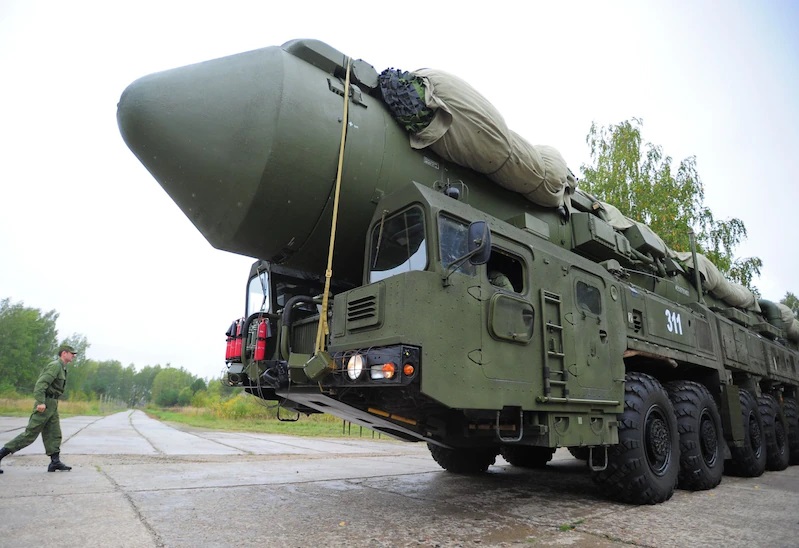
Russlands neue nukleare Interkontinentalrakete kann ein ganzes Land binnen weniger Minuten zerstören.

So far, it is estimated that about 4300 soldiers have been killed, Ukrainian Deputy Defense Minister Hanna Maljar wrote on Facebook. Dozens of planes and helicopters, hundreds of tanks and military vehicles are said to have been destroyed. These figures cannot be independently verified. The numbers seem very high and could be spread to boost the fighting morale of the own army.

According to U.S. data, there is “low-intensity” fighting in Kiev. Russian troops are still about 30 kilometers from the city center, he said. According to the report, the units were also suffering from a lack of fuel, among other things.

Fighting northwest of Kiev
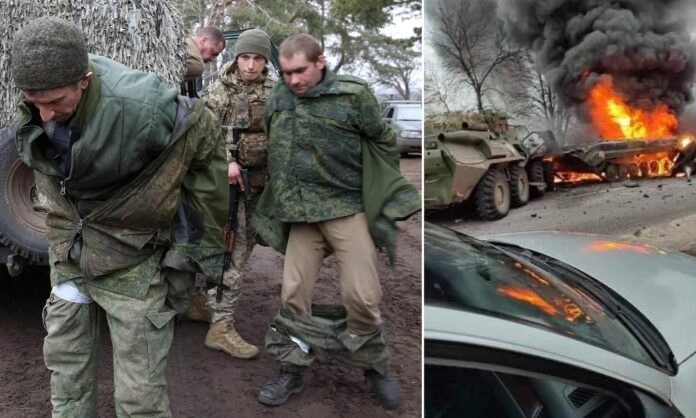
At noon, it was reported that the Ukrainian army had retaken the town of Irpin, northwest of Kyiv. The Unian agency published videos purporting to show fallen Russian soldiers. In addition, armored vehicles belonging to the Russians were reportedly destroyed near Hostomel airfield, which has been contested for days.

To protect the capital, more soldiers are being massed there, according to Ukrainian sources. The main concern is to repel the Russian attack in the north and northwest of the capital, according to Deputy Defense Minister Maljar. It is unclear where the troops are coming from.

Russian missiles hit Ukraine
In the afternoon, “Iskander” short-range missiles were reportedly fired at Ukraine from neighboring Belarus. According to Ukrainian sources, at least one projectile struck at or near the airport in the city of Zhytomyr, west of Kiev.

According to U.S. data, Russian forces have fired more than 300 missiles at targets in Ukraine since Thursday morning. Ukraine has very limited defenses against this type of weapon.

“Kharkiv is under our control”
Skirmishes were also reported from Kharkiv in the east of the country. A Russian attack on the country’s second largest city was reportedly repelled. “Kharkiv is completely under our control,” the governor of the eponymous region, Oleg Sinegubov, said on the Telegram messenger service.

Videos and photos were published on social networks purporting to show a Russian column of armored vehicles. Later, photos circulated of identical vehicles that were apparently damaged or destroyed. These bear Russian nationality insignia. Soldiers are not visible on them.
Russia reports soldiers killed in action
For the first time, the Russian Defense Ministry acknowledged losses in the offensive, which it still downplayed by calling it a “special operation.” It said there had been deaths and injuries, and that “a few” Russian soldiers had also been captured. Exact figures were not given.

At the same time, military successes were reported. More than 1000 military targets – aircraft, tanks and other combat vehicles – had already been destroyed. 471 Ukrainian soldiers had been captured, Ukrainians had “refused to fight en masse”.

Separatists on the advance?
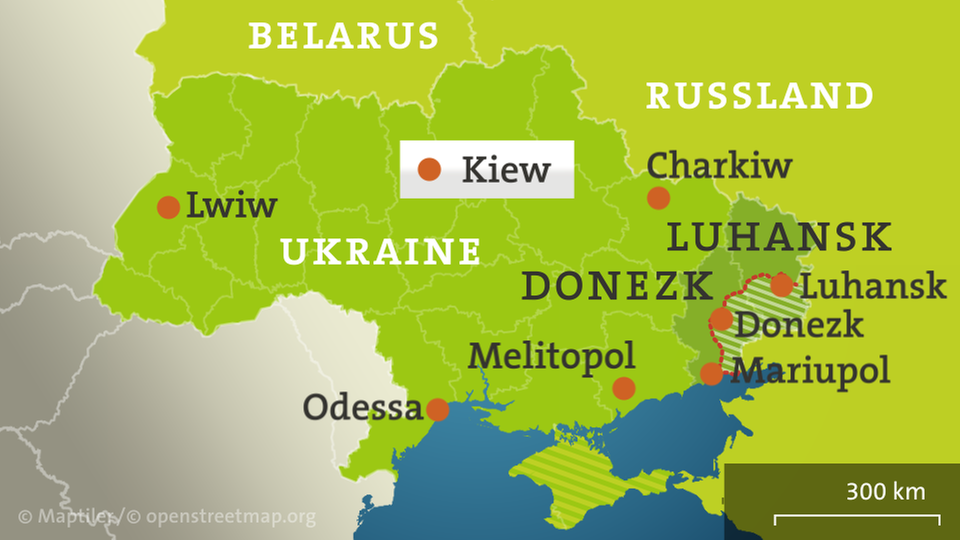
The southern Ukrainian cities of Kherson and Berdyansk were surrounded by Russian troops. In the Donbass, Russian-backed separatists had continued their advance.

The Russian advance in the south of the country barely features in Ukrainian reports. Apparently, units there are advancing inland from Crimea. If they successfully march north, they could eventually cut off supplies to the numerous Ukrainian forces on the “line of contact” with the pro-Russian separatist areas in the Donbass.

Separatists stand next to a battle tank in the Luhansk region. Image: REUTERS

Weitere Waffenlieferungen an die Ukraine

Unterdessen trafen weitere militärische Güter aus NATO-Staaten in der Ukraine ein. Dies umfasst unter anderem Tausende Panzerabwehrwaffen, Hunderte Luftabwehrraketen und Tausende Kleinwaffen; außerdem werden Munition, Schutzausrüstung und humanitäre Hilfe geliefert. Hilfe haben unter anderem Belgien, Schweden, Kanada, Tschechien, Estland, Frankreich, Griechenland, Lettland, Litauen, die Niederlande, Portugal, Rumänien, die Slowakei, Slowenien, das Vereinigte Königreich und die Vereinigten Staaten angekündigt.

Gestern hatte auch Deutschland – das lange Waffenlieferungen in Konfliktgebiete abgelehnt hatte – militärische Hilfe für die Ukraine angekündigt. Unter anderem sollen 1000 “Panzerfaust 3” sowie 500 “Stinger”-Boden-Luft-Raketen an die Ukraine gehen.

NATO-Staaten halten solche tragbaren Waffen für eine besonders wichtige Unterstützung für die ukrainische Armee. Durch die russische Luftüberlegenheit sind größere Waffensysteme gefährdeter, wie die ersten russischen Angriffe gezeigt haben.

Kleinere Trupps von Soldaten mit Panzerabwehrwaffen können russische Fahrzeugkolonnen aus dem überraschend angreifen oder in Städten leichter in Hinterhalte locken. Videos in sozialen Netzwerken zeigen die Effektivität dieser Taktiken.

Tragbare “Stinger”-Raketen können gegen Hubschrauber oder tief fliegende Jets eingesetzt werden, auch wenn die Reichweite gering ist. Die Bedienung der Waffe ist vergleichsweise leicht zu erlernen.
Russian Troops Capture Chernobyl After Fierce Combat & Hold Staff Hostage

0

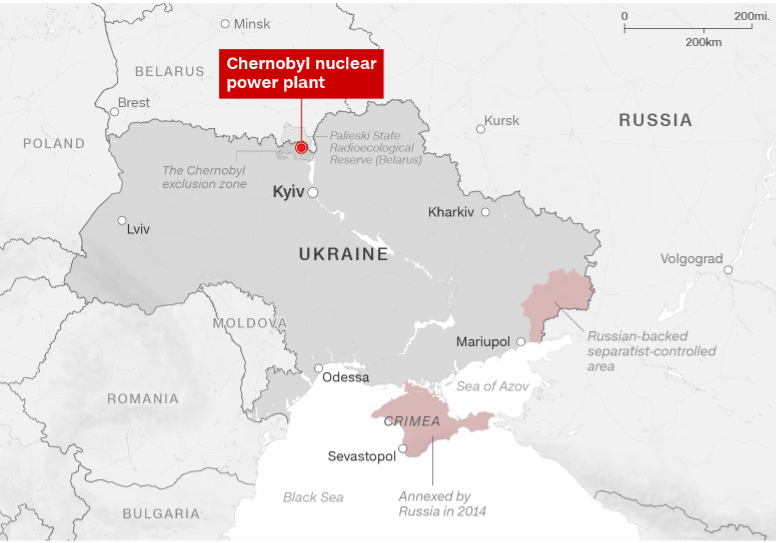
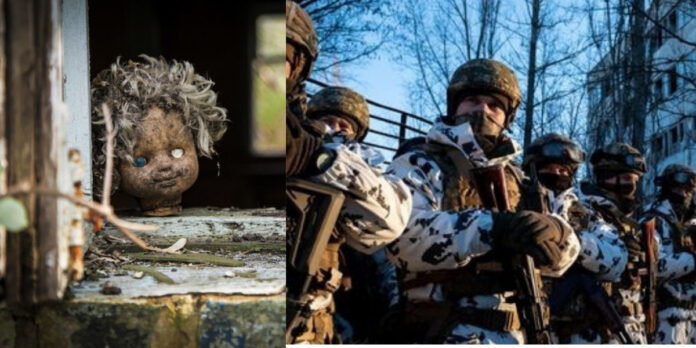
Cities all over the country are attacked and bombed, Russian tanks are on Ukrainian soil. Putin’s soldiers are trying to capture the Chernobyl nuclear power plant and the nuclear waste storage facility there on his behalf and are holding staff hostage, according to Ukrainian officials.

Alyona Shevtsova, advisor to the commander of Ukraine’s Ground Forces, said on Facebook that Russian forces have taken control of the power station and that the staff are being “held hostage.”
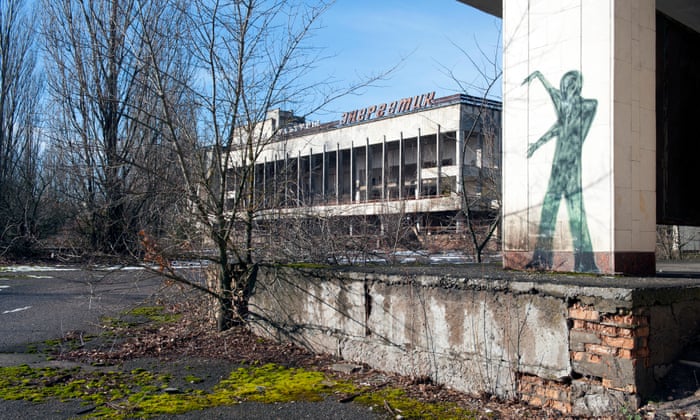
Prypyat, Chernobyl, today.
According to Mykhailo Podolyak, a Ukrainian presidential adviser, control of the Chornobyl zone was lost after a “fierce battle.”

Ukrainian President Volodymyr Selenskyj stated:

“Russian occupation forces are trying to capture the Chernobyl nuclear power plant,” Selenskyj tweeted. “Our defenders are giving their lives to ensure that the 1986 tragedy is not repeated.”

A deserted house in Chernobyl.

Earlier in the evening, the news said, “Russia has taken control of the former Chernobyl nuclear power plant!

Ukrainian Prime Minister Denys Shmyhal said Russia controls the so-called exclusion zone and all facilities of the nuclear ruin.

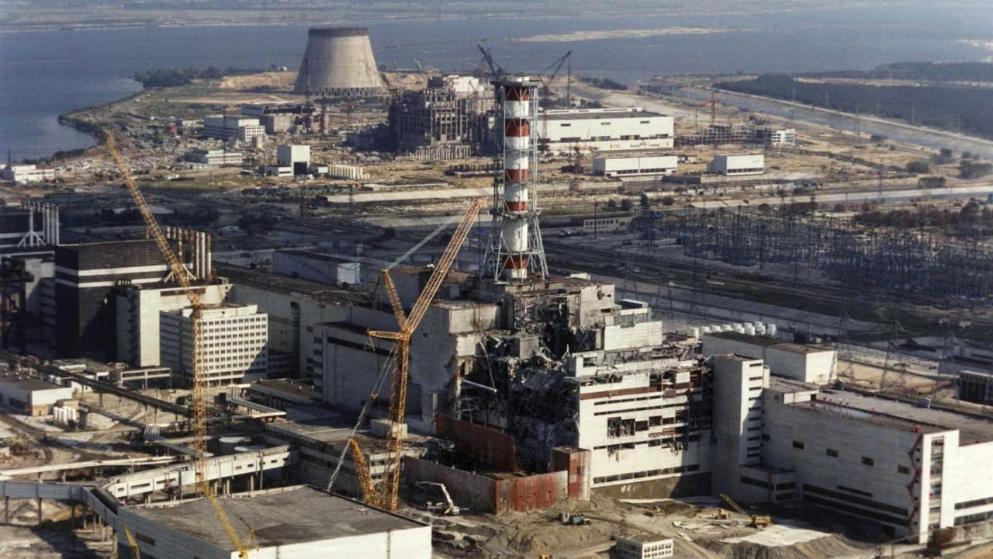
This is how the nuclear power plant looked after the reactor disaster in 1986

Soldiers from Belarus invaded the Chernobyl zone on behalf of Russia. The Ukrainian National Guard, which guards the storage of unsafe radioactive waste, is putting up fierce resistance.

The White House on Thursday said it was outraged over “credible reports” that Russian soldiers are holding staff of the Chernobyl facilities hostage.
“This unlawful and dangerous hostage taking, which could upend the routine civil service efforts required to maintain and protect the nuclear waste facilities, is obviously incredibly alarming and greatly concerning,” White House press secretary Jen Psaki told reporters in a Thursday evening briefing.

The great danger: if as a result of the artillery strikes of the occupiers the nuclear waste repository is destroyed, radioactive dust may cover the territories of Ukraine, Belarus and the EU.

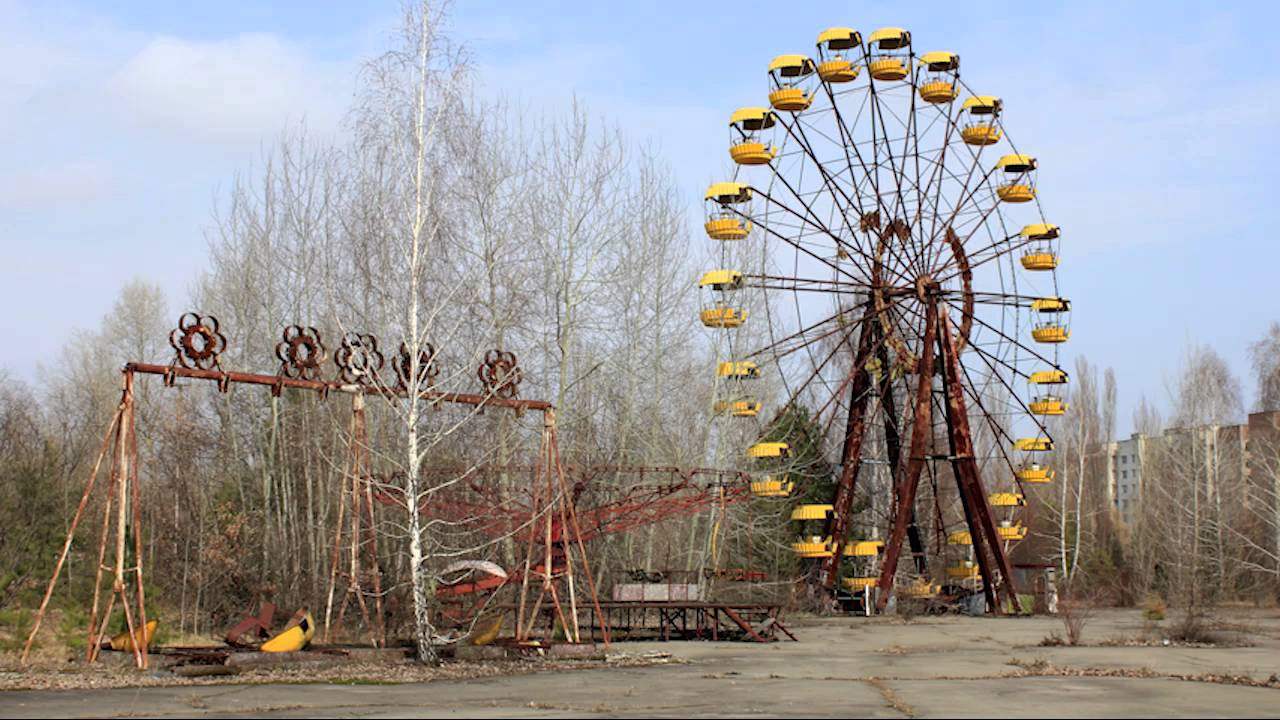
A playground in Chernobyl today.

The Chernobyl accident on April 26, 1986 is considered the greatest disaster in the civilian use of nuclear power. Hundreds of thousands were forcibly relocated. At that time, Ukraine was still part of the Soviet Union. Last summer, a new interim nuclear waste storage facility was inaugurated in the radioactively contaminated exclusion zone around Chernobyl. The Ukrainian capital Kiev is just 70 kilometers away.

Anonymous Declares Cyberwar Against Russia: Takes Down News & Government Websites

0

ANONYMOUS IS BACK.

Hacker collective Anonymous has disabled several Russian government websites including the state-controlled Russia Today news service.

The collective then said it had disabled several websites of Russian government, the Kremlin, the Duma, and the Ministry of Defence.

It also claimed to have taken down the website of Kremlin-backed TV channel Russia today, which broadcasts in Britain.

Earlier this week the news network was described by Labour leader Sir Keir Starmer as Putin’s ‘personal propaganda tool’.

When Anonhq.com (Anonymous main news website) attempted to access the site this morning, it said it was inaccessible and displayed an error message saying ‘this site can’t be reached’.

RT.com confirmed the attack and said it had slowed some websites down and took others offline for ‘extended periods of time’.

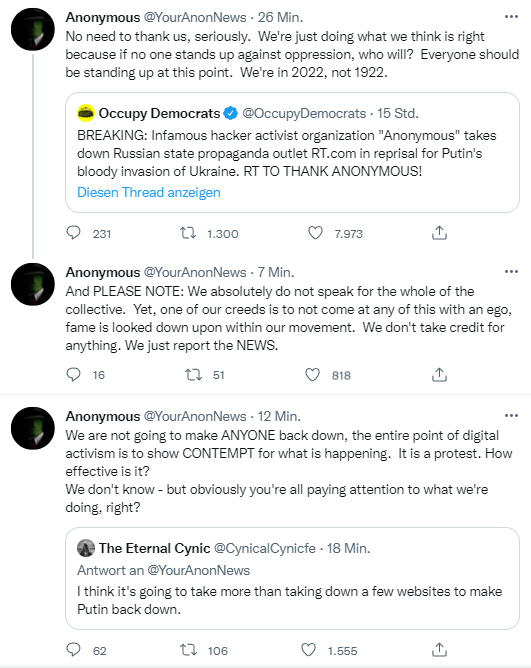
A message on a Twitter account claiming to represent Anonymous said: ‘The Anonymous collective is officially in cyber war against the Russian government.’

Just over 40 minutes later, the group said it had ‘taken down the website of the #Russian propaganda station RT News’.

It added: ‘We read your messages, thank you for supporting Ukraine. Let’s be united!’

The group is thought to have used a relatively simple method known as a distributed denial-of-service (DDos) attack.

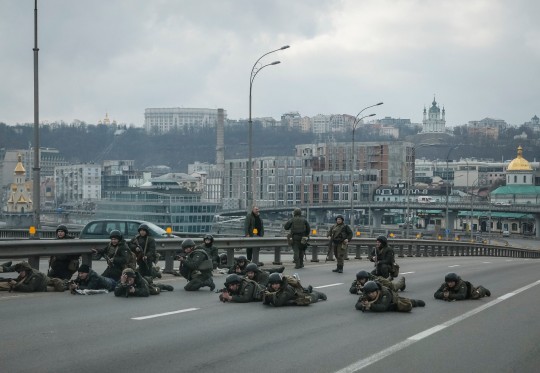
Ukrainian National Guard servicemen take positions in central Kyiv as Russian forces approach (Picture: Reuters)

This involves overwhelming a website with a flood of traffic until it can no longer cope.

Anonymous is a decentralised hacktivist group with no hierarchy or leadership. Their main aim it to target establishment hypocrisy and corruption.

It has become involved with a wide range of global issues in the past, having previously launched attacks on the CIA, the Church of Scientology, ISIS.

The group carried out DDos attacks on Visa, Mastercard and Paypal for cutting their services to Wikileaks.


It also claimed responsibility for an attack on the Minneapolis Police Department following the death of George Floyd.

In a video posted on February 15, Anonymous threatened to take Russia’s industrial systems ‘hostage’ if the Ukraine crisis carried on.

Officials on both sides of the Atlantic have warned of the possibility of Kremlin-backed cyber attacks stretching beyond Ukraine in light of the current crisis.

Former British diplomat and cyber-security expert Danny Lopez told Metro.co.uk how many UK firms are still unprepared for the damage that could be inflicted on them.As Russian forces inched closer to Kyiv, the Ukrainian government asked volunteers from the country’s underground hacker scene to help protect critical infrastructure and to spy against Russia.

‘Ukrainian cybercommunity! It’s time to get involved in the cyber defense of our country,’ a post shared yesterday on hacker forums read.

It asked people to submit an application via Google docs, listing their specialties, such as malware development, and professional references.

Yegor Aushev, co-founder of a cybersecurity company in Kyiv, said he wrote the post at the request of a senior Defence Ministry official who contacted him yesterday.

Another person directly involved in the recruitment drive said the request came from the department.

A defence attache at Ukraine’s embassy in Washington said he ‘cannot confirm or deny information from Telegram (messaging app) channels’ and declined to comment further.

In Talk Show: Trump Calls Putin’s Actions in Ukraine “Genius, Wonderful”

0

Former U.S. President Trump is clearly taken with Russian President Putin’s actions in the Ukraine crisis. Trump called Putin’s latest decisions “ingenious”.

Former U.S. President Donald Trump has called Russian President Vladimir Putin’s actions in the Ukraine crisis “genius” and “smart.” Trump said Tuesday on a conservative radio talk show, referring to Putin’s recent decisions, “It’s genius.” He said the Kremlin leader is declaring a large part of Ukraine independent and sending “peacekeepers” there. “How smart is that?”

Trump: “That would never have happened with us”

Referring to Putin, Trump went on to say, “This is a man who is very smart. I know him very well.” At the same time, the Republican claimed that it would not have happened with him as president: “It never would have happened with us.” With him in office, it would have been unthinkable, Trump said. He accused his successor in office, Joe Biden, of failing to deal with Russia.

White House spokeswoman Jen Psaki said Tuesday evening (local time) when asked about the Trump comment:

We generally try not to take advice from anyone who praises President Putin and his military strategy.

Jen Psaki, White House spokeswoman

Putin had recognized the independence of the separatist regions of Donetsk and Luhansk in eastern Ukraine on Monday. The Kremlin leader ordered a deployment of Russian soldiers. This is the second time after 2014 that he plans to invade Ukraine. The West accuses him of violating international law.

Trump criticizes Biden’s course in Ukraine crisis
Trump had previously criticized Biden’s course in the Ukraine crisis, claiming that had he been president, tensions with Russia would never have escalated to such an extent: No one had ever been tougher on Russia, he said, and Putin and he had respected each other.

Critics, on the other hand, had accused Trump of handling the Kremlin chief with kid gloves during his time in office. According to U.S. investigators, the Russian government interfered “extensively and systematically” in the 2016 U.S. presidential election, which Trump won.

German Governments Wants To Ban Bitcoin In Europe

0

A final draft of the EU Parliament provides for a ban on proof-of-work-based cryptocurrency services. The SPD, the Greens and the Left would have pushed through the position in the negotiations.

Cramming crypto regulation. The European Parliament wants to prohibit the provision of crypto services based on “environmentally unsustainable consensus mechanisms” in its MiCA guidelines. This is according to a final compromise proposal of the responsible Committee on Economic and Monetary Affairs (ECON), which is available to BTC-ECHO. De facto, this could mean the end for proof-of-work-based cryptocurrencies like Bitcoin from January 1, 2025 in the European Union. The final decision on the draft is to be made in Parliament on February 28.

Stefan Berger told BTC-ECHO that he believes it is “very likely” that the proposal will go through. As Chairman of the ECON Committee, he is largely responsible for the design of the MiCA Directive on the regulation of cryptocurrencies in the European Parliament. The advance of the Bitcoin ban had been vigorously demanded by the SPD, the Greens and the Left, said the CDU politician in conversation with BTC-ECHO.

The Christian Democrat, right-wing conservative and liberal groups had vehemently opposed the inclusion of the ban in the negotiations. Ultimately, the Social Democrats, Greens and Left threatened to otherwise withhold their consent to the MiCA draft, according to reports. Previously, SPD politician Joachim Schuster had already publicly called for a bitcoin ban. Green Party European politician Sven Giegold also spoke out in favor of illegalization to BTC-ECHO.

The vote next Monday will be followed by a trilogue between the EU Commission, the Parliament and the member states, at the end of which the Commission will be tasked with evaluating the Parliament’s proposal. The decision on this should be expected before the end of this year. In the October 2020 draft, the Commission opposed a bitcoin ban.

Bitcoin clause is “fatal”
German Finance Minister Christian Lindner did not want to comment on the impending bitcoin ban to BTC-ECHO. Frank Schäffler (FDP), member of the Budget Committee of the Bundestag, considers the new proposal of the EU Parliament “fatal”. He already called for changes to the MiCA guidelines last year.

I assume and also expect that the German government and the lead finance minister Christian Lindner will prevent this.

Robert Kopic of the industry association Blockchain for Europe also sees the potential for the clause to “put Europe at a disadvantage.”

This is a point that would put Europe, along with its green miners, at a disadvantage and would solely lead to them migrating abroad and Europe losing geopolitical access to Bitcoin.

The economic disadvantages of a Bitcoin ban are therefore obvious. A fact that the EU Commission will also take into account in its MiCA assessment, says Stefan Berger. What the final decision will ultimately look like is uncertain at this point.