Several Russian television channels have been hacked and had their programming substituted with coverage of the war in Ukraine by independent broadcasters Current Time and Dozhd TV, outlets blocked in Russia by the authorities.
Twitter accounts historically associated with Anonymous, the amorphous online activist community that first grabbed global attention about a decade ago, claimed it was behind the hacker attack.
Among the television channels impacted were Russian streaming services Wink and Ivi, a service similar to Netflix, and live broadcasts at the TV channels Rossia-24, Channel One, and Moscow 24, the hackers’ group said on Twitter.
“We are involved in the biggest Anonymous op ever seen. That being said, we are worried that some governments will indeed see us as a threat and create some scenario to make us look bad (false flag). We only want peace, not war,” the group said on Twitter.
The streaming platforms and television channels are now back broadcasting without the hackers’ interference.
It is not the first hacking attack on Russian media outlets during Moscow’s unprovoked invasion of Ukraine.
Last week, Anonymous said it hacked several Russian media outlets, including the state TASS news agency, Kommersant, Izvestia, Fontanka, Forbes, and RBK.
Before that, on February 26, the official website of the Kremlin, the office of Russian President Vladimir Putin (Kremlin.ru), was down following reports of denial-of-service attacks on various other Russian government and state media websites.
Anonymous claimed it was behind that hacking attack as well.
Russian authorities have intensified pressure on media outlets, threatening them for their reporting about the invasion on topics such as the heavy resistance being put up by Ukrainian forces despite Russia’s overwhelming military power.
Russia’s media regulator, Roskomnadzor, has ordered media to only publish information provided by official sources. It has also forbidden media organizations from describing Russia’s unprovoked actions as an invasion or a war, instead insisting they are called “special military operations.”
Radio Free Europe/Radio Liberty suspended its operations in Russia on March 5 after local tax authorities initiated bankruptcy proceedings against its Russian entity right after Russian President Vladimir Putin signed a new law that allows for prison sentences of up to 15 years for people who distribute “false news” about the Russian Army..
Major international broadcasters, including BBC News, CNN, Bloomberg News, Canadian national broadcaster CBC, and Germany’s ARD and ZDF have also decided to suspend their operations.
The Agentstvo Telegram channel said on March 7 that, in all, at least 150 journalists have fled Russia since the start of Moscow’s full-scale military attack on Ukraine on February 24.
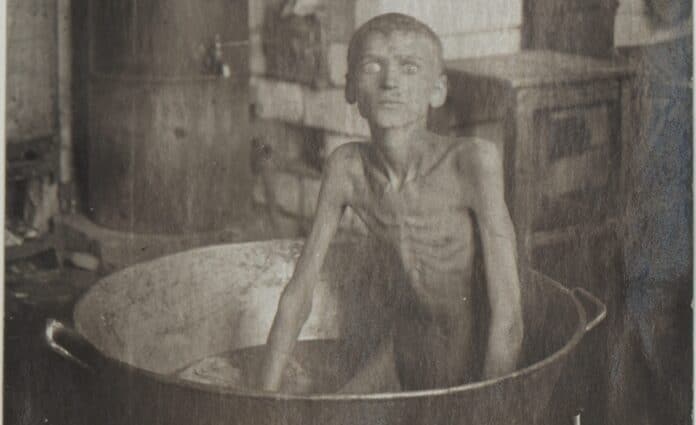
At least 5 million people died from starvation in the Soviet Union between 1931 and 1934—including 3.9 million Ukrainians.
At the height of the 1932-33 Ukrainian famine under Joseph Stalin, starving people roamed the countryside, desperate for something, anything to eat. In the village of Stavyshche, a young peasant boy watched as the wanderers dug into empty gardens with their bare hands. Many were so emaciated, he recalled, that their bodies began to swell and stink from the extreme lack of nutrients.
“You could see them walking about, just walking and walking, and one would drop, and then another, and so on it went,” hesaid many years later, in a case history collected in the late 1980s by a Congressional commission. In the cemetery outside the village hospital, overwhelmed doctors carried the bodies on stretchers and tossed them into an enormous pit.
The Holodomor’s Death Toll
The Ukrainian famine—known as the Holodomor, a combination of the Ukrainian words for “starvation” and “to inflict death”—by one estimate claimed the lives of 3.9 million people, about 13 percent of the population. And, unlike other famines in history caused by blight or drought, this was caused when a dictator wanted both to replace Ukraine’s small farms with state-run collectives and punish independence-minded Ukrainians who posed a threat to his totalitarian authority.
“The Ukrainian famine was a clear case of a man-made famine,” explains Alex de Waal, executive director of the World Peace Foundation at Tufts University and author of the 2018 book,Mass Starvation: The History and Future of Famine. He describes it as “a hybrid…of a famine caused by calamitous social-economic policies and one aimed at a particular population for repression or punishment.”
In those days, Ukraine—a Texas-sized nation along the Black Sea to the west of Russia—was a part of the Soviet Union, then ruled by Stalin. In 1929, as part of his plan to rapidly create a totally communist economy, Stalin had imposed collectivization, which replaced individually owned and operated farms with big state-run collectives. Ukraine’s small, mostly subsistence farmers resisted giving up their land and livelihoods.
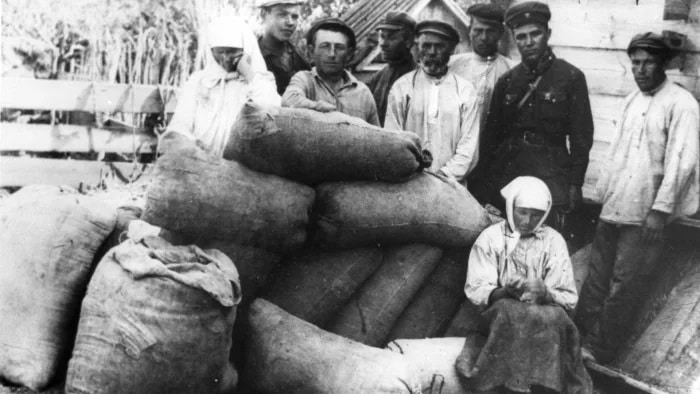
Grain confiscated from a family derided as “kulaks” in the village of Udachoye in Ukraine.
Resistant Farmers Labeled as ‘Kulaks’
In response, the Soviet regime derided the resisters as kulaks—well-to-do peasants, who in Soviet ideology were considered enemies of the state. Soviet officials drove these peasants off their farms by force and Stalin’s secret police further made plans to deport 50,000 Ukrainian farm families to Siberia, historian Anne Applebaum writes in her 2017 book,Red Famine: Stalin’s War on Ukraine.
“Stalin appears to have been motivated by the goal of transforming the Ukrainian nation into his idea of a modern, proletarian, socialist nation, even if this entailed the physical destruction of broad sections of its population,” says Trevor Erlacher, an historian and author specializing in modern Ukraine and an academic advisor at the University of Pittsburgh’s Center for Russian, East European, & Eurasian Studies.
Collectivization in Ukraine didn’t go very well. By the fall of 1932—around the time that Stalin’s wife, Nadezhda Sergeevna Alliluyeva, who reportedly objected to his collectivization policy, committed suicide—it became apparent that Ukraine’s grain harvest was going to miss Soviet planners’ target by 60 percent. There still might have been enough food for Ukrainian peasants to get by, but, as Applebaum writes, Stalin then ordered what little they had be confiscated as punishment for not meeting quotas.
“The famine of 1932-33 stemmed from later decisions made by the Stalinist government, after it became clear that the 1929 plan had not gone as well as hoped for, causing a food crisis and hunger,” explains Stephen Norris, a professor of Russian history at Miami University in Ohio. Norris says a December 1932 document called, “On the Procurement of Grain in Ukraine, the North Caucasus, and the Western Oblast,” directed party cadres to extract more grain from regions that had not met their quotas. It further called for the arrest of collective farm chiefs who resisted and of party members who did not fulfill the new quotas.
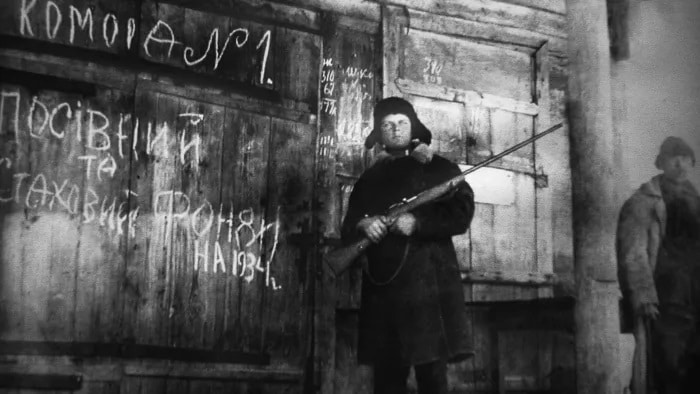
An armed man guards emergency supply grain during the Ukrainian famine of early 1930s. Sovfoto/UIG/Getty Images
Decrees Targeted Ukrainian ‘Saboteurs’
Meanwhile, Stalin, according to Applebaum, already had arrested tens of thousands of Ukrainian teachers and intellectuals and removed Ukrainian-language books from schools and libraries. She writes that the Soviet leader used the grain shortfall as an excuse for even more intense anti-Ukrainian repression. As Norris notes, the 1932 decree “targeted Ukrainian ‘saboteurs,’ ordered local officials to stop using the Ukrainian language in their correspondence, and cracked down on Ukrainian cultural policies that had been developed in the 1920s.”
When Stalin’s crop collectors went out into the countryside, according to a 1988 U.S. Congressional commission report, they used long wooden poles with metal points to poke the dirt floors of peasants’ homes and probe the ground around them, in case they’d buried stores of grain to avoid detection. Peasants accused of being food hoarders typically were sent off to prison, though sometimes the collectors didn’t wait to inflict punishment. Two boys who were caught hiding fish and frogs they’d caught, for example, were taken to the village soviet, where they were beaten, and then dragged into a field with their hands tied and mouths and noses gagged, where they were left to suffocate.
As the famine worsened, many tried to flee in search of places with more food. Some died by the roadside, while others were thwarted by the secret police and the regime’s system of internal passports. Ukrainian peasants resorted to desperate methods in an effort to stay alive, according to the Congressional commission’s report. They killed and ate pets and consumed flowers, leaves, tree bark and roots. One woman who found some dried beans was so hungry that she ate them on the spot without cooking them, and reportedly died when they expanded in her stomach.
“The policies adopted by Stalin and his deputies in response to the famine after it had begun to grip the Ukrainian countryside constitute the most significant evidence that the famine was intentional,” Erlacher says. “Local citizens and officials pleaded for relief from the state. Waves of refugees fled the villages in search of food in the cities and beyond the borders of the Ukrainian Soviet Republic.” The regime’s response, he says, was to take measures that worsened their plight.
By the summer of 1933, some of the collective farms had only a third of their households left, and prisons and labor camps were jammed to capacity. With hardly anyone left to raise crops, Stalin’s regime resettled Russian peasants from other parts of the Soviet Union in Ukraine to cope with the labor shortage. Faced with the prospect of an even wider food catastrophe, Stalin’s regime in the fall of 1933 started easing off collections.
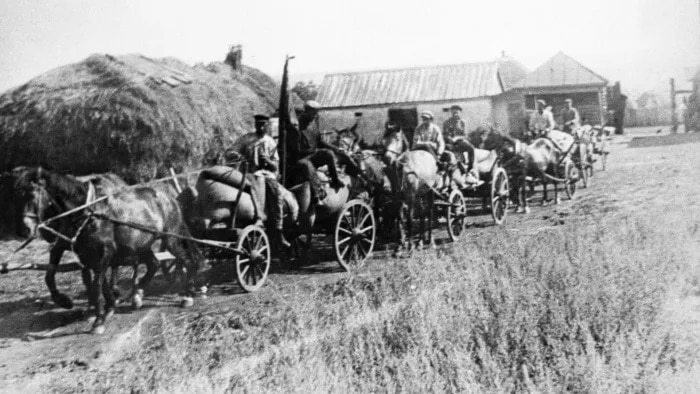
A string of carts with bread confiscated from peasants, circa 1932. Sovfoto/UIG/Getty Images
Russian Government Denies Famine Was ‘Genocide’
The Russian government that replaced the Soviet Union has acknowledged that famine took place in Ukraine, but denied it was genocide. Genocide is defined in Article 2 of the U.N. Convention on the Prevention and Punishment of the Crime of Genocide (1948) as “any of the following acts committed with intent to destroy, in whole or in part, a national, ethnical, racial or religious group.” In April 2008, Russia’s lower house of Parliament passed a resolution stating that “There is no historical proof that the famine was organized along ethnic lines.” Nevertheless, at least 16 countries have recognized the Holodomor, and most recently, the U.S. Senate, in a 2018 resolution, affirmed the findings of the 1988 commission that Stalin had committed genocide.
Ultimately, although Stalin’s policies resulted in the deaths of millions, it failed to crush Ukrainian aspirations for autonomy, and in the long run, they may actually have backfired. “Famine often achieves a socio-economic or military purpose, such as transferring land possession or clearing an area of population, since most flee rather than die,” famine historian de Waal says. “But politically and ideologically it is more often counterproductive for its perpetrators. As in the case of Ukraine it generated so much hatred and resentment that it solidified Ukrainian nationalism.”
Eventually, when the Soviet Union collapsed in 1991, Ukraine finally became an independent nation—and the Holodomor remains a painful part of Ukrainians’ common identity.
“It’s just a horrible, devastating weapon,” said David Johnson, a retired U.S. Army colonel and a principal researcher at the RAND Corporation.
Accusations that Russia may be using thermobaric weapons in Ukraine have raised fears about the potential devastation that could result from attacks with the so-called vacuum bombs.
Oksana Markarova, Ukraine’s ambassador to the United States, said Monday that the Russian military had used a vacuum bomb, which sucks oxygen from the air to trigger a huge explosion. Markarova did not provide additional details and NBC News has not independently verified that the weapon has been used in Ukraine, but Russian thermobaric rocket launchers have been photographed entering the country by a CNN team.
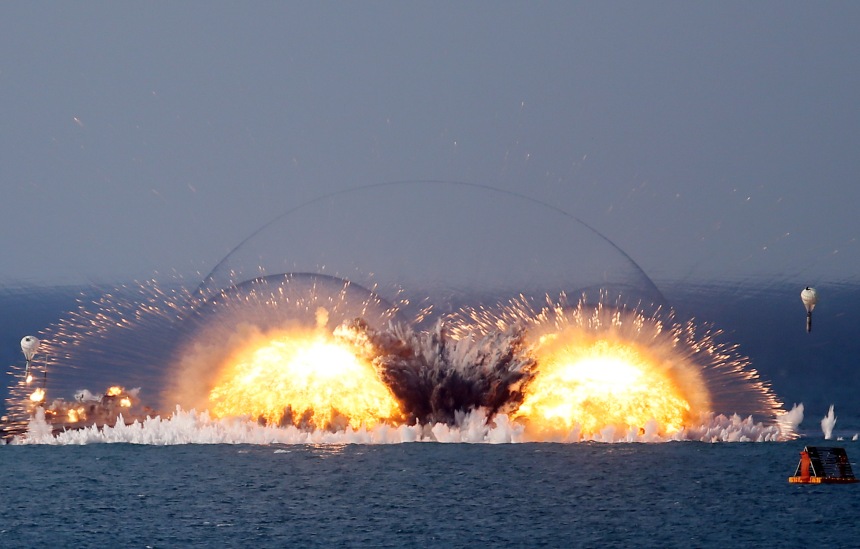
A thermobaric bomb explosion during the Caucasus 2016 strategic drills.Sergei Savostyanov / TASS via Getty Images
Sen. Marco Rubio, R-Fla., the top Republican on the Senate Intelligence Committee, tweeted Saturday that Russia had deployed vehicles with thermobaric weapons. A senior defense official who spoke on the condition of anonymity confirmed that the U.S. assessed that Russia had deployed launcher systems that could be used for thermobaric weapons, but could not confirm whether the warheads were present.
The accusation adds to mounting concerns voiced by several human rights organizations, including Amnesty International and Human Rights Watch, that Russia is conducting indiscriminate attacks in densely populated civilian areas that could constitute war crimes.
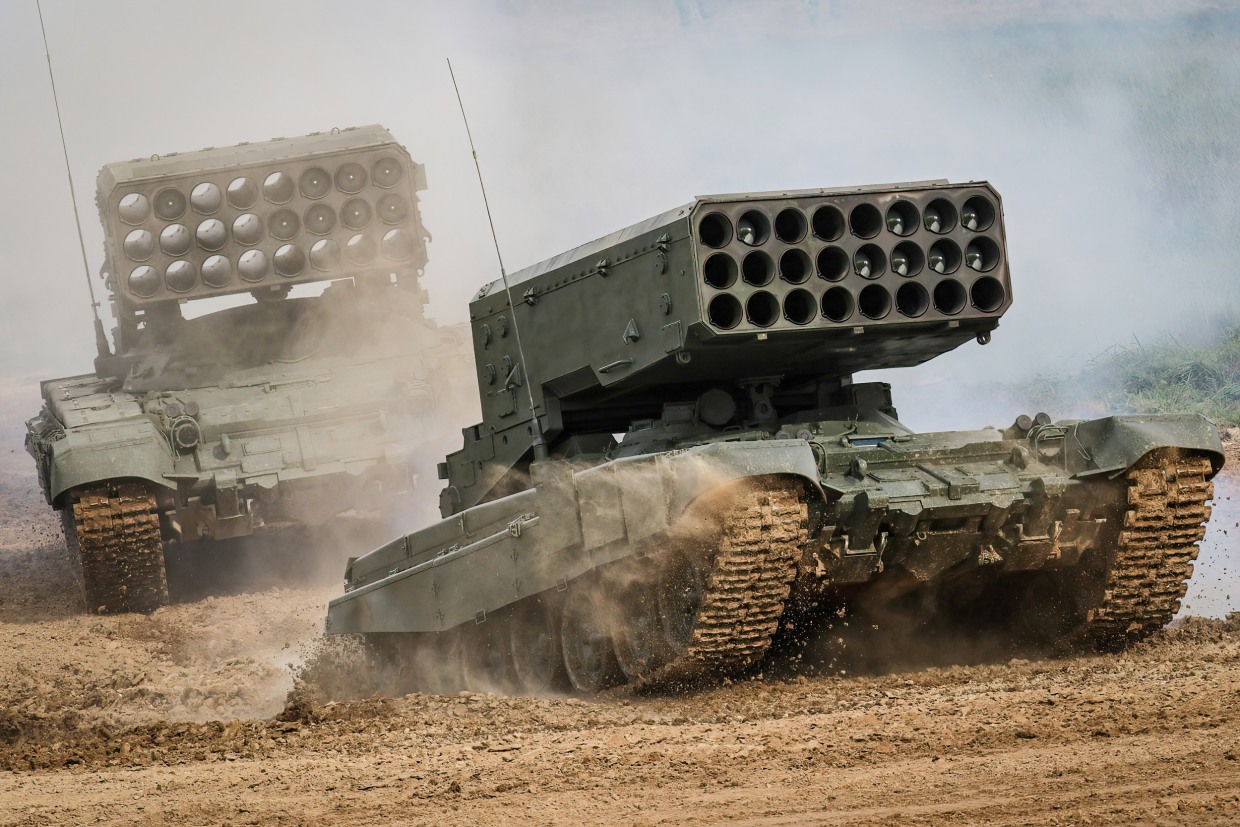
Russian Army thermobaric weapons at a defense exhibition on Aug. 25, 2021.Leonid Faerberg / SOPA Images / LightRocket via Getty Images
The potential use of vacuum bombs is of particular concern because these thermobaric munitions are designed to cause immense destruction.
“It’s just a horrible, devastating weapon,” said David Johnson, a retired U.S. Army colonel and a principal researcher at the RAND Corporation, a nonprofit policy research organization headquartered in California.
What is a vacuum bomb?
Thermobaric weapons, or vacuum bombs, are a type of two-stage munition that create enormous explosions. Launched in a rocket or artillery shell, the first explosive charge spreads an aerosol akin to vaporized gasoline over the area. A second charge then ignites the aerosol fog, creating a huge blast, flames, a large pressure wave and a vacuum as oxygen from the surrounding air is sucked up.
Johnson said thermobaric munitions are sometimes known as “a poor man’s nuclear weapon,” because they can obliterate any humans in the vicinity. Victims can be killed by the blast or the accompanying shock wave, and the subsequent vacuum can rupture people’s lungs.
The type of thermobaric weapon that has been spotted with Russian convoys inside Ukraine is known as the TOS-1A multiple rocket launcher. It has a range of around 2.5 miles and a blast radius that extends out approximately 1,000 feet, Johnson said.
“Everything inside that would be vaporized, essentially,” he said.
The weapons are sometimes nicknamed “bunker busters” because they can effectively demolish defensive barriers.
“If you’re approaching from about 4 kilometers out, you can unleash not just one but dozens of them and just melt a hole through the defensive position,” Johnson said.
While they weren’t originally designed to be used in urban areas, vacuum bombs could be particularly lethal if shot into building complexes and other densely populated regions, he added.
“You can imagine if this is contained inside an enclosed space — nothing would survive inside that space,” Johnson said. “If you don’t die immediately, the pressure would rupture your internal organs. It’s really horrendous.”
How dangerous are these weapons?
Despite the horrifying destruction that thermobaric munitions can cause, there are no laws that ban their use in warfare, though they are widely condemned by nongovernmental organizations. The use of such weapons against civilians, however, is prohibited by the Geneva Conventions and could constitute war crimes.
“It’s kind of like the neutron bomb: There was no prohibition against it, but everybody just realized how horrible it was and they didn’t want that,” Johnson said.
While it’s not clear if Russian forces have already used vacuum bombs in Ukraine, Johnson said he fears it’s only a matter of time.
“I have no doubt they will use them,” he said. “They have them there because these weapons have operational combat utility. At some point, the Russians are going to bump into something, whether it’s in one of the cities or a defensive position, and that will be their weapon of choice.”
As New York times and several others medias are reporting today: at least half a million African refugees flee Ukraine, more reports of mistreatment by Ukrainian border guards surface.
Sadly, it’s not the first time Ukraine is in the news for mistreating or abusing refugees. Since 2010, human rights watch have published 100+ pages report about the abuse of refugees and the lack of protection of refugee children.
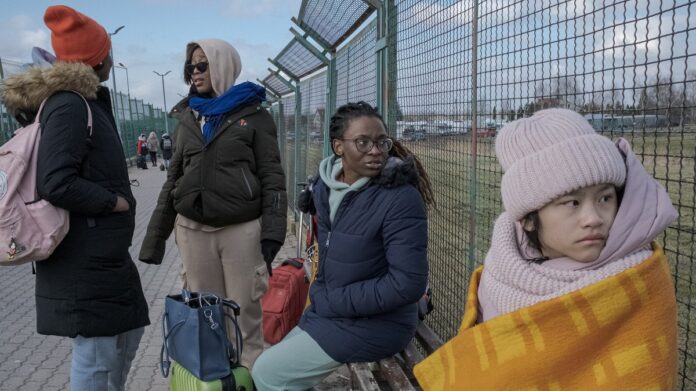
Barlaney Mufaro Gurure, a space engineering student from Zimbabwe, had finally reached the front of a nine-hour queue at Ukraine’s western border crossing of Krakovets after an exhausting four-day trip.
It was her turn to cross. But the border guard pushed her and four other African students she was travelling with aside, giving priority to Ukrainians. It took hours, and relentless demands, before they were also allowed to go through border control.
“We felt treated like animals,” the 19-year-old said in a phone interview from a Warsaw hotel. Gurure, a freshman at the National Aviation University, fled Kyiv hours after Russian President Vladimir Putin ordered troops into Ukraine on February 24.
“When we left [Kyiv] we were just trying to survive,” she said. “We never thought that they would have treated us like that […] I thought we were all equal, that we were trying to stand together,” Gurure added.
Her story is not isolated as scores of Africans have reported episodes of abuse and discrimination while trying to cross into Ukraine’s neighbours.
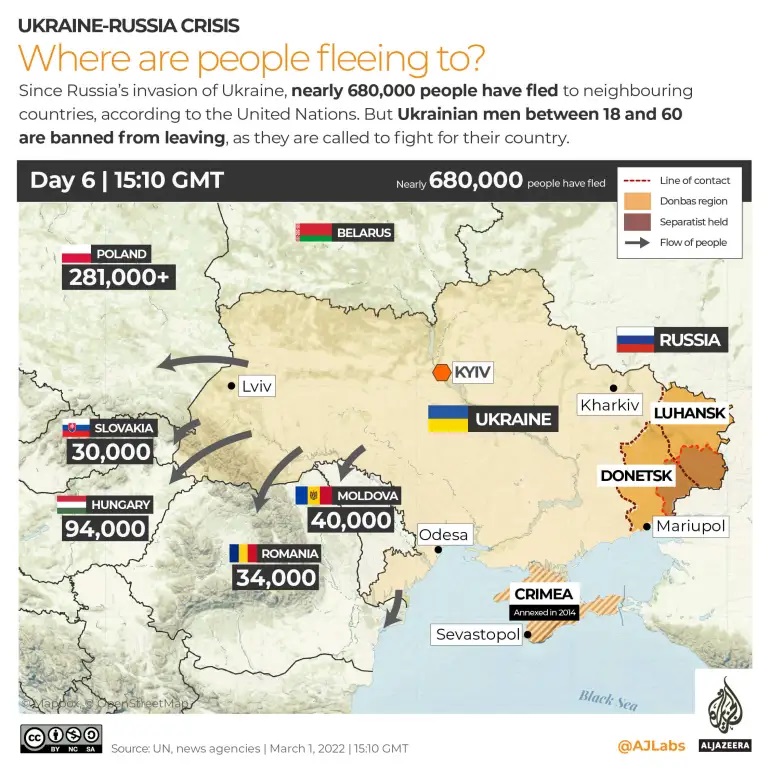
Since the war started, at least 677,000 refugees have fled from Ukraine to neighbouring countries, the United Nations said. Half of those are currently in Poland. Queues along the border are now tens of kilometres long with some African students saying they have been waiting for days to cross amid freezing temperatures and with no food, blankets or shelters.
Claire Moor, another Black student, was pushed down as she tried to board a train at Lviv’s train station. The guard insisted that only women could take the train. The officer looked away, Moor said, as she pointed out that she was, indeed, a woman. “I was shocked because I did not know the extent of the racism,” she added.
Jan Moss, a volunteer with the Polish aid organisation, Grupa Zagranica, who has been providing assistance at the Polish-Ukrainian border, said while refugees have been welcomed at many crossings out of Ukraine without any form of discrimination, the reception near Medyka has been more problematic as refugees were being organised based on “racial profiling”.
Ukrainians and Polish nationals are allowed to pass through the much quicker vehicles’ lane, while foreigners have to go through the pedestrian one, a three-stage process that can last from 14 to 50 hours, Moss said.
Al Jazeera contacted Ukraine’s Border Guard Service via email over the allegations of segregation at the borders but had not received a response before the publication of this report.
In the last 20 years, Ukraine has emerged as a choice destination for African students, especially in medicine-related fields as it is cheaper compared with universities in the United States and elsewhere in Europe.
Videos and tweets under the hashtag #AfricansinUkraine have flooded social media, triggering numerous crowdfunding initiatives on Telegram and Instagram to support students at the borders and put pressure on respective governments.
The African Union reacted to the outcry on Monday: “Reports that Africans are singled out for unacceptable dissimilar treatment would be shockingly racist and in breach of international law,” it said in a statement. A spokesperson from South Africa’s foreign ministry said on Sunday that a group of its nationals and other Africans were being “treated badly” at the Polish-Ukrainian border.
The Nigerian government also expressed concerns over reports of discriminatory behaviour, including a video widely shared on social media showing a Nigerian woman with her young baby being forcibly made to give up her seat to another person. It also said that a group of Nigerians had been refused entry into Poland – an allegation dismissed by Poland’s ambassador to Nigeria.
But some foreigners said they received a warm welcome in neighbouring countries, such as Moldova and Romania, including a relatively smooth transit.
And Russia claimed it had recaptured a strategic airport in an air assault with 200 helicopters, paving the way for a massive troops landing just four miles from the capital.
This website uses cookies to improve your experience. We'll assume you're ok with this, but you can opt-out if you wish.AcceptRead More
Privacy & Cookies Policy
Privacy Overview
This website uses cookies to improve your experience while you navigate through the website. Out of these, the cookies that are categorized as necessary are stored on your browser as they are essential for the working of basic functionalities of the website. We also use third-party cookies that help us analyze and understand how you use this website. These cookies will be stored in your browser only with your consent. You also have the option to opt-out of these cookies. But opting out of some of these cookies may affect your browsing experience.
Necessary cookies are absolutely essential for the website to function properly. This category only includes cookies that ensures basic functionalities and security features of the website. These cookies do not store any personal information.
Any cookies that may not be particularly necessary for the website to function and is used specifically to collect user personal data via analytics, ads, other embedded contents are termed as non-necessary cookies. It is mandatory to procure user consent prior to running these cookies on your website.