
Home Blog Page 46

Shocking Footage Shows NY Police Laughing Moments Before Daniel Prude Chokes To Death

0

The fatal encounter, which occurred on 23 March, had gone unreported until this wednesday.

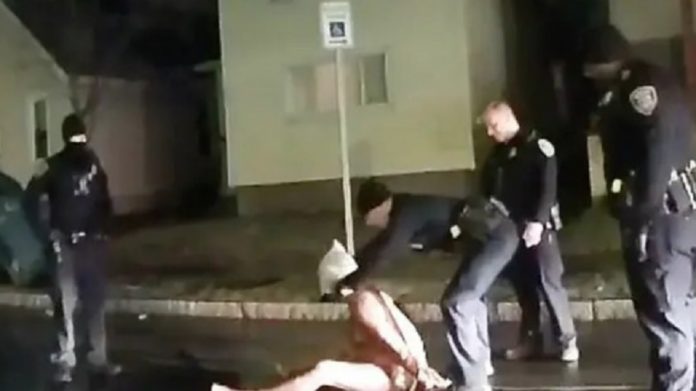
Disturbing new police body cam has emerged that shows New York police laughing as they placed a hood over the head of an unarmed man before pressing his face into the pavement for two minutes.

The victim, 41-year-old Daniel Prude, died on March 30, seven days after his brutal treatment by police and after his family determined that he should be removed from life support.

The release of footage showing the police apparently mocking their victim as they kill him is already sparking nationwide uproar just one day after community activists and family members released the footage on Wednesday press conference. The fatal encounter, which occurred on 23 March, had gone unreported until yesterday.

Officers in Rochester, New York’s third-largest city, will now be facing an internal investigation as well as an investigation by New York State attorney general Letitia James. All of the officers remain on the force.

Prude, a Chicago native who was suffering from mental health problems while visiting family in Rochester, was detained by police on March 23 after leaving the home of his brother, Joe Prude, in a state of distress. Joe Prude had called 911, as did a truck driver who reported seeing a man without clothes trying to break into a car while saying he had the coronavirus.

In 12 minutes of police body cam footage first reported by the Democrat and Chronicle of Rochester, Prude can be seen with his arms handcuffed behind his back, in an agitated state, while officers restrain him with a so-called “spit hood” – a mesh bag meant to prevent arrestees from spitting on officers that has been criticized for causing deaths in police custody. At the time, New York was facing surging coronavirus pandemic numbers.

As officers laughed before placing the hood over Prude’s head, he began shouting: “Give me that gun. Give me that gun.” The three officers then shoved him to the ground.

Prude continued to yell at the officers before the shouts became muffled. One officer can be heard repeatedly urging Prude to “calm down”

and “stop spitting.”

After two minutes of being held down with the spit hood over his head, the same officer asked, “You good, man?”

The officer then noticed that water was spilling from Prude’s mouth, and asked “My man. You puking?” The officers then removed the hood and his handcuffs before medics performed CPR on him and loaded him into an ambulance.

One week later, Prude died in what medical examiners ruled a homicide caused by “complications of asphyxia in the setting of physical restraint,” an autopsy report read.

The report added that “Excited delirium” and acute intoxication by PCP were contributing factors.

The death of Prude in police custody is disturbingly similar to the May 25 death of George Floyd, who was killed by Minneapolis Police officers who held him down on the floor until he was no longer able to breathe.

On Wednesday, family members and supporters demanded justice for David Prude while accusing police of upholding a pattern of practices that make such in-custody deaths inevitable.

Joe Prude called the incident a case of “cold-blooded murder” and compared his brother’s death to a modern-day lynching.

“How many more brothers got to die for society to understand that this needs to stop?” Joe Prude aked.

Community organizers are also demanding that the officers face charges.

“We are in need of accountability for the wrongful death and murder of Daniel Prude. He was treated inhumanely and without dignity,” said Ashley Gantt, a social movement organizer who works with Free the People Roc and the New York Civil Liberties Union. “These officers killed someone and are still patrolling in our community.”

“The Rochester Police Department has shown time and again that they are not trained to deal with mental health crises,” Gantt told the Democrat & Chronicle“These officers are trained to kill and not to de-escalate. Daniel’s case is the epitome of what is wrong with this system and today we stand firmly seeking justice for Daniel and his family, and for all the victims who have been murdered and terrorized by the Rochester Police Department.”

Critics of police brutality and systemic racism are also pointing to the death of Prude as clear proof of the need to continue demanding that police departments across the nation be defunded.

“The only police reform that will prevent cases like George Floyd and Daniel Prude is to drastically reduce or eliminate the size and scope of policing,” tweeted filmmaker Bree Newsome Bass. “Any measure calling for more $$$ or more officers will result in more death. We already know this. That’s why [our demands are] defund & abolish.”

 

Wrongfully-Convicted Black Man Freed After 44 Years In Prison, Celebrates Release

0

Long, 64, was suddenly released late last week after the State of North Carolina admitted it could no longer defend the case, and asked a court to vacate his convictions.

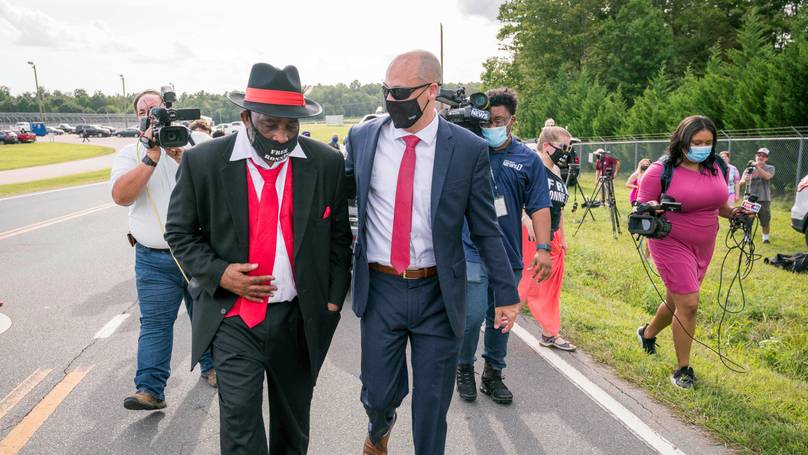
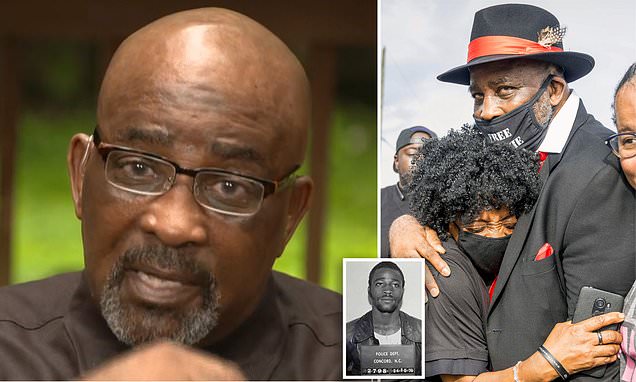
A North Carolina man, sentenced to 80 years in prison for rape and burglary, was released last week after spending 44 years behind bars. A federal appeals court determined that Ronnie Long, who has always maintained his innocence, had been a victim of “extreme and continuous police misconduct.”

The state’s abrupt and unexpected reversal on this case came after a federal appeals court said last week that Long had been a victim of “extreme and continuous police misconduct.”

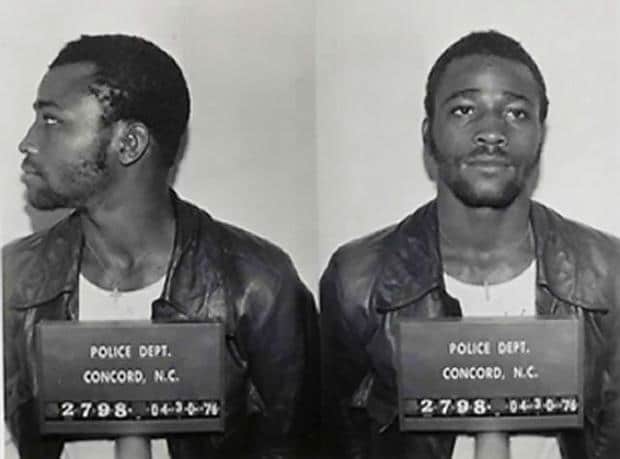
For decades Ronnie Long maintained he was innocent of a 1976 rape, for which he was convicted by an all-White jury and sentenced to 80 years in prison. CONCORD POLICE DEPARTMENT/THE CHARLOTTE OBSERVER VIA AP

With that, Long’s four-decade battle for freedom was suddenly over.

“48 Hours” correspondent Erin Moriarty spoke to Long in his first sit-down interview since his release.

“To be able to walk out of them gates without being supervised, it was breathtaking,” Long said.

He left a North Carolina prison last Thursday in sartorial style, thanks to friends and family waiting outside who’d never lost faith in his innocence.

When his lawyer, Jamie Lau, with Duke University Law School’s Wrongful Convictions Clinic, first called with the news, Long couldn’t quite believe he was really going home.

Ronnie Long

“‘You serious?'” Long recalled saying. “The state can’t go back on their word? They gonna stick to what they say?”

In fact, the state kept its word, finally ending Long’s 44-year quest to clear his name.

It began in May of 1976 when Long, a Black man, was accused of breaking into a home in Concord, North Carolina and raping a 54-year-old White woman, Sarah Bost.

Although there was no physical evidence tying Long to the crime, he was convicted by an all-White jury, and given an 80-year sentence.

“I feel as though the criminal justice system here in this state failed me,” Long said.

It was only after spending nearly 30 years in prison that Long learned that Concord police investigators had tested more than a dozen pieces of evidence, and had hidden the results. That evidence, as attorney Lau described in an interview last month, supported Long’s innocence.

Moriarty asked, “Did the defense at trial know that there were 43 fingerprints found at the crime scene that didn’t match Ronnie Long?”

“They did not,” Lau replied.

“Did the defense know that there had actually been a rape kit taken and evidence taken from the victim?”

“They did not.”

“Did the defense know that a hair that was found at the crime scene did not match Ronnie Long?”

“They did not,” Lau said.

But attorneys for the state argued that none of this would have changed the original verdict, and Long remained in prison, despite growing protests and demands for his release.

Long said, “I’m 64, going on 65. They took my life away from me when I was 20 years old. I ain’t got nothing but memories. But yet, and still, you say the evidence collected in the case was immaterial?”

Until last week, when the 4th Circuit U.S. Court of Appeals finally ruled that Long’s rights had been violated by “a troubling and striking pattern of deliberate police suppression of material evidence.”

The North Carolina Attorney General’s office decided to no longer fight the case, and asked for Long’s release.

“CBS This Morning” was with Long when he got more good news, as Lau told him, “We just got the dismissal from the Cabarrus County District Attorney’s office. You’re clear entirely!”

That dismissal of all charges officially gives back to Long his innocence, and his life.

He has a lot of catching up to do.

Long wants to spend time with his family, including his wife, AshLeigh, whom he married in 2014, and visit the graves of his parents. He said, “I know my mother and father died with a broken heart. I’m gonna tell them now, when I visit the gravesite, ‘Your son is clear.'”

The attorney general’s office declined CBS News’ request for an interview.

Next step for Long and his attorneys: to ask Governor Roy Cooper for what is called a pardon of innocence, so he can collect money from a state fund that gives money to the wrongfully-convicted.

University of Alabama Orders Faculty To Keep Quiet About Outbreak

0

The University of Alabama is telling professors to keep quiet about a coronavirus outbreak afflicting the student body, the Atlanta Journal-Constitution reports, with more than 500 students already infected.

Faculty in multiple departments said they received emails this week telling them not to discuss the situation in classrooms and to keep students in the dark if they became aware of anyone contracting the virus, according to an exclusive report by The Daily Beast.

“Do not tell the rest of the class,” the email reads, with the word “not” underlined, the Beast reported.

Face masks and social distancing, the email states, would mitigate any exposure risk if infected students were actually in the classroom. The memo also warned faculty not to post anything about the matter on social media, claiming that would violate federal privacy laws, the Beast reported.

The state’s flagship school in Tuscaloosa reported 531 confirmed cases among students, faculty and staff since classes resumed last week, according to an online COVID-19 dashboard that was unveiled Monday.

Another 35 cases were reported throughout the greater UA System, which includes six cases at UAB Birmingham, eight cases at UAB Huntsville and 21 cases at UAB Clinical Enterprise — for a total of 566 positive tests since Aug. 19, according to data.

University officials called the high number of positive cases “unacceptable” and then appealed to Tuscaloosa Mayor Walt Maddox, who announced the city would close bars for the next two weeks.

Alabama Provost James Dalton sent an email Tuesday telling professors to refrain from informing students about positive cases because the university already had a “robust program” in place to inform and isolate exposed students, the Beast reported.

“If the established rules for masks and physical distancing are followed in the classroom, then the risk of transmission from the positive student is minimal, and it is not necessary to inform the rest of the class they may have been in the same room as a positive classmate,” the email states. “For privacy reasons, the instructor should not announce to the class that a student in the class tested positive, even anonymously.”

The unexpected mandate was unsettling for some staff.

“A lot of my colleagues and people I’ve talked to, they’re terrified,” said Michael Innis-Jimenez, an American studies professor who decided to teach remotely after losing confidence in the university’s reopening plan.

“Every statement at least for the last month has been about this plan, they’ve got this plan,” he said, according to the Beast. “It makes it feel like a lot of this is for show, especially when they don’t want you to confirm it’s not working.”

Coronavirus guidelines posted on the University of Alabama website state “for privacy reasons, the instructor should not announce to the class that a student in the class has tested positive, even anonymously.”

Associate VP for Communications Monica Watts told the Beast that a 30-second questionnaire provided by the UA Healthcheck system gives professors the ability to “verify that students are in compliance with all health and safety protocols.”

At a news conference earlier this week, the Tuscaloosa mayor suggested sending students home for the semester for remote learning.

“The truth is that fall in Tuscaloosa is in serious jeopardy,” Maddox said.

University officials said the rapid rise in cases was particular among fraternities and sororities. Late last week, the school banned student gatherings on and off campus for the next 14 days.

Common areas of dormitories and fraternity and sorority houses are also closed, according to the new guidelines.

Visitors are not allowed in dormitories and sorority and fraternity houses.

Students who violate the moratoriums could face suspension.

“Although our initial reentry test was encouraging, the rise in COVID cases that we’ve seen in recent days is unacceptable and if unchecked threatens our ability to complete the semester on campus,” University of Alabama President Stuart Bell said at Monday’s news briefing.

The University of Alabama tested 29,938 students returning to campus and found 310 positive cases among them, according to the website’s data.

Testing a week later, however, revealed more alarming results.

“During that time, we encountered many students who have been exposed since returning to campus, particularly in the Greek system,” said Dr. Ricky Friend, dean of college of community health sciences, according to The Associated Press.

For now, UAB students accounted for little more than 1% of the total positive cases found, according to the data.

Colleges and universities elsewhere are also dealing with similar scenarios.

At Auburn University, 207 new positive cases of COVID-19 were reported between Aug. 15 and Aug. 21, including 202 students and five employees, according to the school’s Campus-Specific COVID-19 Data.

Although lower than the University of Alabama’s totals, Auburn’s numbers were still a dramatic increase from the 41 positive cases reported the week before. The university has had 545 total positive cases since March.

For the most part, students disregarded state mask mandates and packed the bars in downtown Auburn over the weekend, AL.com reported.

Alabama Gov. Kay Ivey praised the mayor and university officials for acting swiftly, according to the AP.

“They have made tough decisions, and I appreciate Mayor Walt Maddox and the University of Alabama leadership for tackling a serious problem as quickly as possible,” Ivey said.

In one of the biggest crackdowns on student gatherings, Ohio State University suspended more than 200 students last week for violations of the school’s coronavirus safety measures, and parties of 10 or more people on or off campus have been banned.

The University of North Carolina at Chapel Hill and the University of Notre Dame also moved to online-only classes after cases spiked this month.

Asteroid Headed To Earth Before Election day – 2020 Is Not Over Yet

0

As if 2020 wasn’t already full of surprises, it now appears that scientists have identified an asteroid that is on course to Earth – and though the chances are slim, it could strike the planet one day before Election Day in the U.S.

Luckily, the flying space object known as 2018VP1 only has a diameter of about 6.5 feet. However, it has been stated that it will pass near our planet on November 2, one day prior to the presidential election scheduled for Nov. 3, according to the Center for Near Objects Studies at NASA’s Jet Propulsion Laboratory.

The asteroid was first identified at Palomar Observatory in California in 2018.

The U.S. space agency believes there are three potential impacts “based on 21 observations spanning 12.968 days,” and fortunately the chance of a direct impact is less than 1 percent – or more specifically, it only has a 0.41 percent chance of striking our planet.

Either way, this space rock wouldn’t have a deep impact – nor will it lead to the sorts of apocalyptic scenes from blockbuster films like Armageddon.

As such, researchers at NASA are not considering the asteroid to be a “potentially hazardous object.”

In NASA parlance, potentially hazardous objects such as asteroids or comets are those which are large enough to cause significant damage to a region if they did hit our planet.

A car-sized asteroid recently flew past the Earth last weekend in the closest flyby on record, blindsiding scientists who didn’t know about the space rock until it had already passed.

The asteroid, now dubbed 2020 QG by astronomers, flew past our home planet on Aug. 16 at only 1,830 miles away, reports Space – making it the closest known non-impacting asteroid known to mankind, according to NASA.

Astronomers at the Palomar Observatory didn’t even know that the asteroid was flying by the planet until six hours after the fact.

“The asteroid approached undetected from the direction of the sun,” Paul Chodas, the director of NASA’s Center for Near Earth Object Studies, told Business Insider“We didn’t see it coming.”

“[The] close approach is [the] closest on record,” he added. “If you discount a few known asteroids that have actually impacted our planet.”

Asteroids are rocky, small objects that orbit the sun and are far smaller in size than planets. Most asteroids can be found in the main asteroid belt. the region of space lying between the orbits of Mars and Jupiter.  Some asteroids can also be found in the orbital path of planets. meaning that the asteroid and the planet follow the same path around the sun. Our planet and a few others have such types of asteroids

While some asteroids can span hundreds of miles in diameter, far more asteroids can be as tiny as pebbles, NASA explained. Most asteroids are made of different rock types, but some have clays or metals including nickel and iron.

Jacob Blake Paralyzed From Waist Down After Wisconsin Police ‘shot my son like a dog,’ Dad Says

1

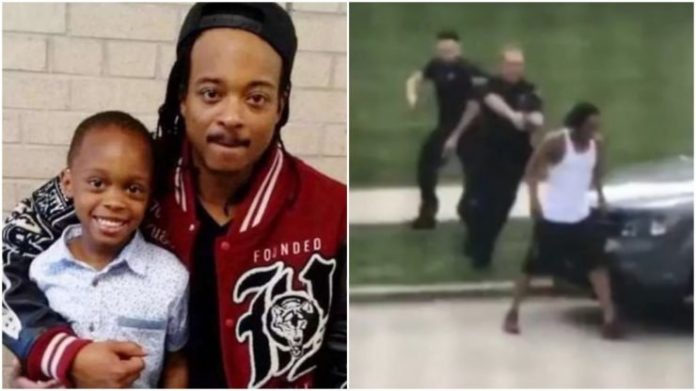
Jacob Blake, the 29-year-old man riddled with bullets by police in Kenosha, Wisconsin, is now paralyzed from the waist down after suffering severe spinal damage and he now has “eight holes in his body,” his father says.

The life-changing injuries come after police officers fired several shots into Blake’s back in broad daylight in the full view of his children after he attempted to lean into his vehicle.

Blake’s father, who is also named Jacob, told the Chicago Sun-Times that his son is now in stable condition following surgery in a Minneapolis hospital but he is now paralyzed – and doctors don’t know if the paralysis will be a permanent disabling condition that will change the course of his life.

“I want to put my hand on my son’s cheek and kiss him on his forehead, and then I’ll be OK,” the senior Blake said, adding “I’ll kiss him with my mask. The first thing I want to do is touch my son.”

He explained that when he spoke to his son earlier Sunday, the younger Jacob was getting ready for a day of family celebrations for his own son’s eighth birthday.

Later that evening, the elder Jacob learned that his son had been shot by police while attempting to board his vehicle. A mere 18 minutes later, the father was horrified when he saw footage of his son being fired upon by police in video that has now gone viral.

“What justified all those shots?” the father asked. “What justified doing that in front of my grandsons? What are we doing?”

When the police shot Blake, his three children were in the back seat of the vehicle, according to Blake’s partner and the children’s mother, Laquisha Booker.

“That man just literally grabbed him by his shirt and looked the other way and was just shooting him. With the kids in the back screaming, screaming,” Booker told WTMJ.

A second video has since emerged that shows Blake engaged in a scuffle on the ground with two of the officers. At some point, Blake managed to break free before walking to his SUV.

According to Raysean White, 22, who filmed the initial cellphone video, officers screamed “Drop the knife! Drop the knife!” during the altercation, but witnesses say they did not see a knife in Blake’s hands.

It remains unclear why the Kenosha officers saw fit to begin firing into the man’s back, but the officers have since been placed on paid administrative leave, as is the norm in officer-involved shootings.

According to witnesses, Blake was trying to break up a fight between two women before officers arrived at the scene.

Attorney Ben Crump, a high-profile lawyer who has represented the families of prominent victims of police misconduct and abuse – including Blake’s family – said that Blake was “simply trying to do the right thing by intervening in a domestic incident.”

The update on Blake’s health comes as anger and unrest continue to seethe in the streets of Kenosha as clashes continued for a second night, with police officers firing tear gas and less-lethal rounds into crowds of aggrieved and combative community members.

Hundreds of residents defied an 8 p.m. curfew order Monday night to line up outside of the Kenosha County courthouse and refused to disperse despite being scattered numerous times by strong tear gas and flash-bang grenades, according to BBC.

Incidents of property damage, including graffiti and vehicles being set on fire, have also been reported.

Protesters have vowed to remain on the streets in spite of the repression and defiantly chanted “We’re not leaving” into the early hours of the morning.

“It is a breath of fresh air,” a young protester told BBC“I am tired of being scared of the police killing me. Tonight they are going to listen.”

Wisconsin Gov. Tony Evers has requested that 125 members of the National Guard be deployed to Kenosha in a “limited mobilization” to “protect critical infrastructure” and ensure the right to protest for community members, according to a press release from the governor’s office.

The continued unrest in the Lake Michigan city threatens to rekindle weeks of explosive nationwide unrest that resulted from the May 25 killing of George Floyd by Minneapolis Police and saw the resurgence of a powerful movement against racism and police brutality, with protests occurring throughout the summer in hundreds of cities nationwide and internationally.

However, Jacob Blake’s father sees the Kenosha police as providing “the flint as well as the gasoline” for the unrest in the Midwestern city.

“Those police officers that shot my son like a dog in the street are responsible for everything that has happened in the city of Kenosha,” the elder Blake said. “My son is not responsible for it. My son didn’t have a weapon. He didn’t have a gun.”