
Home Blog Page 29

Bill Gates Becomes Biggest Owner of Farmland In US, ‘Food Shortages’ For Humanity Announced

0

Bill Gates recent land grab has made him America’s biggest farm owner almost overnight. With Gates now seizing control of America’s food supply, is it a coincidence that globalist institutions like the UN have suddenly started warning about an incoming global food shortage?

In total, Gates now owns approximately 242,000 acres of farmland with assets totaling more than $690m. Land is wealth, land is power, and, more importantly, hundreds of thousands of acres of farm land provides Gates with the ability to control humanity in ways he has only dreamed about before.

But what if claims of food shortages are a dangerous sham and Gates is misleading humanity in order to provide cover and usher in a new era of chemical-intensive and industrial-style agriculture?


Wherever Bill Gates plies his trade, disaster for humanity looms.

No doubt you’ve seen ads about the need to feed the world. The claim is made that by 2050 we’ll need to increase food production by 50%. These ads come from agribusiness corporations such as ADM, Cargill and Bayer-Monsanto, and then they are parroted by the media and academics, despite the fact that there is no scientific basis for the claim.

What if the urgent ‘feed a growing, hungry world’ is a  red herring?

These alarming claims are not only flawed, but dangerous, says Jonathan Latham, co-founder and Executive Director of the Bioscience Resource Project and the Editor of Independent Science News, along with many other researchers, including Serban ScrieciuMichael Reilly and Dirk WillenbockelTimothy Wise, Frances Moore Lappé and Joseph Collins.

In Latham’s article, “Agriculture’s Greatest Myth: There Isn’t an Impending Food Crisis” (April 2021), he provides four reasons why the claims are wrong. And if Latham is right, Bill Gates’s approach to agriculture is not only wrong, but damaging to farmers, the environment, and efforts to combat climate chaos.

For decades, and despite the opposition from many sides, Gates and his foundation have been pushing a chemical-intensive, industrial-style agriculture on Africa through the Alliance for a Green Revolution in Africa (AGRA).

In a recent letter to the Gates Foundation, the interfaith Southern Africa Faith Communities’ Environment Institute said:

We urge the Gates Foundation to stop pushing a green ‘revolution’ that imposes technologies and seeds that are controlled by companies with vested interests. Rather, it should be looking at and learning from small-scale farmers from around the world who are working to build alternative food systems that are socially just and ecologically sustainable.

Yet, Gates and the agribusiness corporations participating in AGRA push forward with their genetically engineered seeds and chemical farming model, driven by profits and justified by the rationale of feeding a growing population.

Latham states that the rationale is wrong. He says that global food models both underestimate global food supply and overestimate demand, and so they predict a crisis when there isn’t one. In his new, peer-reviewed paper, The Myth of a Food Crisis, Latham critiques the United Nations’s GAPS model of estimating food supply and demand – and by extension, he refutes the validity of all similar food system models.

Latham summarizes the four major flaws:

1) That biofuels are driven by “demand”.

As the paper shows, biofuels are incorporated into GAPS on the demand side of equations. However, biofuels derive from lobbying efforts. They exist to solve the problem of agricultural oversupply. Since biofuels contribute little or nothing to sustainability, land used for them is available to feed populations if needed. This potential availability (e.g. 40 percent of US corn is used for corn ethanol) makes it plainly wrong for GAPS to treat biofuels as an unavoidable demand on production.

2) That current agricultural production systems are optimized for productivity.

As the paper also shows, agricultural systems are typically not optimized to maximize calories or nutrients. Usually, they optimize profits (or sometimes subsidies), with very different results. For this reason, practically all agricultural systems could produce many more nutrients per acre at no ecological cost if desired.

3) That crop “yield potentials” have been correctly estimated.

Using the example of rice, the paper shows that some farmers, even under sub-optimal conditions, achieve yields far in excess of those considered possible by GAPS. Thus the yield ceilings assumed by GAPS are far too low for rice and probably other crops too. Therefore GAPS grossly underestimates agricultural potential.

4) That annual global food production is approximately equal to global food consumption.

As the paper also shows, a significant proportion of annual global production ends up in storage where it degrades and is disposed of without ever being counted by GAPS. There is thus a very large accounting hole in GAPS.

The specific ways in which these four assumptions are incorporated into GAPS and other models produces one of two effects. Each causes GAPS to either underestimate global food supply (now and in the future), or to overestimate global food demand (now and in the future).

Some of the above gets technical, but one important bottom-line conclusion is —

1)  The dominant, corporate-driven model of agriculture is based on overproduction, which produces low agricultural commodity prices to benefit agribusiness corporations, rather than an agroecological model designed to benefit farmers and eaters with affordable, healthy food. And the myth of ‘feeding a hungry world’ is fabricated to justify the dominant approach.

Another conclusion is —

2)  There is no global shortage of food – not now nor in the foreseeable future.

Even with population growth and shifting diets, worldwide production can easily surpass increased demand. In fact, the current and future glut will continue and will likely cause commodity prices to decline.

One wild card is the way climate disruption may change the field of play. But promoting industrial agriculture as a way to mitigate or adapt to climate change, when industrialized food systems are the leading emitter of carbon dioxide, defies logic.

Instead, agroecology, which sequesters atmospheric carbon into the soil, needs to be promoted and scaled out to

  • cool the planet
  • provide better nutrition
  • serve farmers needs and
  • protect biological diversity and the integrity of ecosystems around the world

Alarmism about future shortages, especially given enormous faults in the calculus, should never be used to rationalize agricultural expansion, especially when our overproductionist model of agriculture is spurring land grabs, driving ecosystem destruction and climate change, and destroying the livelihoods of smallholder farmers and the economies of poorer nations dependent on agriculture. False concern about feeding a hungry world is being used to justify AGRA-style agriculture, featuring heavy pesticide and fertilizer use and genetic engineering.

Bill Gates is dead wrong and the Alliance for a Green Revolution in Africa (AGRA) is a dangerous sham.

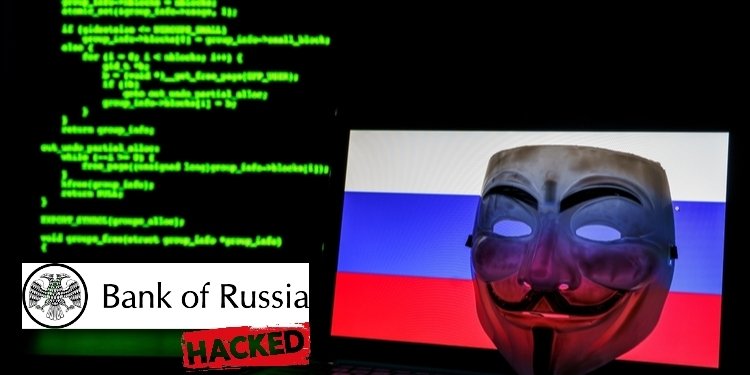


Anonymous Hacked Russia’s Central State Bank

0

The hacktivist group Anonymous announced on Saturday it has broken into secret data bases of the Central Bank of the Russian Federation (CBRF), and that more than 28 gigabytes of privileged Russian government financial information will soon be made the public.

Anonymous hacktivist collective has announced hacking the Central Bank of Russia (aka the Bank of Russia), Hackread.com can now confirm. The hack was conducted under Operation “OpRussia” to mark a protest against the Russian attack on Ukraine.

The Central Bank of Russian Federation leak (28 GB) has been published by Anonymous. We distributed these documents to various points of the internet. If the links are censored, we will share them on different links.
Anonymous

28GB Worth of Central Bank Data Leaked

As a result, the group, particularly one of the Anonymous affiliate groups who goes by the Twitter handle of @Thblckrbbtworld, has leaked 28GB worth of Central Bank’s data which is now available for public download.

On the other hand, Distributed Denial of Secrets (aka DDoSecrets), a non-profit whistleblower organization has also announced archiving the entire data on its official website earlier today.

On Twitter, @YourAnonNews, one of the largest social media representatives of the Anonymous movement also confirmed the hack stating that “Russian Central Bank hack is confirmed and will be released soon via DDoSecrets.”

It is worth noting that on March 23rd, 2022, Anonymous had claimed to hack the Central Bank of Russia and steal 35,000 files. The group went on to claim “We have your economic secrets now, you will tremble with fear, Putin.” To verify their initial claims the group had also tweeted copies of banking documents in the Russian language.

What data has been leaked?

Hackread.com has seen the leaked data however due to its humongous size, it was virtually and physically impossible to scan each file/folder. Nevertheless, our limited analysis shows that the exposed records included years’ worth of financial records with some documents going as far back as 1999.

Furthermore, invoices, internal communication, documents, memos, bank statements, names of shareholders of various banks, bank licenses, names, addresses of apparently high-profile customers/clients, etc. are part of the leaked records.

Screenshot from the leaked records (Image: Hackread.com)

Note: A detailed analysis will be published based on the findings of DDoSecrets in the coming days.

Anonymous Disclosing Data Breach

https://twitter.com/Thblckrbbtworld/status/1507426095754264604?r

Role of The Central Bank of Russia

For your information, the Central Bank of Russia is responsible for monetary policy and ensuring the functioning of the payment system in the Russian Federation. The bank is also responsible for protecting the stability of the national currency, the ruble. Therefore any attack on its networks could be devastating for the country and its currency.

Anonymous Cyberwar Against Russia

It is no secret that Anonymous has sided with Ukraine over the ongoing conflict between two countries. The group has so far targeted the government and the private sector to spread its message.

A couple of weeks ago, the group hacked Roskomnadzor (aka Federal Service for Supervision of Communications, Information Technology and Mass Media), a major Russian federal agency. The group also leaked over 360,000 files via DDoSecrets.

The list and timeline of some of the cyberattacks reported by Hackread.com on the ongoing conflict between Russia and Ukraine are as follow:

  1. Feb 28th: Anonymous hacks EV charging station + TV channels
  2. March 4th: Anonymous hacks Russian space research institute website
  3. March 7th: Anonymous hacks Russian TV & streaming sites with war footage
  4. March 10th: Anonymous hacks 90% of misconfigured Russian cloud databases
  5. Match 12th: Anonymous sent 7M texts & hacked 400 Russian security cams
  6. March 15th: Anonymous DDoSd Russian Fed Security Service & other sites
  7. March 19th: Anonymous hacked & leaked 79GB of Russian pipeline giant data
  8. March 23rd: Anonymous hacks printers in Russia to send anti-war messages

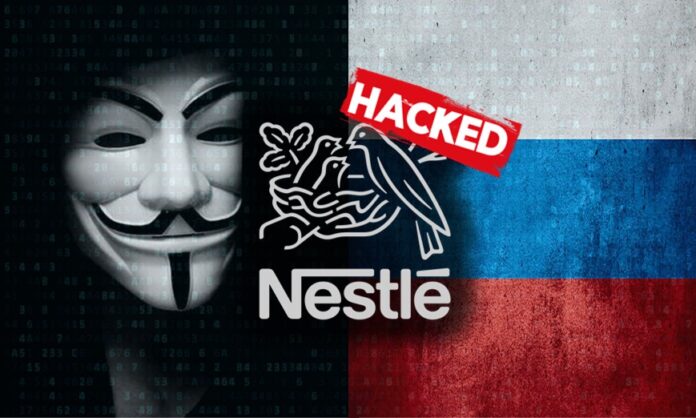
Anonymous Claims To Have Hacked Nestlé – Nestlé doesn’t want to know about it

0

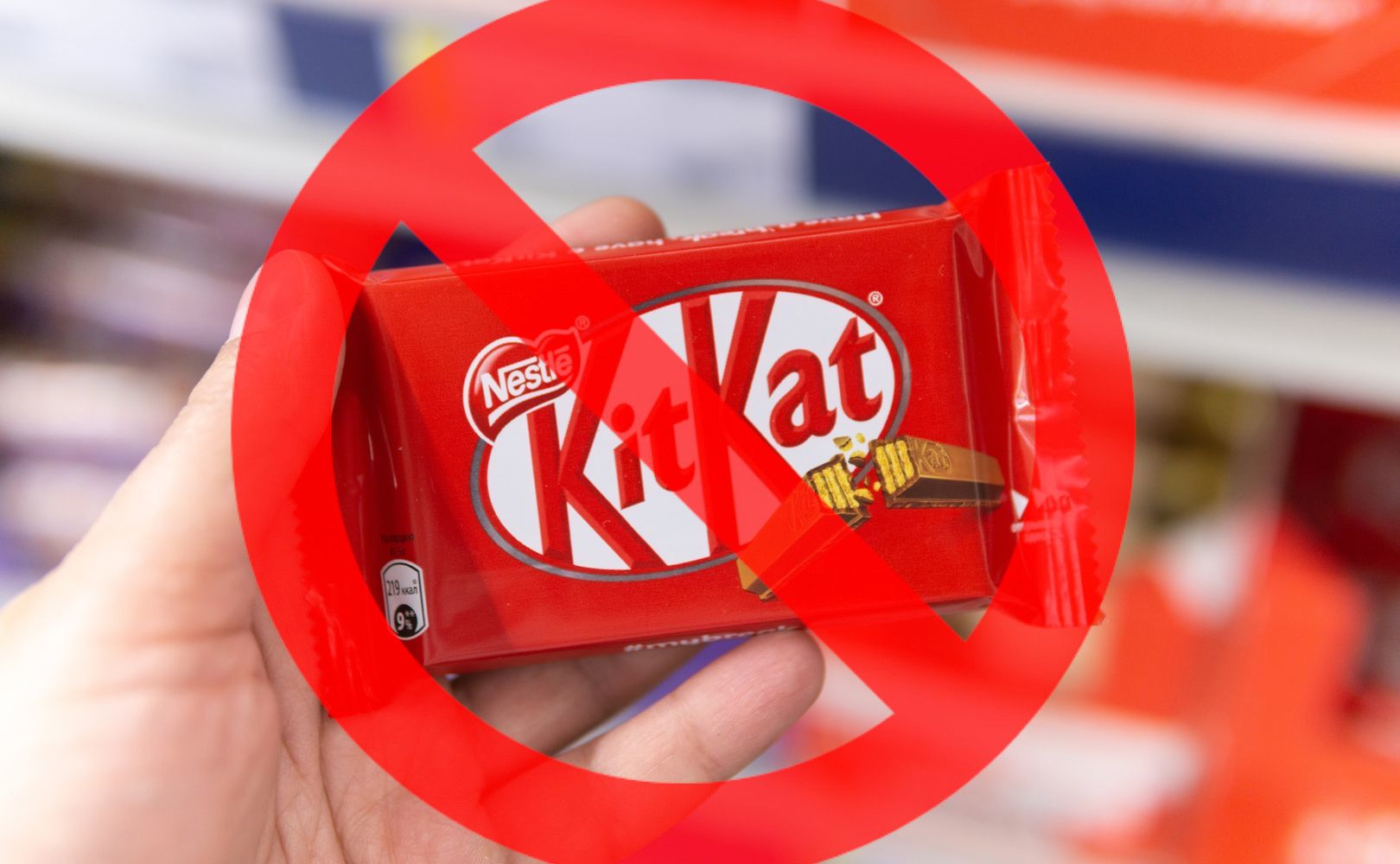
Nestlé denies being hacked by Anonymous and claims to have accidentally leaked data itself – but it will stop selling Kit Kats and Nesquik to Russians.

UPDATE: Only a sample of data has been published with more than 50K Nestlé business customers. Leak: https://gofile.io/d/kyFj0A (No Virus detected) Currently the weight is 10GB in SQL Format.

The war in Ukraine is also creating clear fronts on the web: Because many companies continue to do business in Russia despite the attacks, the hacker collective Anonymous warned of retaliation. The most prominent example backfired, but was not without effect.

The hacker collective Anonymous is fighting against Russia during the Ukraine conflict and has already crippled hundreds of Russian news sites, government sites and even the site of the Russian intelligence service. They have also hacked Russian TV channels and broadcast war footage of the Russian invasion.

When it comes to the war in Ukraine, most people in Europe do not find it difficult to choose sides. There is a corresponding lack of understanding that some Western companies are doing business as usual in Russia. The hackers from Anonymous didn’t want to let that pass. And set a clear deadline.

The companies had 48 hours to withdraw from Russia, otherwise they would face consequences, Anonymous announced late Sunday evening. They left no doubt as to whom the threat was specifically directed at: a graphic showed the logos of all the companies that were supposed to feel targeted. These included fast food chains such as Burger King and Dunkin Donuts, the Marriott hotel chain, but also digital service providers such as Cloudflare or the oil company Chevron. And also the food giant Nestlé.

Nestlé denies being hacked by Anonymous and claims to have accidentally leaked data itself – but it will stop selling Kit Kats and Nesquik to Russians.

Hack or not?

At Nestlé, the hackers then apparently wanted to show that they were serious about their threats. “The hacker group Anonymous has published 10 gigabytes of data from the Swiss company Nestlé. This is in retaliation for the company’s continued business in Russia,” a large Anonymous account on Twitter said yesterday. According to the account, the data includes emails, passwords and data on 50,000 customers.

But the matter is probably not as clear as Anonymous makes it out to be. According to Nestlé, the attack did not take place at all. The alleged hack has no basis in fact, the company told the Handelszeitung. An internal investigation had not been able to prove any signs of intrusion into the system. The alleged loot was also not loot at all: it was test data that had already been inadvertently posted online for public viewing in February, the company said. In the opinion of IT security, therefore, no further measures were necessary, Nestlé explained.

Nestlé reacts: No Kitkat in Russia

Nestlé was targeted by the hackers because Ukrainian President Volodymyr Selenskyj had explicitly criticized the major corporation for continuing to do business in Russia. This was not without effect: The company, which was also criticized for numerous business practices before the war, announced on Wednesday that it would withdraw numerous brands such as Kitkat and Nesquik from the Russian market. The group said it only wanted to offer essential products such as baby food and medical products there. The Group rejected the accusation that it was indirectly financing the war with its taxes in the country: Because no profits can be expected in Russia in the near future, no taxes would have to be paid there, the statement said. If profits were made, they would be donated.

Anonymous, meanwhile, has already embarked on its next action: it has hijacked thousands of printers in Russia, the collective explained. They used them to print out instructions on how to use free media via the anonymization service TOR in huge numbers of Russian households.

In addition, there was a handicraft sheet that would not please Russian President Vladimir Putin very much: The four pigs depicted can be reassembled with three creases – and then show his face.


Related articles:

Anonymous Takes Down Russian Secret Service Website FSB

Anonymous Hacks Russian Federal Agency – Leaks 360,000 Documents About Media Control & Censorship

Anonymous Hacks Over 400 Russian Public Cameras – Broadcasts Ukrainian Civilian Death Count

Anonymous Hacks Russian TV & Streaming Services – Broadcasts War Footage From Ukraine

Anonymous Declares Cyberwar Against Russia: Takes Down News & Government Websites

Anonymous Leaks Russian Military Communication Frequencies – Jams Them & Plays Ukrainian Music

Anonymous Takes Over Putin’s Yacht – Renames It To ‘FCKPTN’ & Sends It To ‘Hell’

Anonymous Message To Russian Citizens

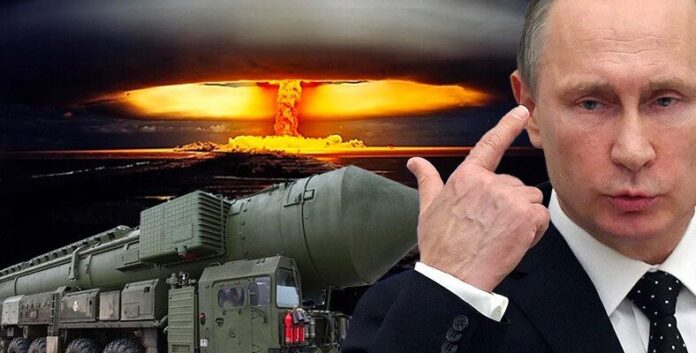
Putin Tells When He Will Use Nuclear Weapons

0

Paris: 

Russia’s invasion of Ukraine has raised the spectre of something considered almost unthinkable until recently: the use of a small nuclear weapon during a conflict in Europe.

AFP looks at the risk that Russian President Vladimir Putin would authorise a so-called “tactical” nuclear strike against a country he has repeatedly claimed forms “one people” with Russia.

Tsar Bomba, Russia’s weapon of mass destruction: 3,800 times more powerful than an atomic bomb

Why is there concern?

On February 27, three days after the start of the invasion, Putin ordered his defence chiefs to put Russia’s nuclear forces on high alert in a highly choreographed meeting in front of TV cameras.

Western countries quickly condemned the move, with US Secretary of State Antony Blinken calling it “provocative” and “the height of irresponsibility.”

Most Western analysts believe the rhetoric was designed to deter the United States and its allies from increasing their support for Ukraine beyond existing economic sanctions and weapons supplies.

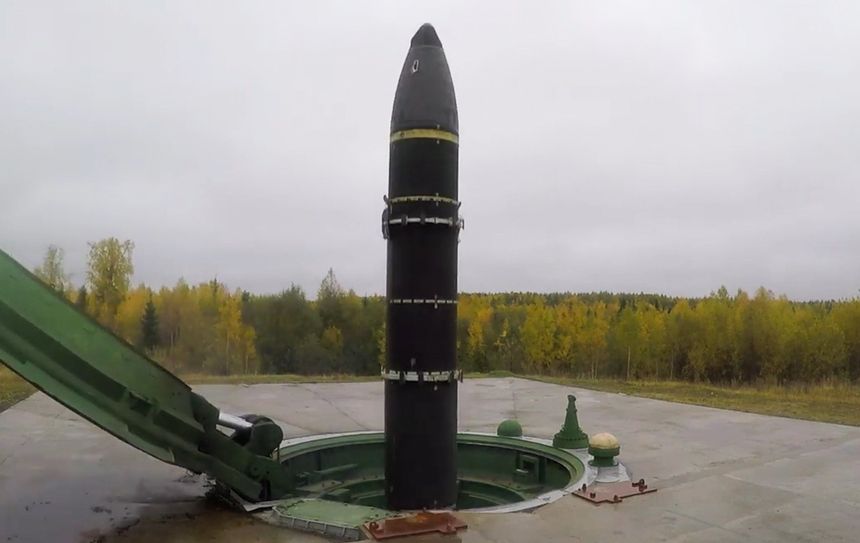
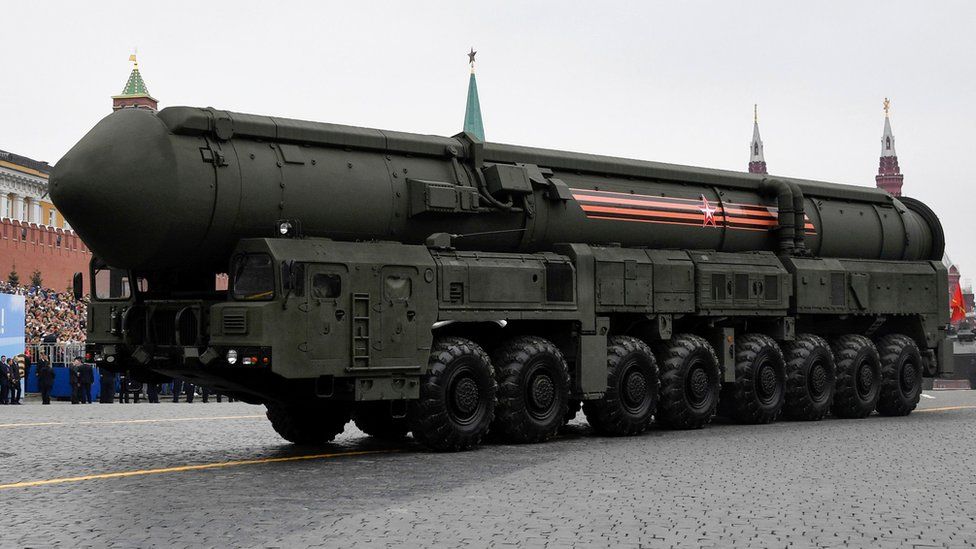
Russia has secret nuclear weapons sites all across the country.

“Not only is this meant to instill fear in the whole world; it’s also meant to scare anyone from helping in Ukraine,” Beatrice Fihn, who leads the International Campaign to Abolish Nuclear Weapons, told AFP.

How big is Russia’s nuclear arsenal?

Russia has the largest number of nuclear warheads of any country, according to the SIPRI peace research institute in Stockholm, which puts the figure at 6,255.

Experts say the risk in Ukraine is not the deployment of a giant “strategic” weapon, which pose a threat to the entire planet.

Instead, Putin might be tempted to use a “tactical” weapon, with a smaller warhead that causes localised devastation but without threatening life across Europe.

These weapons come in various sizes, and their impact depends on whether they explode at ground level or above the Earth’s surface.

US President Joe Biden also claimed this week that Moscow was considering the use of chemical and biological weapons in Ukraine.

“Chemical weapons would not change the course of the war. A tactical nuclear weapon that reduces a Ukrainian city to rubble? Yes,” Mathieu Boulegue, an analyst at the London-based Chatham House, told AFP.

Russia owns more nuclear weapons than the U.S.

Aren’t nuclear weapons a last resort?

Yes, but Ukraine and Western capitals fear that Putin finds himself cornered, sustaining major battlefield losses and economic problems at home that put his political survival in doubt.

A tactical nuclear strike would be intended to break the resistance of Ukrainian forces and force President Volodymyr Zelensky to surrender.

Pavel Luzin, an expert at the Russia-focused think-tank Riddle, said the first step would see a tactical weapon used over the sea or an uninhabited area, as an act of intimidation.

“After that, if the adversary still wants to fight, it may be used against the adversary in the direct way,” he said — meaning over a city.

Christopher Chivvis, who served as the top US intelligence official for Europe from 2018 to 2021, said recently that there were “only two paths” to end the war.

“One, continued escalation, potentially across the nuclear threshold; the other, a bitter peace imposed on a defeated Ukraine,” he wrote in The Guardian newspaper.

What does the Kremlin say?

On Tuesday, Putin’s spokesman Dmitry Peskov was asked three times by CNN interviewer Christiane Amanpour to rule out the use of nuclear weapons.

He pointed instead to Russia’s nuclear doctrine published in 2020, in which “you can read all the reasons for nuclear arms to be used.”

“If it is as an existential threat for our country, then it can be used in accordance with our concept,” Peskov said.

Recent claims from the Kremlin about Ukraine developing chemical, biological or even nuclear weapons — dismissed as disinformation by Western officials — are a cause for concern.

“The use of a weapon of mass destruction against Russia would be a doctrinal justification for responding with a nuclear weapon,” said Kristin Ven Bruusgaard, an expert on Russia’s nuclear doctrine at the University of Oslo.

Is this just alarmism?

Possibly. William Alberque, an expert on arms control at the International Institute for Strategic Studies, a British think-tank, told AFP that he doubted Putin would deploy tactical nuclear arms.

“The political cost of the use of nuclear weapons would be outrageous. He would lose the little support he still has. Indians would have to pull out. The Chinese as well,” he said.

Ven Bruusgaard suggested that Putin’s concern about his own place in history might deter him.

He would also need approval to launch one from either Defence Minister Sergei Shoigu or Chief of the General Staff Valery Gerasimov.

“The military repercussions would be unpredictable to say the least and potentially extremely dangerous for Russia,” she said, since NATO or the United States might feel obliged to enter the conflict directly.

“That’s the exact scenario that Russia is trying to avoid,” she said.

Boeing Engineer On Heroin Robbed 30 Banks In Just One Year

0

(Zero Hedge) Heroin addict, and former Boeing engineer Anthony Hathaway, robbed 30 banks from 2013 to 2014, spoke with Bloomberg about how a life of addiction that led to the crime.

Hathaway was appointed technical designer by Boeing, after a decade of hard work. He was in charge of design for galleys on the 747-8 Intercontinental. He told Bloomberg that he was the only engineer at the Boeing Everett Factory in Everett, Washington, that didn’t have a college degree.

Several years of earning $100,000 per year and living large in the 2000s, he had a herniated disc after an incident during a company sporting event and was prescribed OxyContin by his doctor in 2005.

“It was like a miracle drug,” Hathaway told Bloomberg.

And this is when his life spiraled down: Hathaway had two back surgeries to fix the disc, doctors prescribed him even more opioids, sometimes at higher doses. He said he instantly developed an addiction and became reclusive.

Hathaway said: “I was peeling the coating off of the OxyContin, crushing them, and snorting them. I knew I was in trouble.”

When OxyContin in 2010 modified pills to make it uncrushable,  Hathaway and his teenage son resorted to heroin instead.

His salary couldn’t support the expensive drug habit, and in summer 2011, his son robbed a bank and was arrested after a dye pack in cash exploded as he left.

Shortly after, Hathaway became homeless, had to move in with his mother, and at that very moment, he decided to become a professional bank robber. “I started planning,” he said.

He added: ” I knew that as long as I didn’t leave any fingerprints or DNA or facial recognition that I should be able to pull this off without too many problems.”

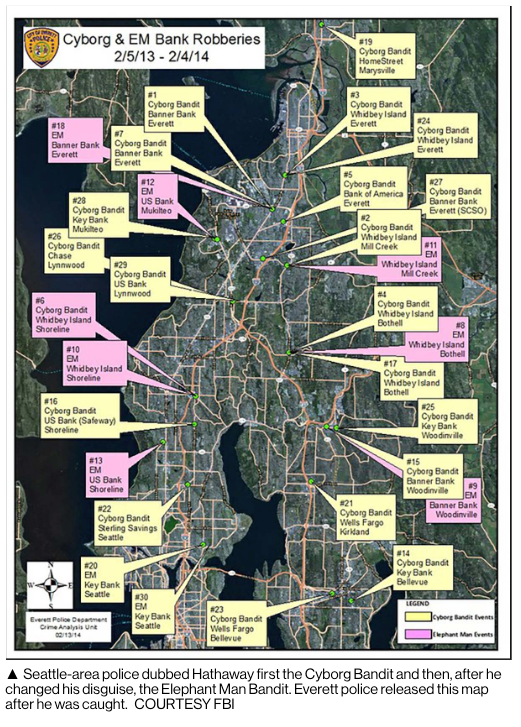
Hathaway knocked over his first bank on February 5, 2013, at a Banner Bank in Everett, down the street from the Boeing factory; 27 more robberies followed over the year. He told Bloomberg that he never carried a weapon.

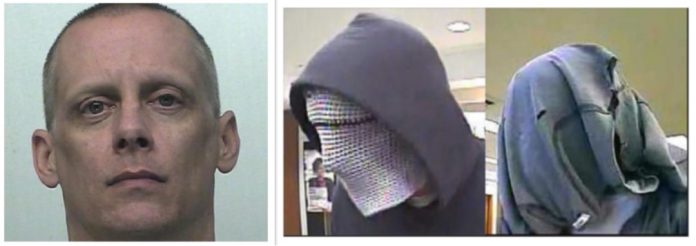
By Spring of 2013, he robbed several more banks and was broadcasted on Washington’s Most Wanted TV show. Police called him the Cyborg Bandit as detectives believed his face mask was made of metal.

Hathaway switched up costumes for different banks, with one that looked like he had roughly cut t-shirts as a mask.

He said there were several incidents where the police almost caught him – one with a teller who planted a GPS device into the money bag, which he quickly discovered, as well as one teller who became uncooperative during a heist.

The most money he ever stole from a bank was a little over $6,000 from Whidbey Island Bank in Bothell. He averaged one robbery per week in 2013, but there was a 67-day quiet period from May to June when his winnings from a casino allowed him to take a break.

Hathaway staged his last bank robbery on February 11, 2014, at KeyBank in Seattle. He shot up with heroin right before the robbery and passed out. Minutes later he awoke and robbed the bank, made off with $2,310. FBI and police immediately surrounded him as he walked outside – ending his 30-robbery streak.

In a plea arrangement in January 2016, Hathaway was sentenced to 106 months in prison.

Detective Len Carver with the Seattle Police Department and a member of the FBI’s Seattle Safe Streets Task Force, said he thought one of Hathaway’s masks were made of metal.

Carver said in one instance, Hathaway wore a T-shirt draped over your head. “I’ve never seen a guy just drape a T-shirt over his head and cut some holes in it” before robbing a bank.

Hathaway, now 50, sits in the Monroe Correctional Complex in Washinton state. Has cable TV, and a job at the jail that pays 42¢ an hour, with a maximum of $55 per week, and 20% of that goes to court fees and restitution for his crimes.

“It’ll be around $112,000 by the time I get out,” he tells Bloomberg during a visit in June. “But I have my whole life to pay it off.”

Hathaway’s quick transition from star engineer at Boeing to a nasty heroin addiction that contributed to dozens of bank heist, all started with pain management programs in hospitals prescribing highly addictive legal opioids.